AI Learning Platform
Dhamma AI
A Buddhist study platform for Myanmar and English learners, combining AI answers linked to canonical sources with Tipiṭaka search, guided lessons, quizzes, and spaced repetition for Pāli vocabulary.
- Role
- AI product design & development
- Project type
- AI Learning Platform
- Status
- Live beta
- Organization
- Personal project
- Timeline
- — Present
- Confidentiality
- public
- Published
- published
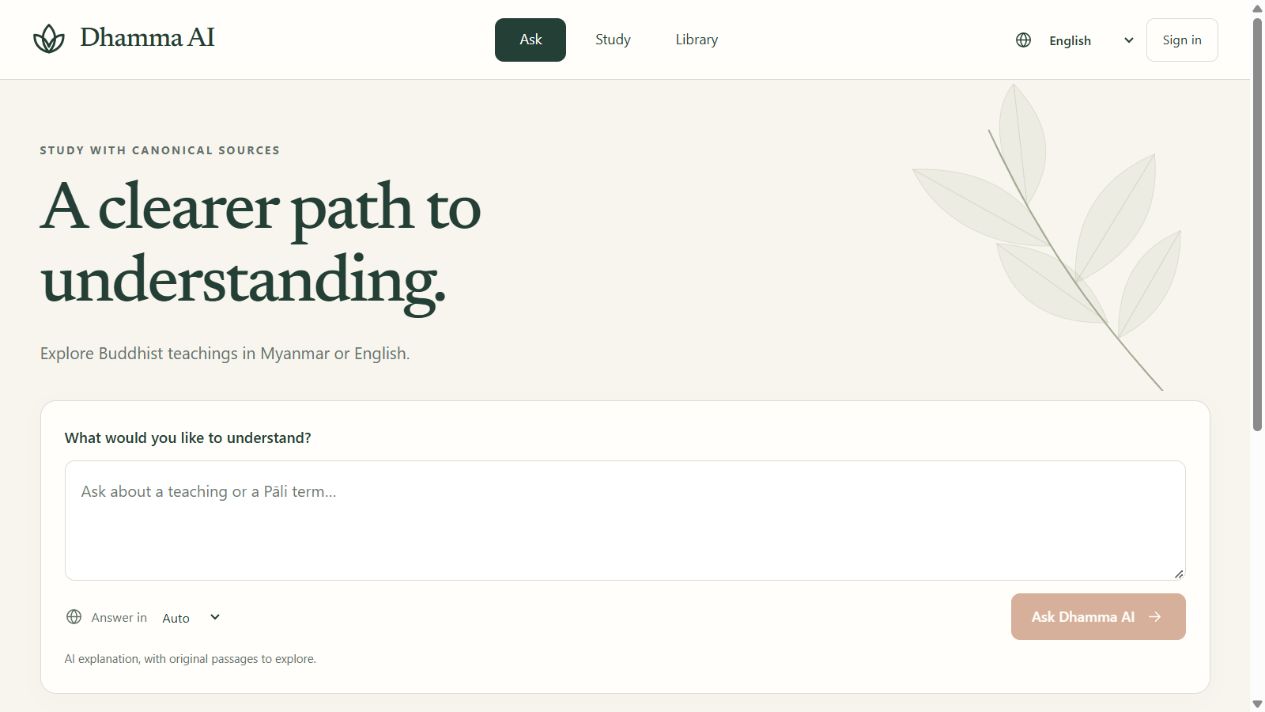
Product walkthrough
Selected screens
Confidentiality note
This is a personal Buddhist study project. Screenshots show the implemented public interface. Canonical Pāli texts come from the CC0-1.0 tipitaka-md/tipitaka2500 corpus. AI explanations are study aids; learners can inspect the cited passages and consult qualified teachers for interpretation.
Project overview
Dhamma AI is a personal AI product that helps learners explore Buddhist teachings in Myanmar or English while keeping the original canonical sources within reach. The experience connects natural-language questions to retrieved Pāli passages, readable explanations, and interactive citations.
Beyond question answering, the application includes a searchable canonical library, structured lessons, quizzes, saved vocabulary, learning progress, and daily study plans. Roman Pāli, Myanmar-script, and reading-aid controls make source exploration more approachable.
The responsive Next.js interface is supported by a Java Spring Boot backend, PostgreSQL with pgvector, and OpenRouter for embeddings and answer generation. The product is a textual study aid, with explicit recovery when evidence is insufficient.
Business problem
Learners need accessible explanations of Buddhist concepts without losing the connection to canonical evidence. Language, Pāli spelling variations, and fragmented study resources can make it difficult to find relevant passages, verify an answer, and continue learning.
Product objective
Connect approachable Myanmar and English explanations to inspectable canonical passages, then support continued learning through structured lessons, quizzes, vocabulary review, and daily study plans.
Product approach
Build around a question-to-evidence journey: retrieve relevant canonical passages, generate an explanation grounded in those passages, and let the learner inspect each source. Extend that journey into guided study and deterministic review. Use reproduced answer failures and responsive interface checks to improve retrieval quality and clarity.
Solution summary
A Next.js frontend provides Ask, Study, and Library experiences with Myanmar and English navigation, desktop source previews, and mobile source drawers. A Spring Boot API combines PostgreSQL lexical search, pgvector similarity, and curated concept aliases for retrieval. OpenRouter supports embeddings and grounded generation. Account-backed lessons, quizzes, saved terms, and spaced repetition support continued study.
Target users
- Myanmar-speaking learners exploring Buddhist teachings
- English-speaking learners seeking explanations with canonical sources
- Students building Pāli vocabulary and a regular study practice
Selected product decisions
Keep canonical evidence beside the answer
Reasoning
Clickable citations and source previews let learners inspect the passages behind an explanation without losing their place.
Combine semantic search with lexical and concept matching
Reasoning
Myanmar, English, and Pāli queries need support for spelling variants, diacritics, and Buddhist terminology as well as semantic similarity.
Make insufficient evidence a useful recovery state
Reasoning
Keep the question visible and offer editing, related topics, and Library search when the retrieved material cannot support an answer.
Use deterministic learning and review rules
Reasoning
Progress, quiz scoring, spaced repetition, and daily plans can work without automatic generation calls, keeping routine study predictable.
Outcomes
Live study platform
Delivered Ask, Study, and Library experiences with a responsive Myanmar and English interface.
Product deliveryInteractive citations
Learners can open canonical source previews, switch reading scripts, and navigate to complete passages.
Evidence accessLessons + review
Implemented quizzes, persisted progress, saved vocabulary, spaced repetition, and daily study plans.
Continued learningChallenges
- Retrieving the intended Buddhist concept across Myanmar, English, and Pāli spelling variants
- Keeping generated explanations connected to relevant canonical passages
- Rendering Myanmar text and Pāli reading controls on narrow screens
- Distinguishing insufficient evidence from provider, rate-limit, and network failures
Lessons learned
- Retrieval relevance determines whether an explanation can answer the learner's actual question
- A valid citation identity alone does not establish that its passage supports the explanation
- Multilingual study interfaces need careful typography, script controls, and mobile source navigation
- Routine learning features can remain useful without automatic AI calls