Independent AI Product Case Study
DecisionFlow - Decision Intelligence AI
An AI-powered decision-support platform that helps professionals transform unstructured information into clear criteria, explainable recommendations, and documented decisions.
- Role
- AI Product Manager & Solution Architect
- Project type
- Independent AI Product Case Study
- Status
- MVP
- Organization
- Personal project
- Timeline
- 2026-07-06 — Present
- Team
- Independent portfolio project led by Min Thu Kyaw across product management and AI solution architecture. Product strategy, UX specifications, AI evaluation, technical architecture, delivery planning, and lifecycle governance were created as part of the case study. The MVP was implemented using AI-assisted development workflows.
- Confidentiality
- Generalized
- Published
- published
Product walkthrough
Selected screens
Confidentiality note
This independent portfolio case study contains no confidential employer or customer information. The prototypes, source repositories, and implementation-derived MVP are actual project artifacts. Customer research, commercial metrics, later lifecycle results, and retirement outcomes are illustrative or simulated and are clearly labelled.
Project overview
DecisionFlow is an independent AI product-management case study covering the complete product lifecycle—from concept and planning through MVP development, launch qualification, controlled scaling, and responsible retirement.
The actual project evidence includes high- and low-fidelity prototypes, frontend and backend repositories, an implementation-derived MVP, and supporting product documentation. Later customer, commercial, scaling, and retirement outcomes are clearly identified as illustrative or simulated portfolio scenarios.
The project demonstrates how AI product strategy, user experience, technical architecture, responsible AI evaluation, delivery governance, and lifecycle decision-making can be connected into one coherent product system.
Business problem
Important decisions are often made using fragmented documents, meeting notes, personal judgement, and inconsistent evaluation methods. Decision context, alternatives, assumptions, and rationale are frequently lost, making decisions slower, harder to explain, and difficult to review later.
Product objective
Create a trusted AI-assisted workspace that helps users structure complex decisions, review extracted evidence, compare alternatives, receive explainable recommendations, and preserve a clear decision record while maintaining human control.
Product approach
DecisionFlow followed an evidence-gated lifecycle. The project began with a broad organizational decision-intelligence vision, then narrowed to an individual decision-owner workflow for the MVP. The core product was designed around AI-assisted extraction, human review, transparent comparison, explainable recommendations, explicit finalization, and durable decision history. Advanced collaboration, integrations, and enterprise administration remained gated until supported by evidence.
Solution summary
DecisionFlow guides users through a structured decision journey: provide decision context, review AI-extracted information, define criteria and weights, compare alternatives, receive an evidence-based recommendation, select the final outcome, and preserve the rationale for future reference. The solution combines a web interface, backend APIs, persistent decision records, AI-assisted analysis, provenance tracking, monitoring, and explicit human approval.
Target users
- Product managers
- Startup founders
- Business analysts
- Operations leaders
- Consultants
- Knowledge workers responsible for complex decisions
Selected product decisions
Used an individual decision-owner workflow as the initial product wedge
Kept human review mandatory before recommendations could be finalized
Separated actual implementation evidence from simulated lifecycle outcomes
Prioritized explainability and provenance over fully autonomous decision-making
Limited the initial intake scope to pasted text and TXT files
Deferred collaboration, enterprise administration, and integrations until validated
Used qualification gates before approving additional product investment
Selected controlled scaling instead of unrestricted expansion
Preserved responsible retirement as part of complete lifecycle governance
Outcomes
Functional MVP
Delivered integrated frontend and backend implementations for the core decision-support workflow
ActualInteractive Prototypes
Published both low-fidelity and high-fidelity prototypes for usability and product-flow demonstration
ActualProduct Documentation
Created a complete, traceable product-management document set across the full lifecycle
ActualAI Governance
Defined evaluation, explainability, human oversight, monitoring, and model-governance controls
ActualRelease Readiness
Identified implementation gaps and documented the production-hardening path required before launch
Evidence-BasedLifecycle Strategy
Demonstrated qualification, delivery, controlled-scale, and retirement decision frameworks
SimulatedScope Discipline
Kept collaboration, integrations, and enterprise capabilities evidence-gated rather than presenting them as completed
VerifiedChallenges
- Translating a broad decision-intelligence vision into a realistic MVP
- Preventing AI-generated recommendations from appearing more certain than the evidence
- Maintaining consistency across product, UX, AI, architecture, and delivery documents
- Separating implemented capabilities from planned and simulated capabilities
- Designing reliable persistence and workflow-resume behavior
- Defining measurable AI quality, trust, cost, and human-oversight criteria
- Balancing portfolio completeness with honest evidence disclosure
- Preventing collaboration and enterprise scope from entering the MVP prematurely
Lessons learned
- A narrow, complete product workflow is stronger than a broad but partially implemented platform
- AI recommendations require transparent evidence, uncertainty, provenance, and human approval
- Product documentation must distinguish clearly between actual evidence, assumptions, targets, and simulations
- Phase-to-phase traceability prevents roadmap features from being presented as completed capabilities
- Retention and repeated value are more meaningful than registrations or initial usage
- Enterprise requests should not automatically become roadmap commitments
- Release readiness requires operational, security, monitoring, and recovery evidence—not only working features
- Responsible product management includes knowing when to scale, pause, pivot, or retire a product
Project artifacts
Selected documents and supporting product work.
Concept
Document
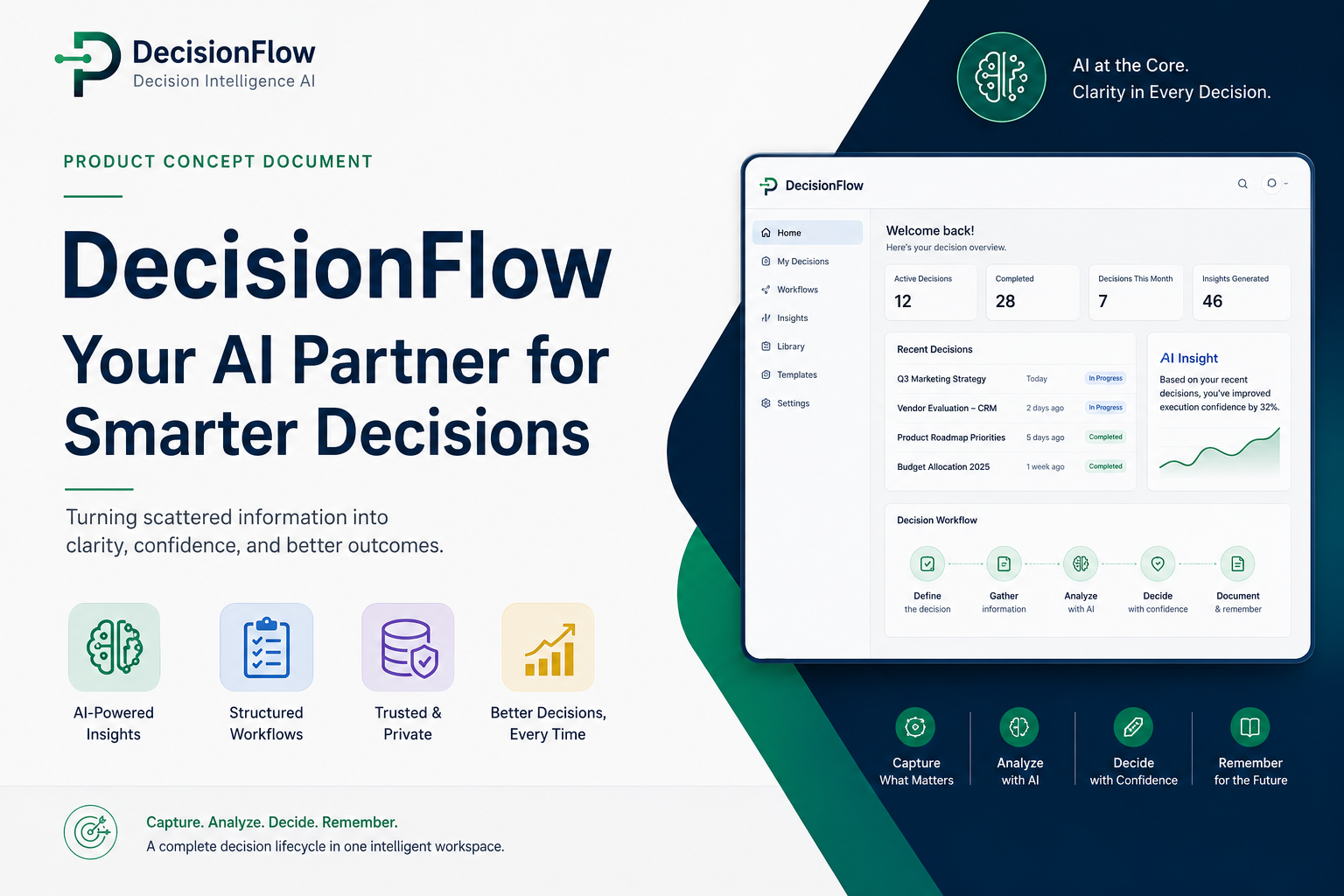
Product Concept Document
Defines DecisionFlow’s product vision, target users, core problem, value proposition, MVP scope, AI approach, success measures, key risks, and validation assumptions.
Plan
Document
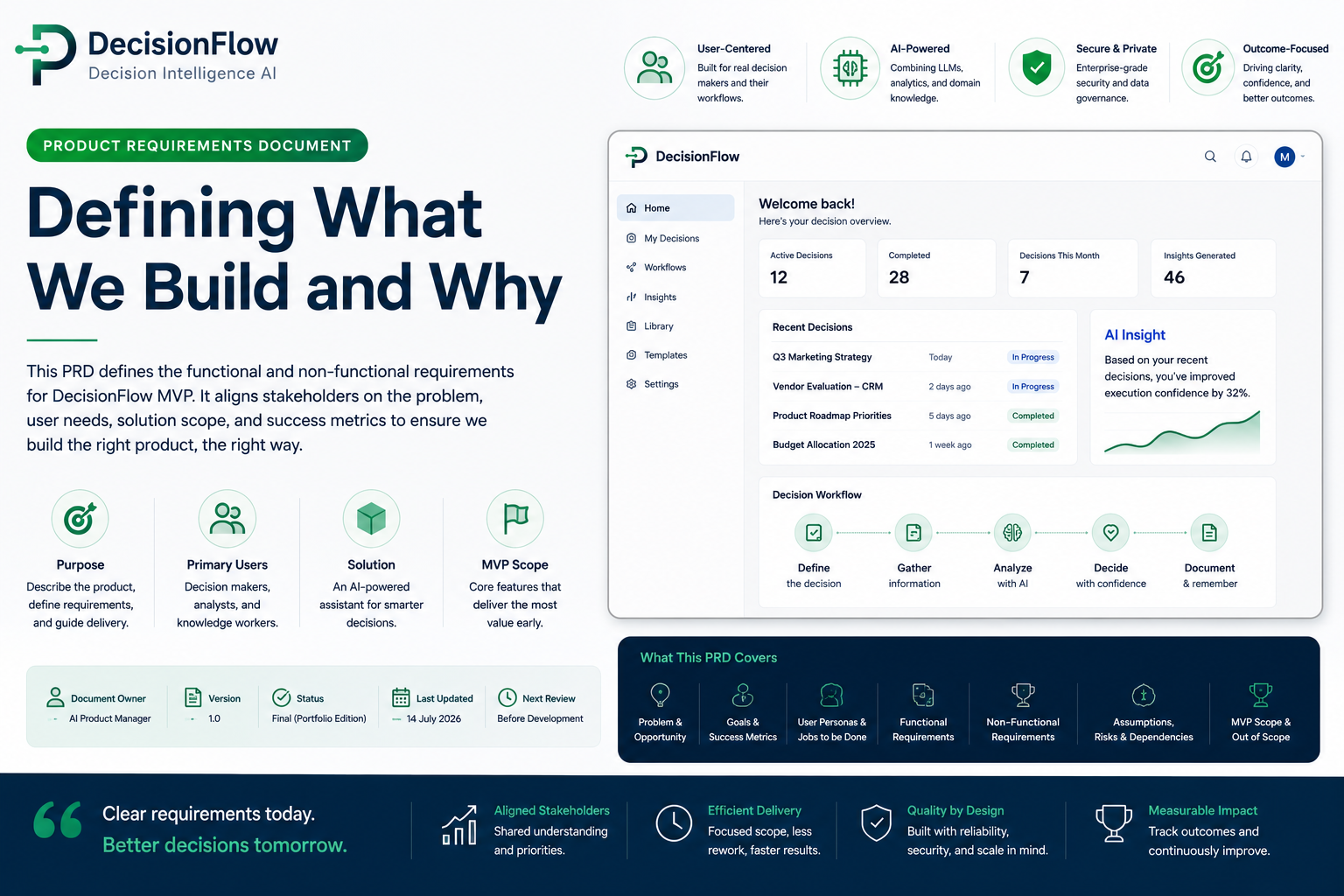
Product Requirements Document
Defines DecisionFlow’s product requirements, user needs, MVP scope, core workflows, functional and non-functional requirements, success metrics, risks, and delivery expectations.
Document
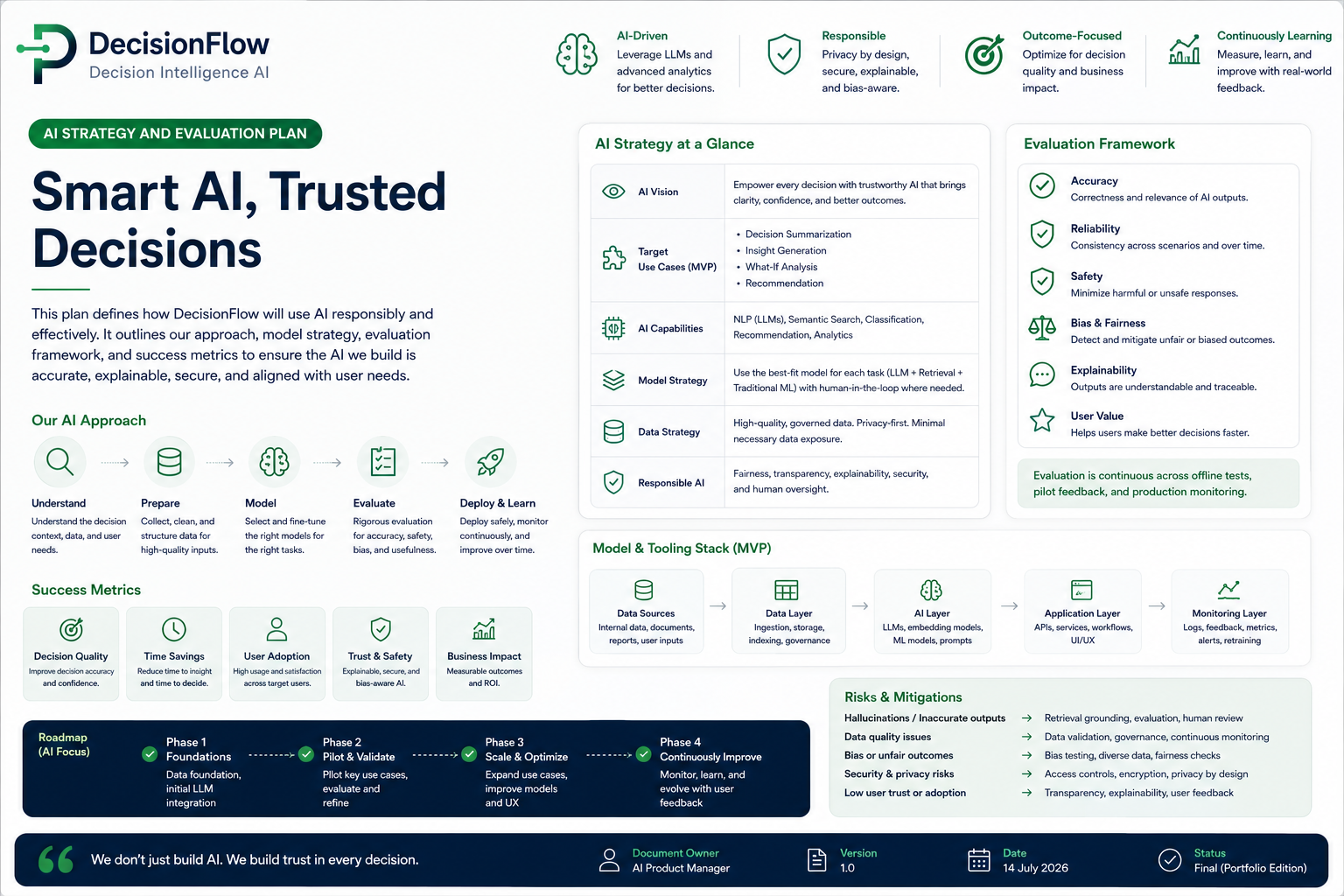
AI Strategy and Evaluation Plan
Defines DecisionFlow’s AI strategy, model approach, evaluation framework, responsible AI controls, quality metrics, risks, and continuous monitoring plan.
Document
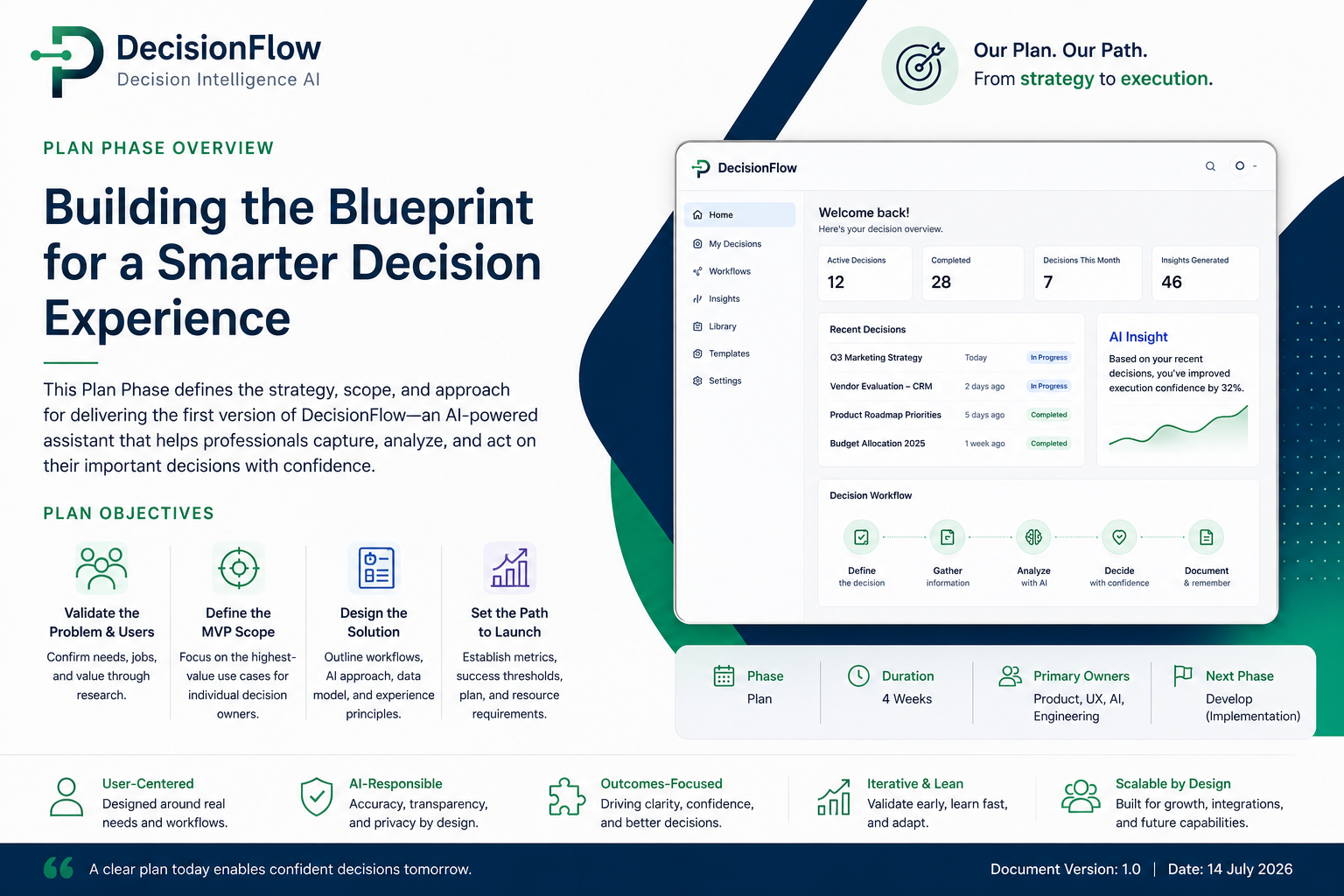
Plan Phase Overview
Summarizes DecisionFlow’s product strategy, target users, MVP scope, AI approach, delivery roadmap, success metrics, risks, and readiness for development.
Document
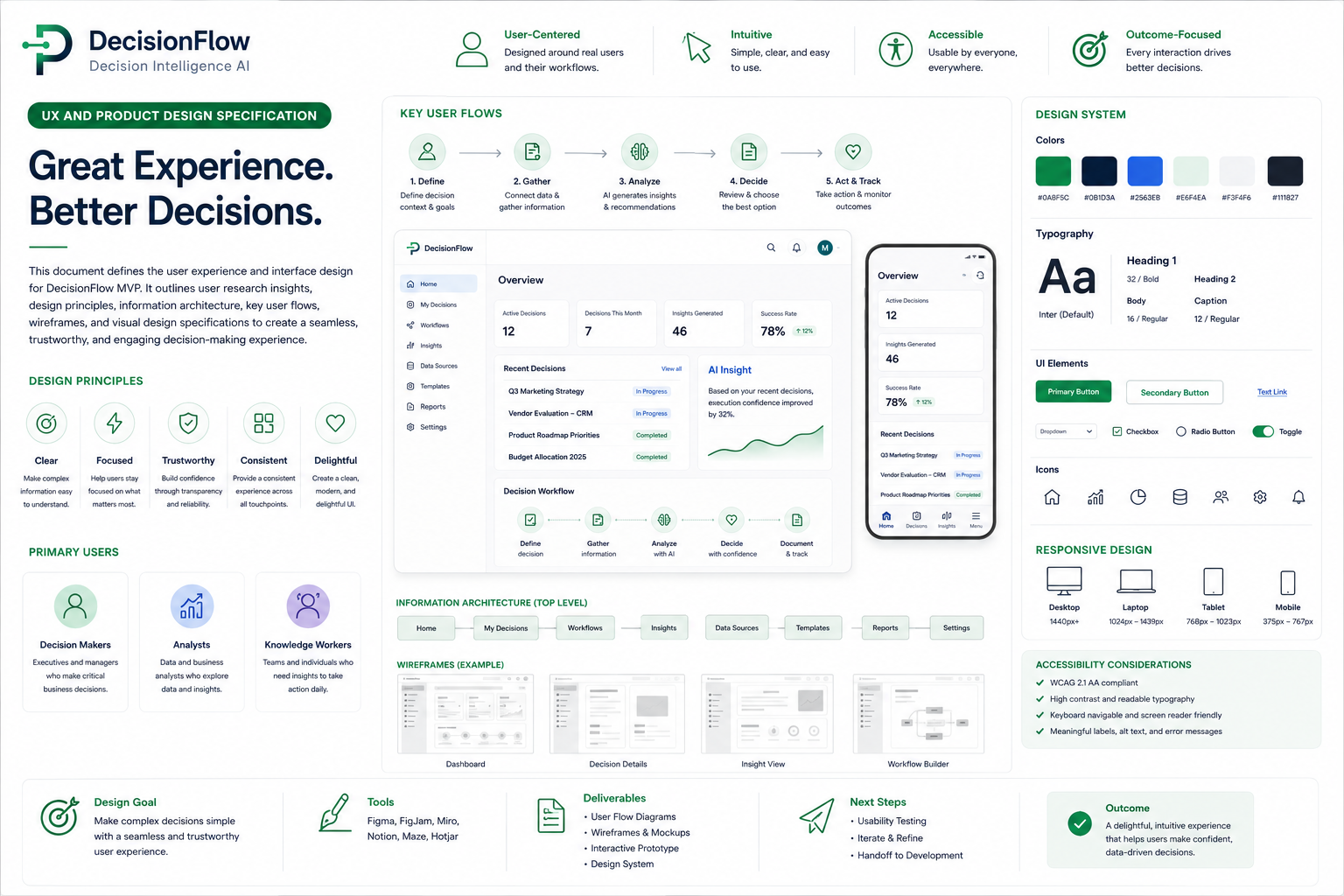
UX and Product Design Specification
Defines DecisionFlow’s user experience, information architecture, core user flows, interaction patterns, accessibility requirements, responsive behavior, wireframes, and design system.
Document
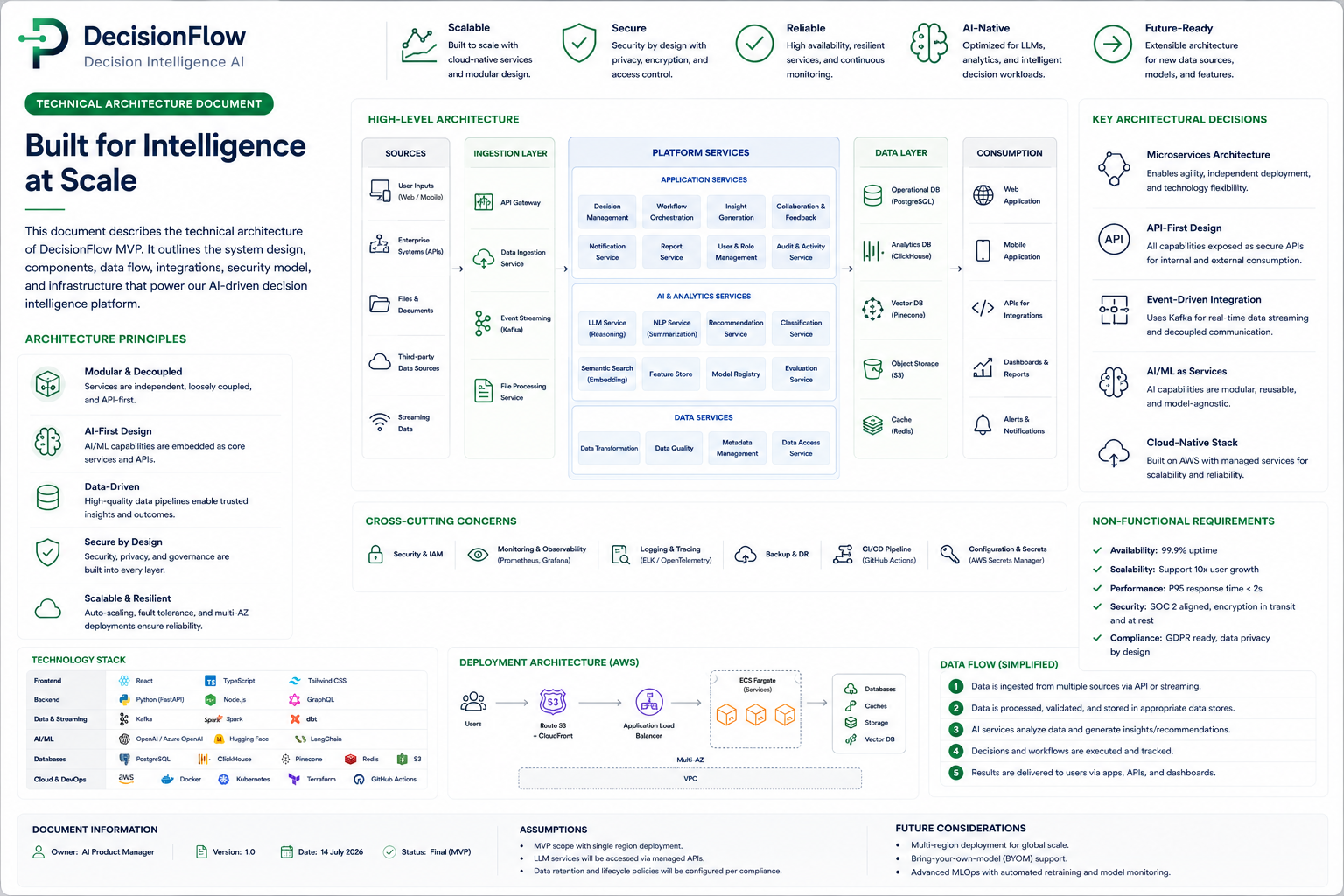
Technical Architecture Document
Defines DecisionFlow’s system architecture, technology stack, APIs, data flows, AI services, security controls, deployment model, scalability requirements, and key technical decisions.
Document
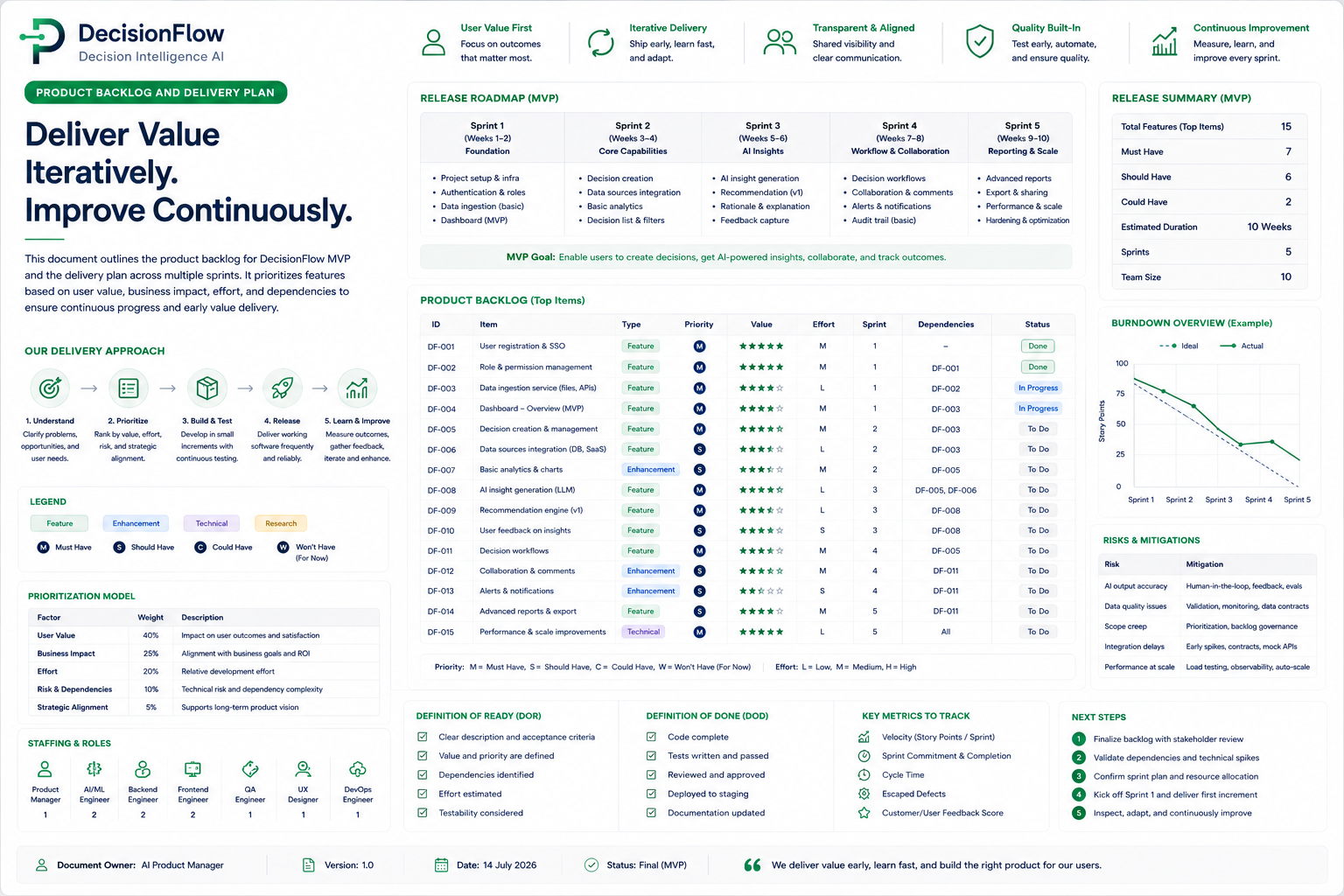
Product Backlog and Delivery Plan
Defines DecisionFlow’s prioritized product backlog, release roadmap, sprint structure, dependencies, delivery approach, acceptance standards, risks, and progress metrics.
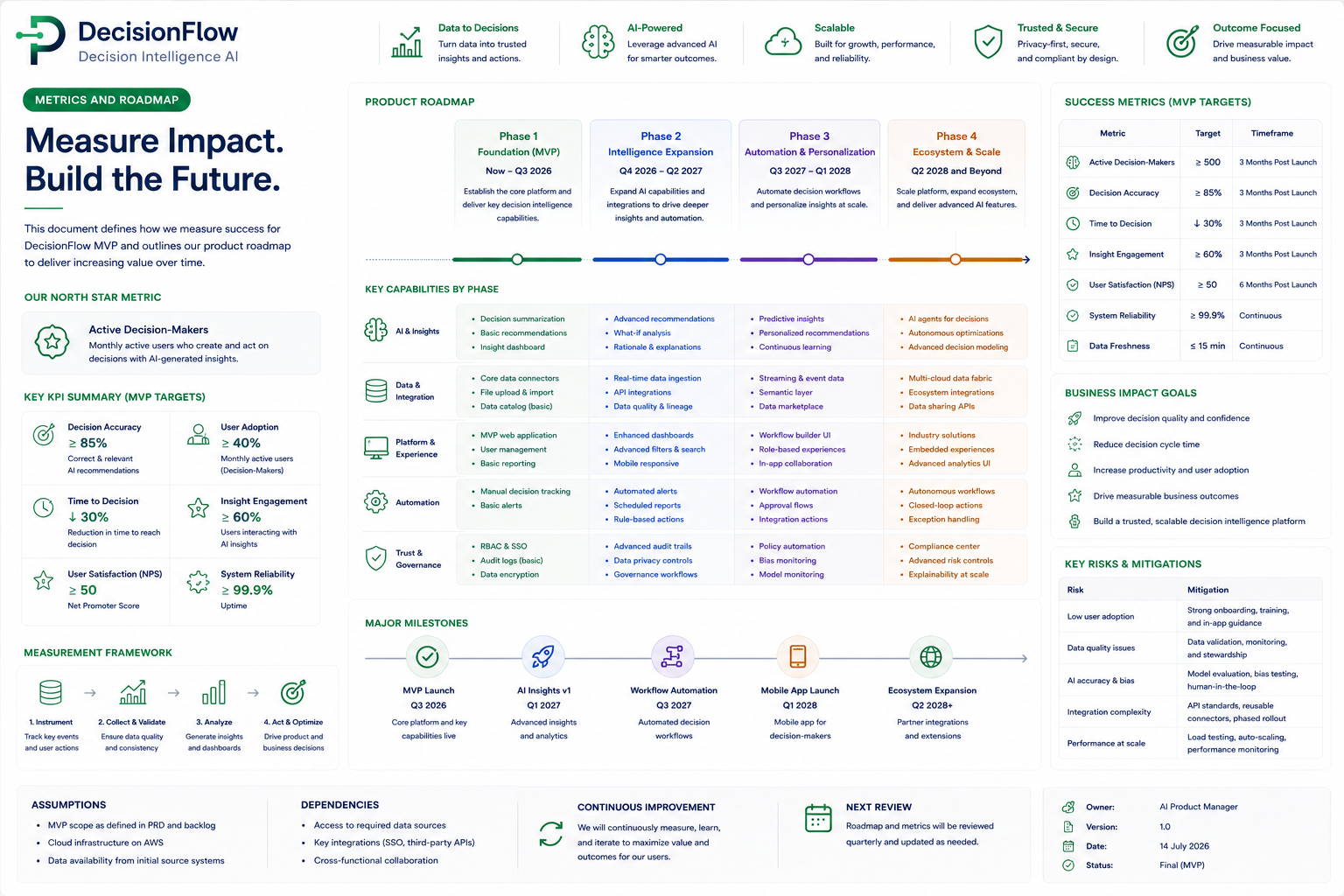
Document
Metrics and Roadmap
Defines DecisionFlow’s success metrics, North Star Metric, KPI framework, product roadmap, major milestones, dependencies, risks, and continuous improvement approach.
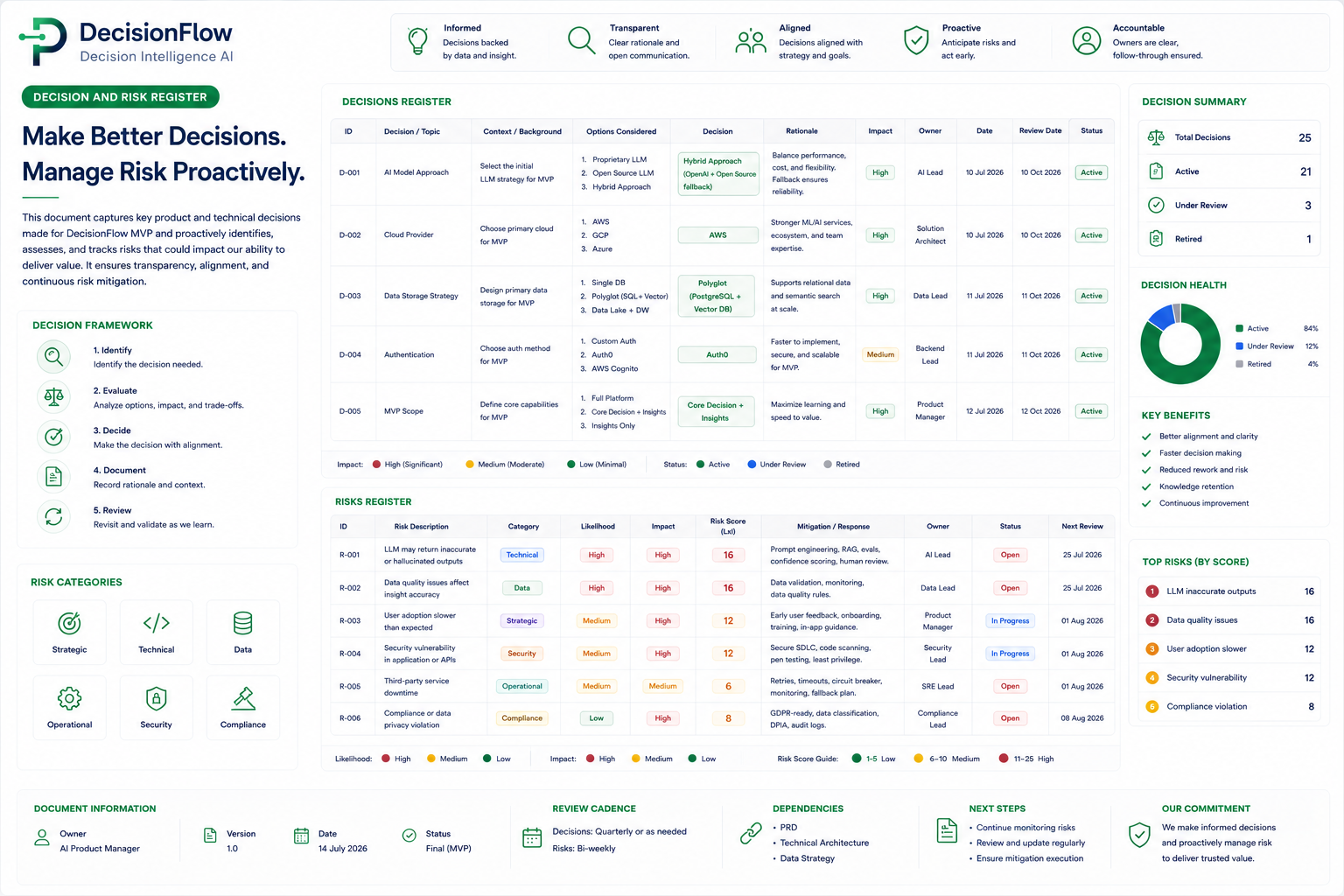
Document
Decision and Risk Register
Tracks DecisionFlow’s key product and technical decisions, rationales, owners, review dates, risks, mitigation actions, dependencies, and governance status.
Develop
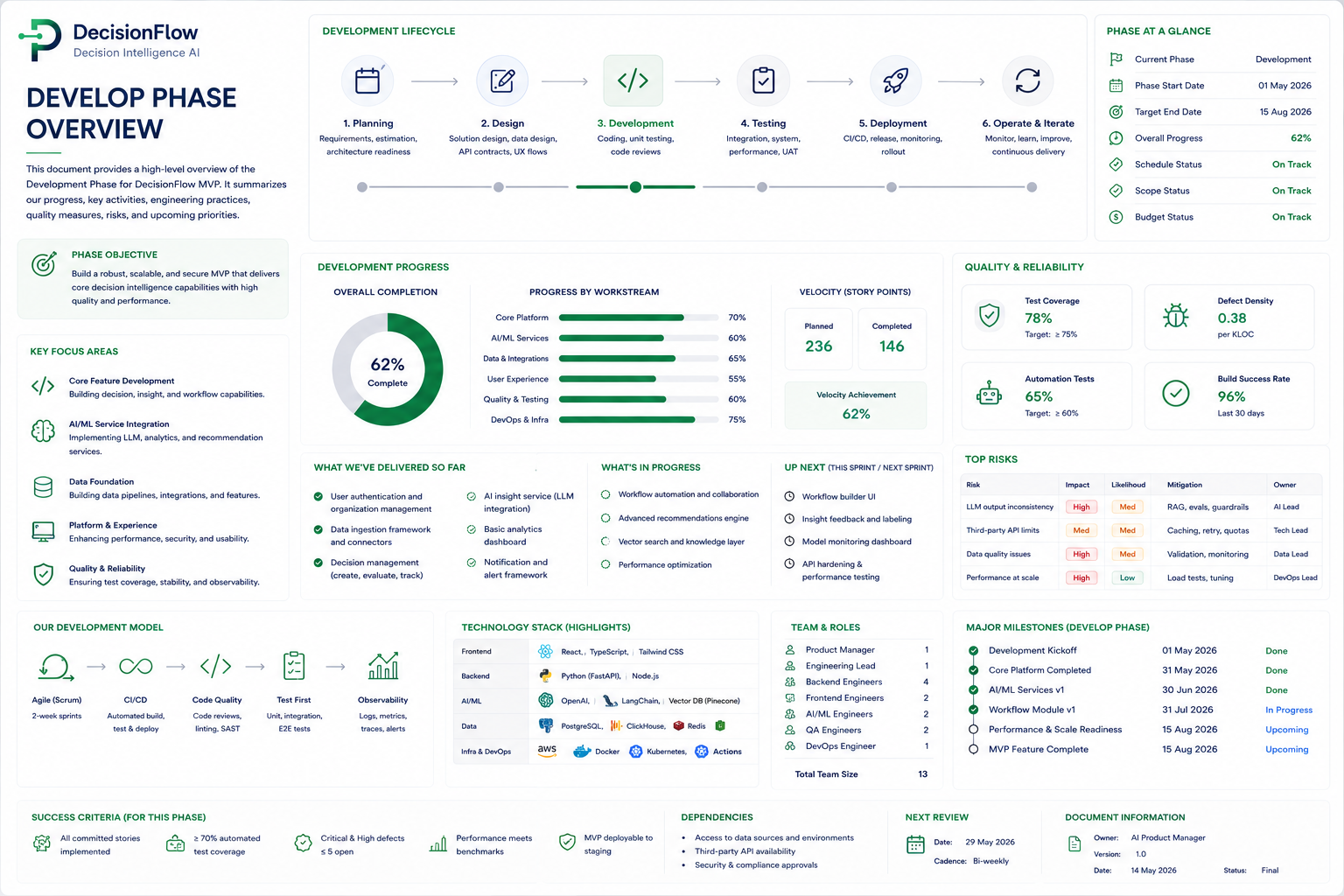
Document
Develop Phase Overview
Summarizes DecisionFlow’s MVP development progress, implemented capabilities, technical stack, quality status, key risks, release gaps, milestones, and readiness for productionization.
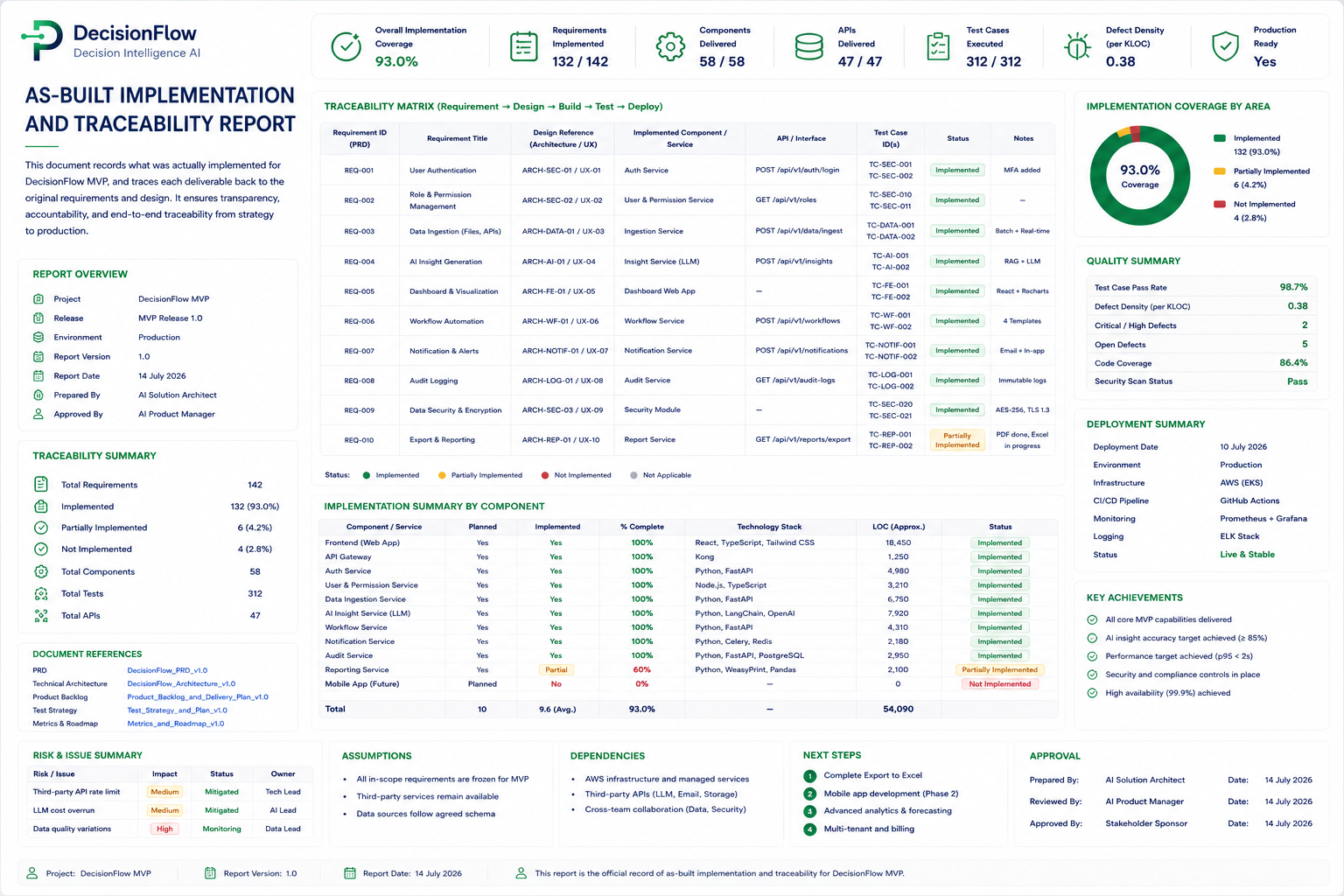
Document
As Built Implementation and Traceability Report
Documents what was actually implemented in DecisionFlow and traces each capability from requirements and design through development, testing, deployment, gaps, and release readiness.
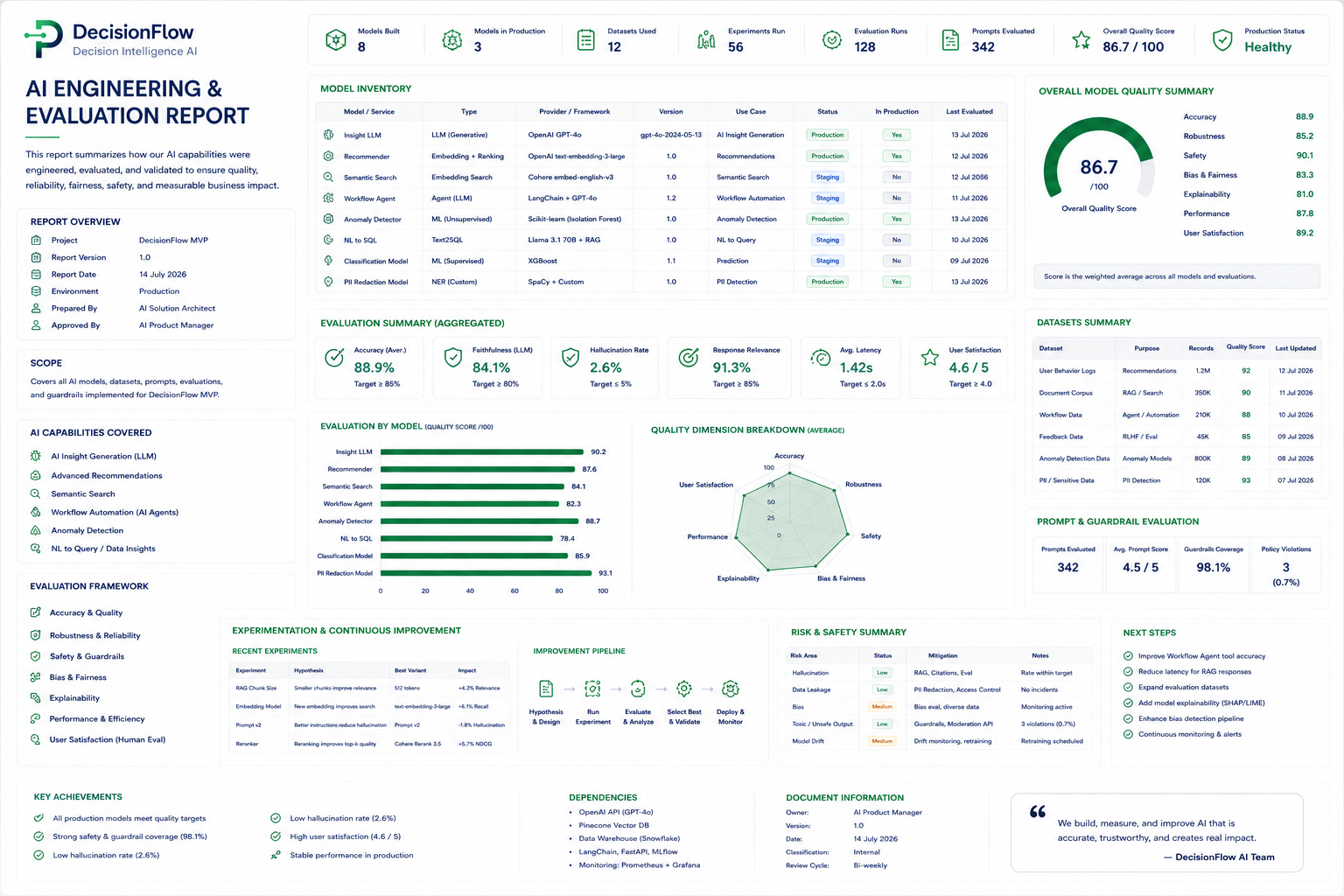
Document
AI Engineering & Evaluation Report
Summarizes how DecisionFlow’s AI capabilities were engineered, evaluated, monitored, and improved across model quality, groundedness, safety, latency, cost, human oversight, and production readiness.
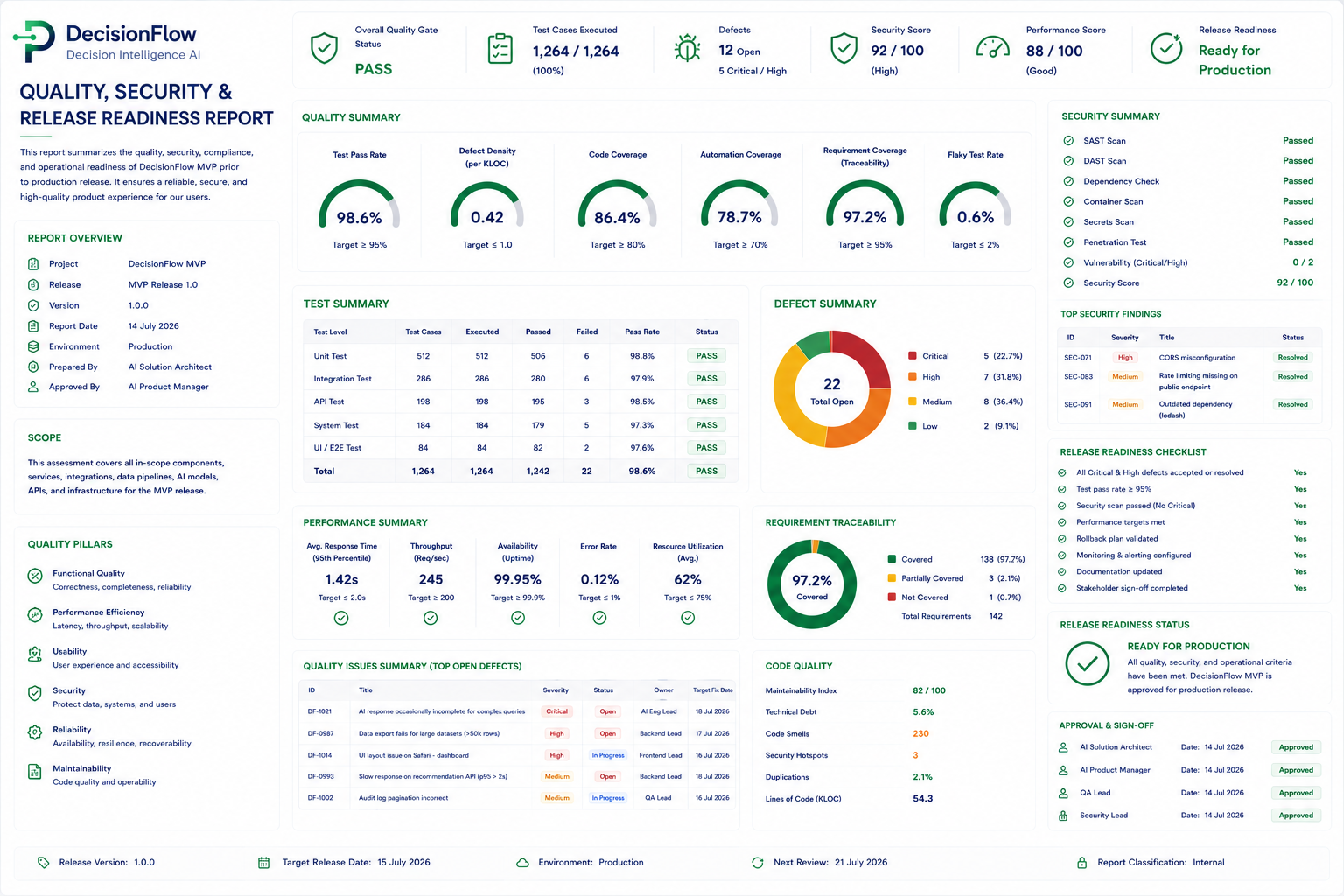
Document
Quality Security and Release Readiness Report
Summarizes DecisionFlow’s testing, defect status, security controls, performance, compliance, operational readiness, release risks, and approval criteria for production deployment.
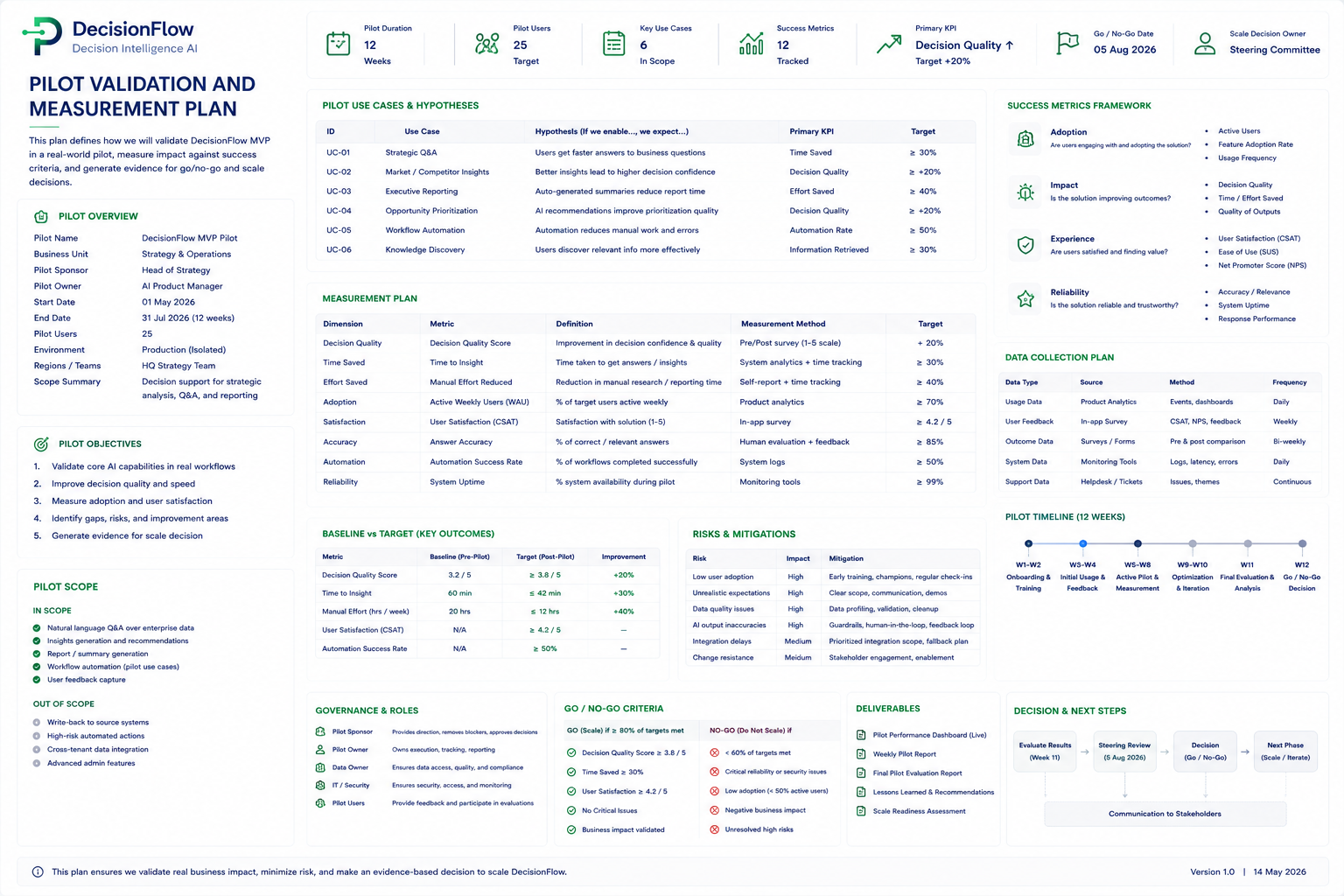
Document
Pilot Validation and Measurement Plan
Defines how DecisionFlow’s pilot will validate user value, AI quality, adoption, reliability, and business impact through clear hypotheses, metrics, data collection, risks, and go/no-go criteria.
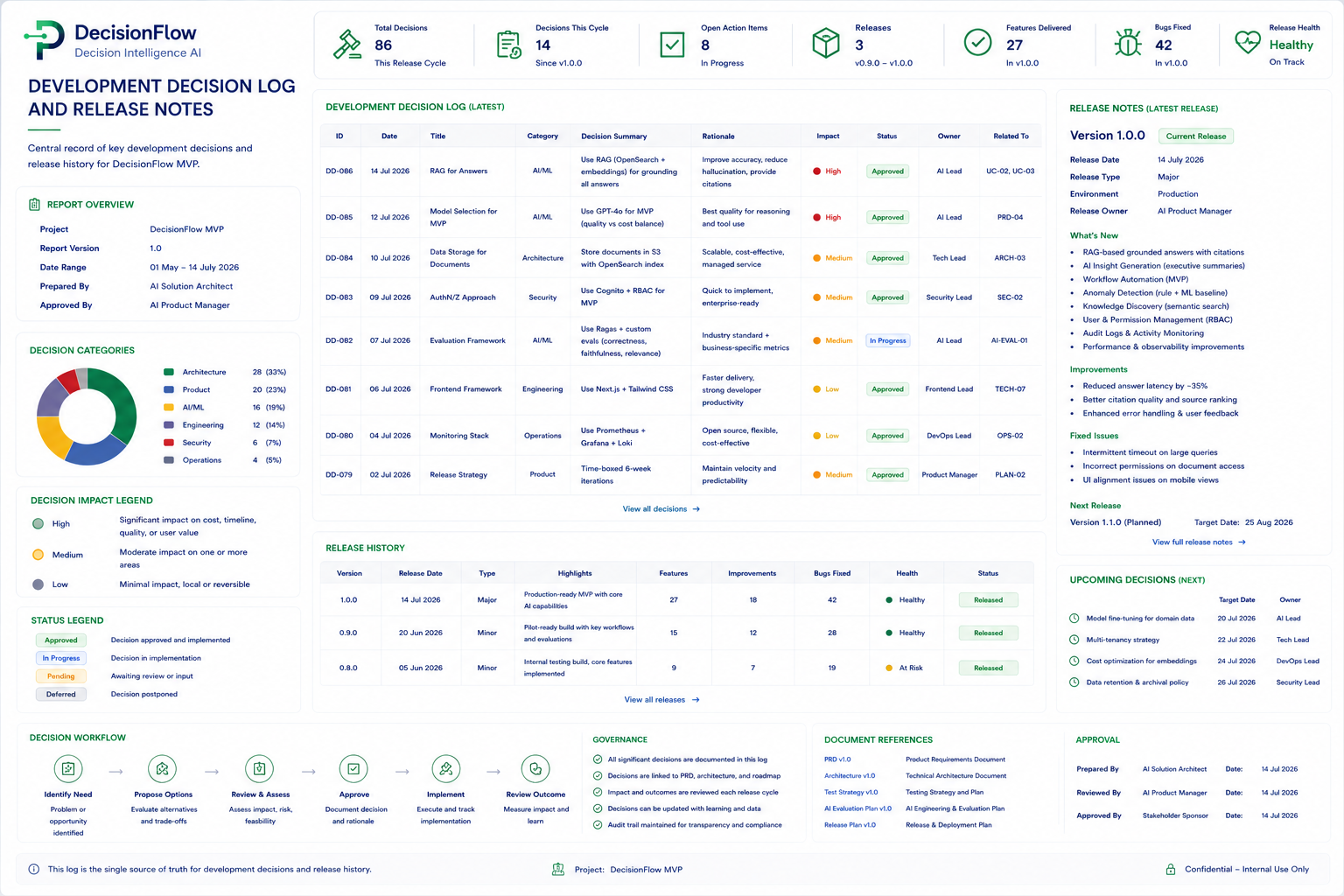
Document
Development Decision Log and Release Notes
Tracks key development decisions, rationales, owners, implementation status, release history, delivered features, resolved issues, and upcoming technical or product decisions.
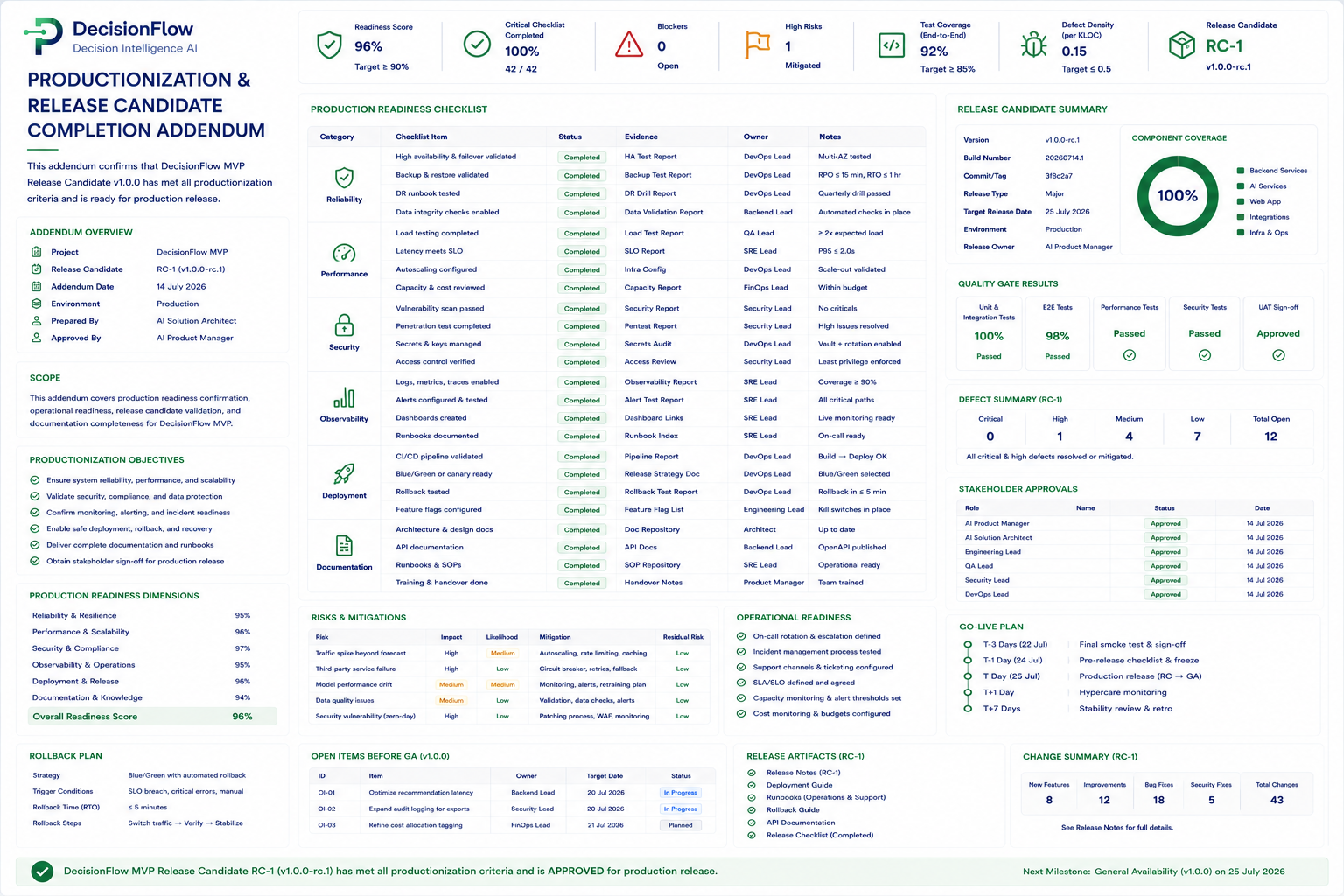
Document
Productionization and Release Candidate Completion Addendum
Confirms that DecisionFlow completed production hardening, passed release gates, resolved critical blockers, validated operational readiness, and was approved as a release candidate for production launch.
Qualify
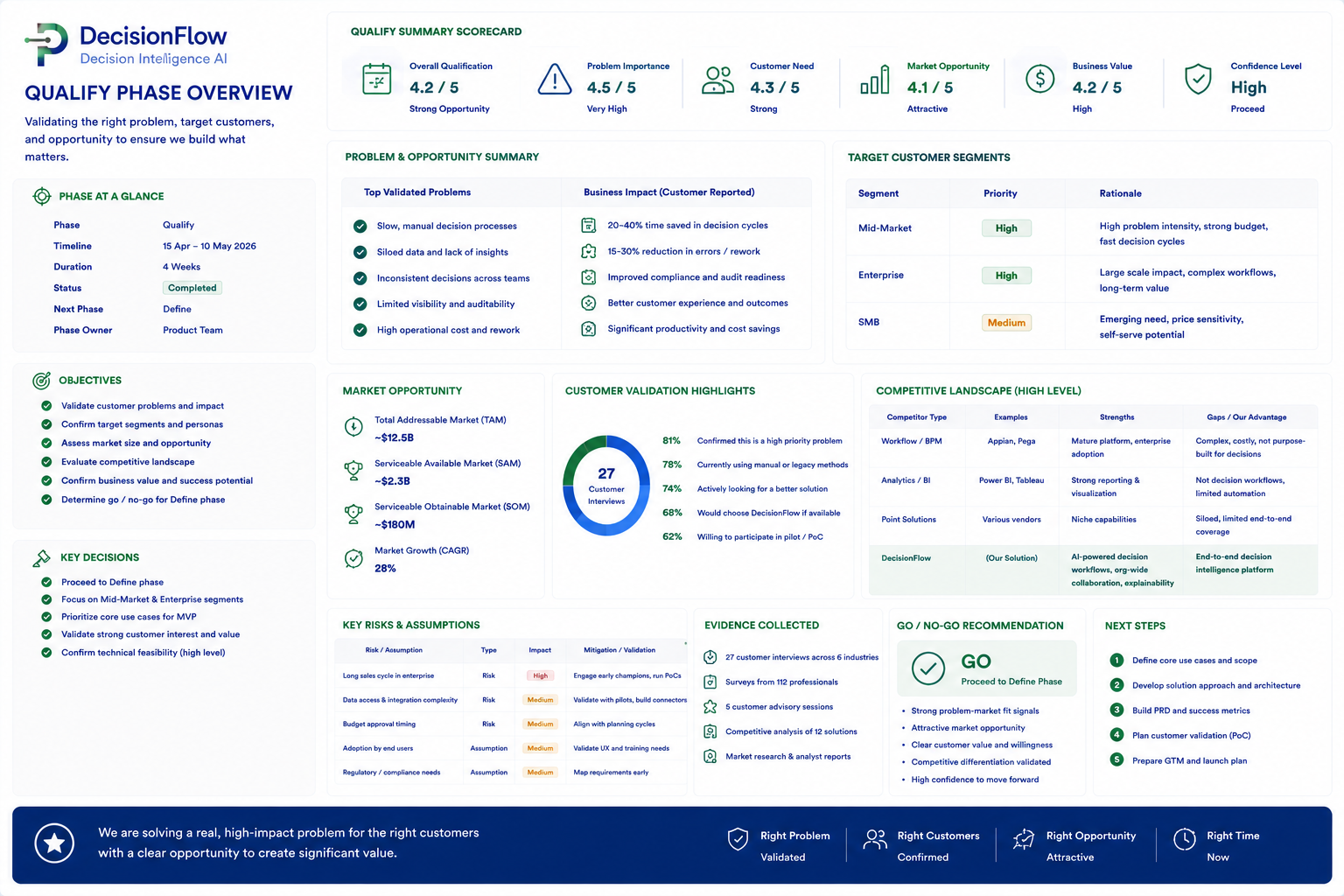
Document
Qualify Phase Overview
Summarizes how DecisionFlow was evaluated for customer value, product-market fit, AI trust, business viability, operational readiness, key risks, and the final scale decision.
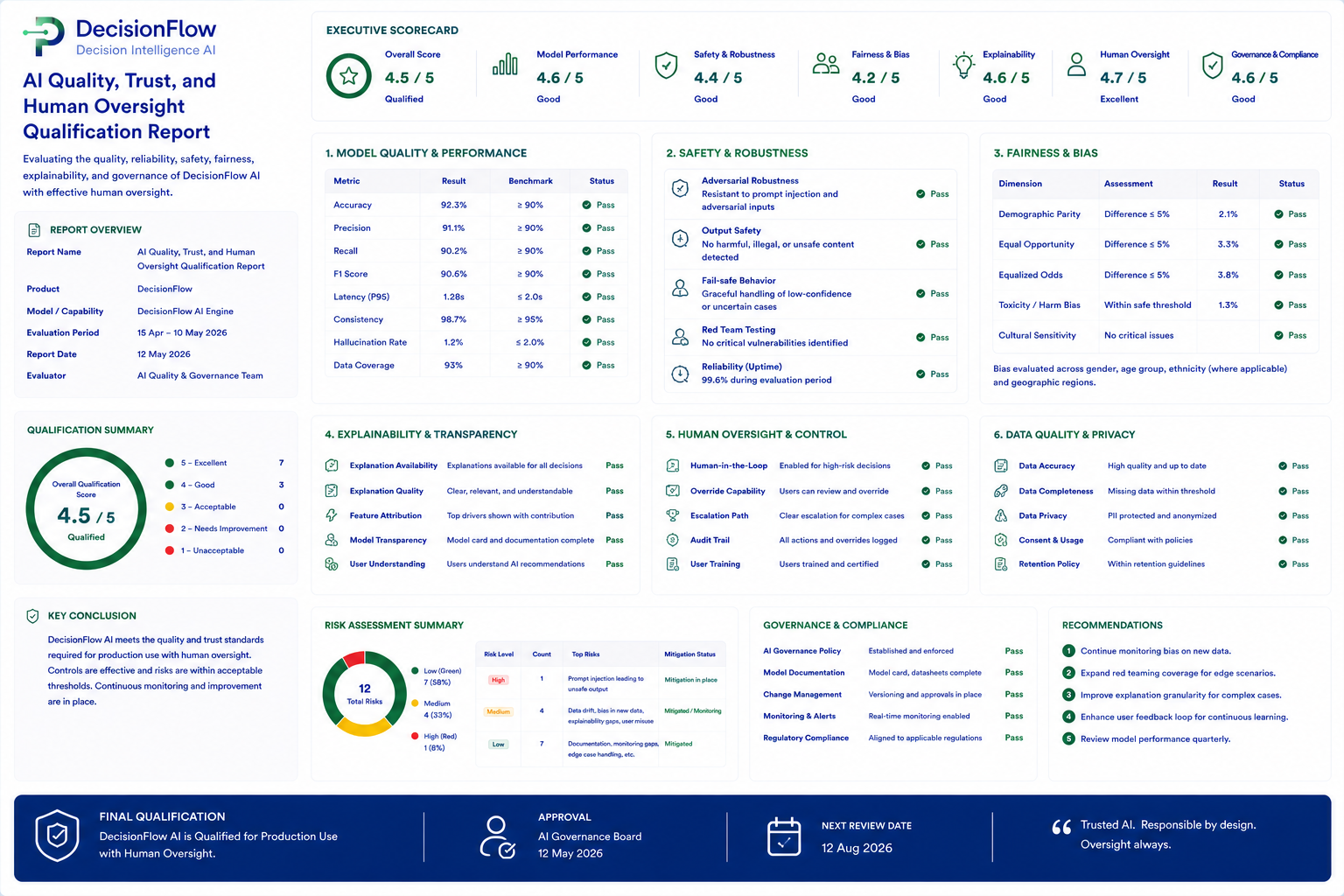
Document
AI Quality Trust and Human Oversight Qualification Report
Evaluates DecisionFlow’s AI quality, safety, fairness, explainability, privacy, reliability, governance, and human oversight to determine readiness for responsible production use.
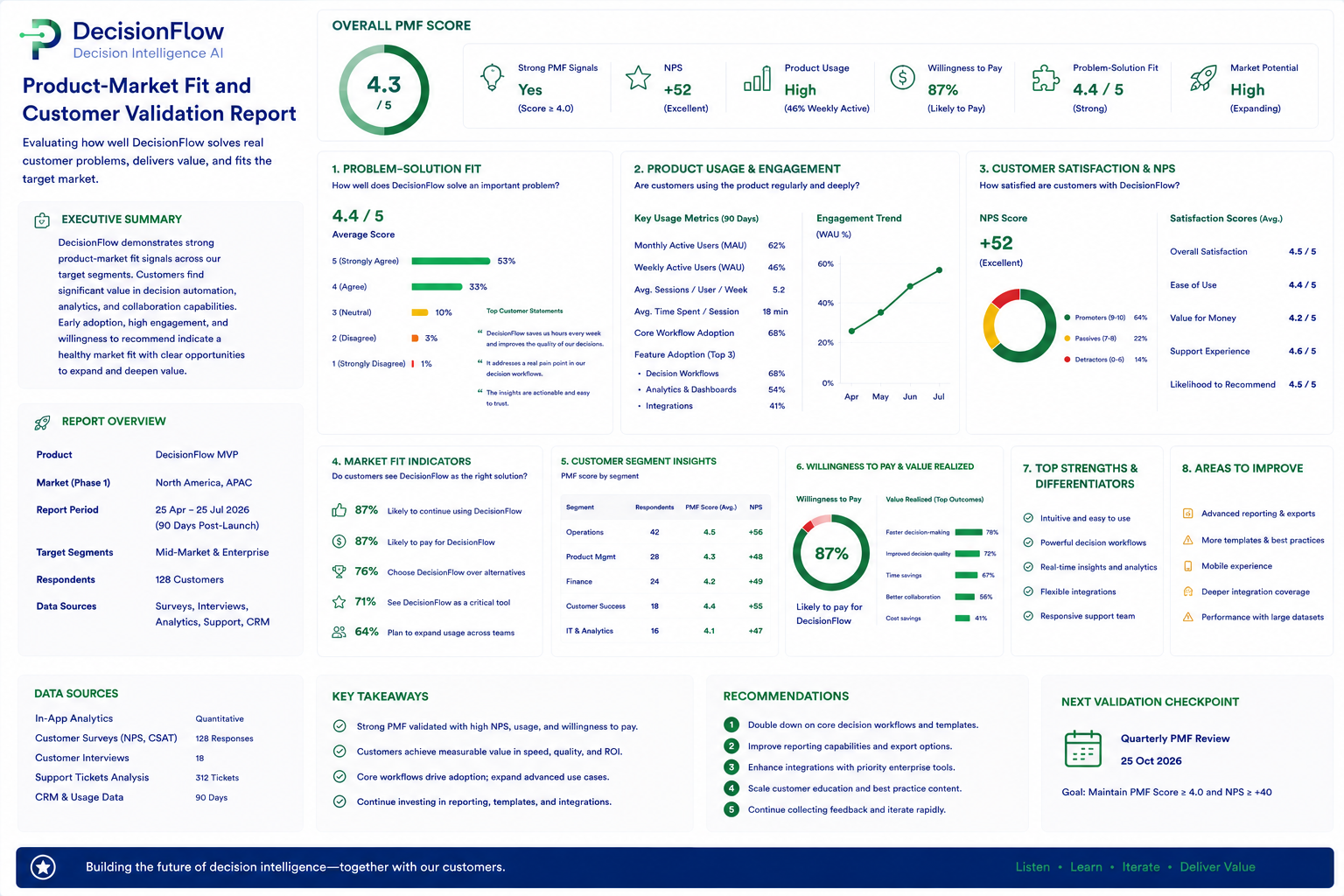
Document
Product Market Fit and Customer Validation Report
Evaluates DecisionFlow’s product-market fit through customer needs, adoption, retention, satisfaction, willingness to pay, segment insights, value realization, and growth recommendations.
Document
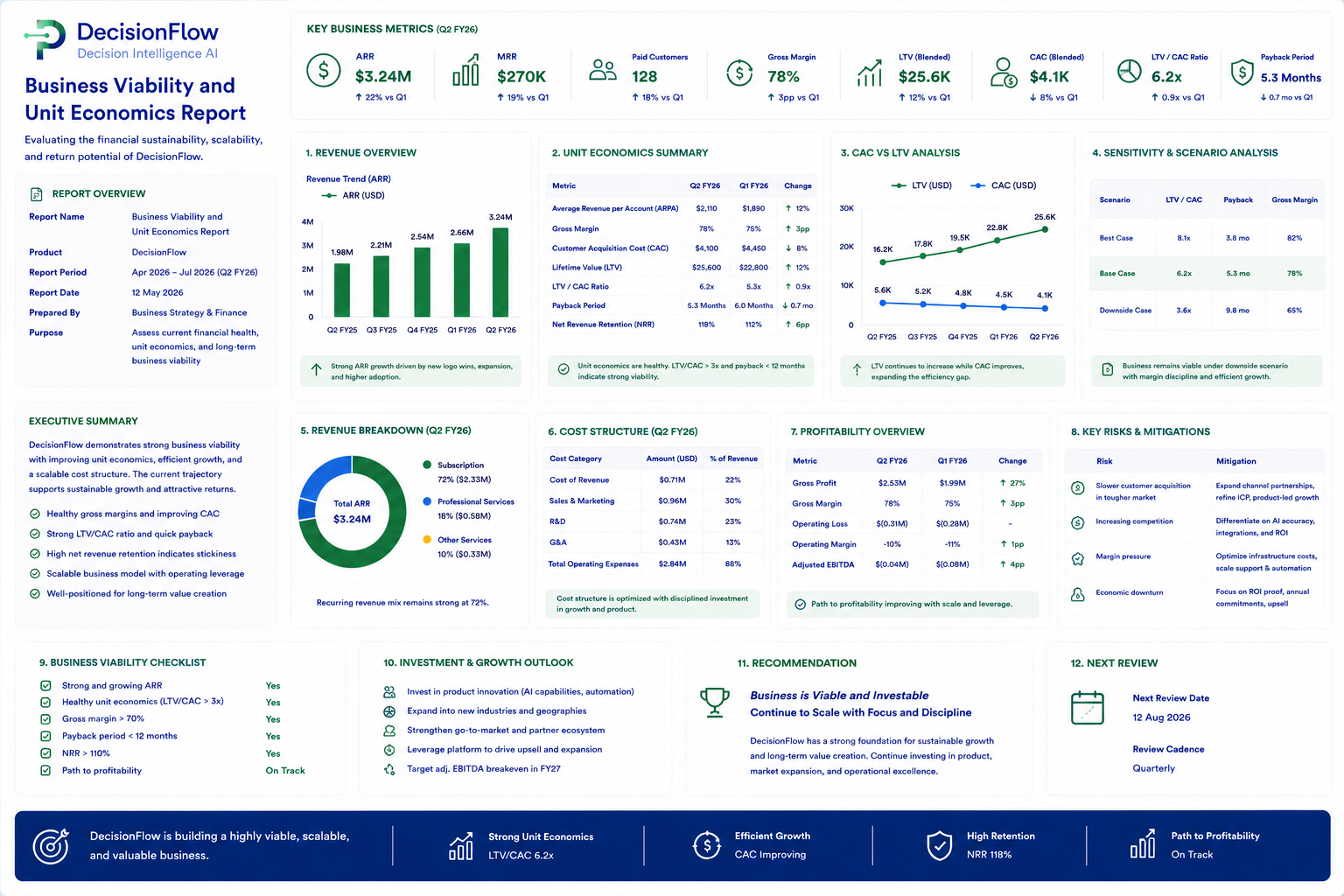
Business Viability and Unit Economics Report
Evaluates DecisionFlow’s financial sustainability through revenue, pricing, customer acquisition cost, lifetime value, margins, AI operating costs, payback period, and growth scenarios.
Document
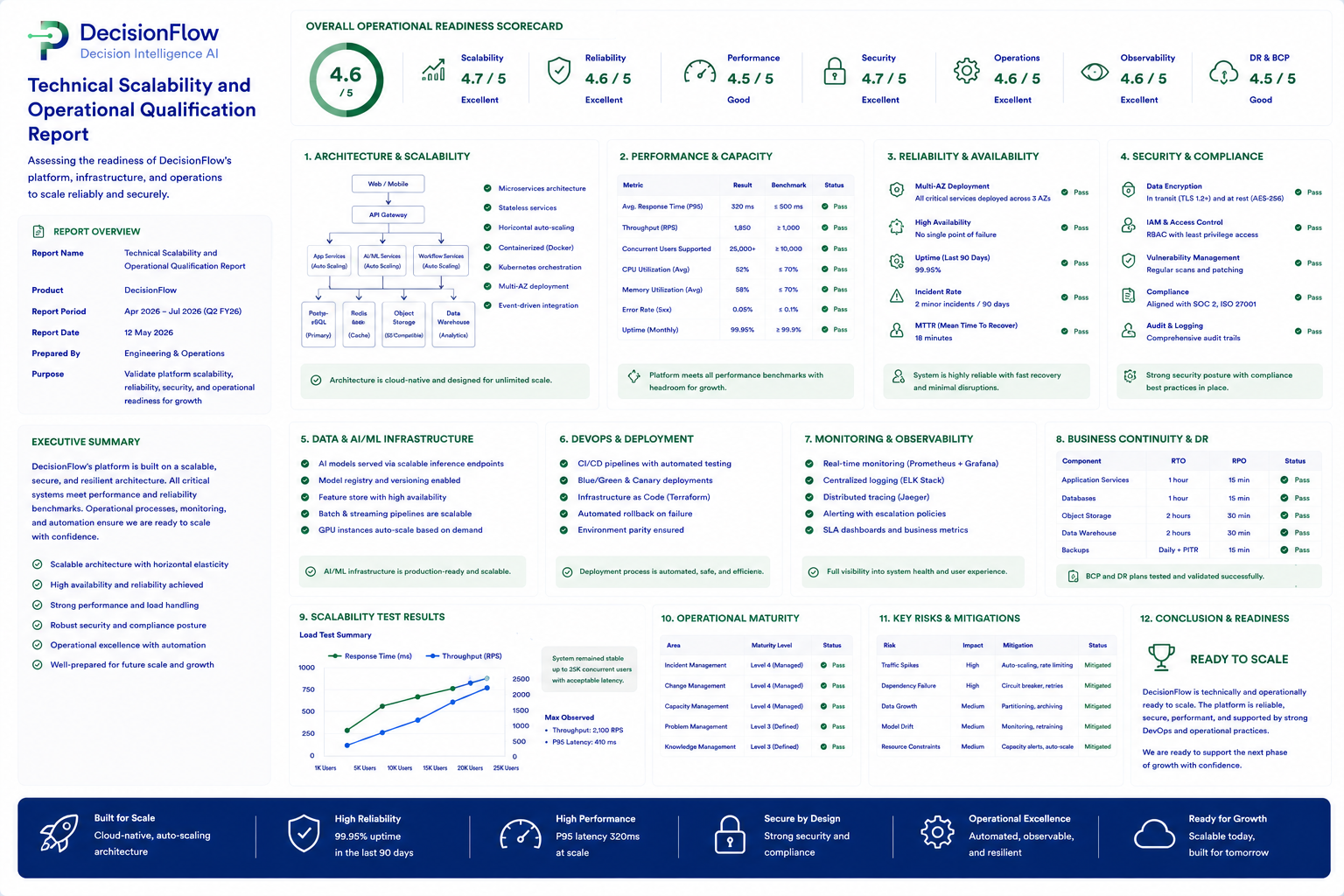
Technical Scalability and Operational Qualification Report
Evaluates DecisionFlow’s architecture, scalability, performance, reliability, security, observability, disaster recovery, operational maturity, and readiness for controlled growth.
Document
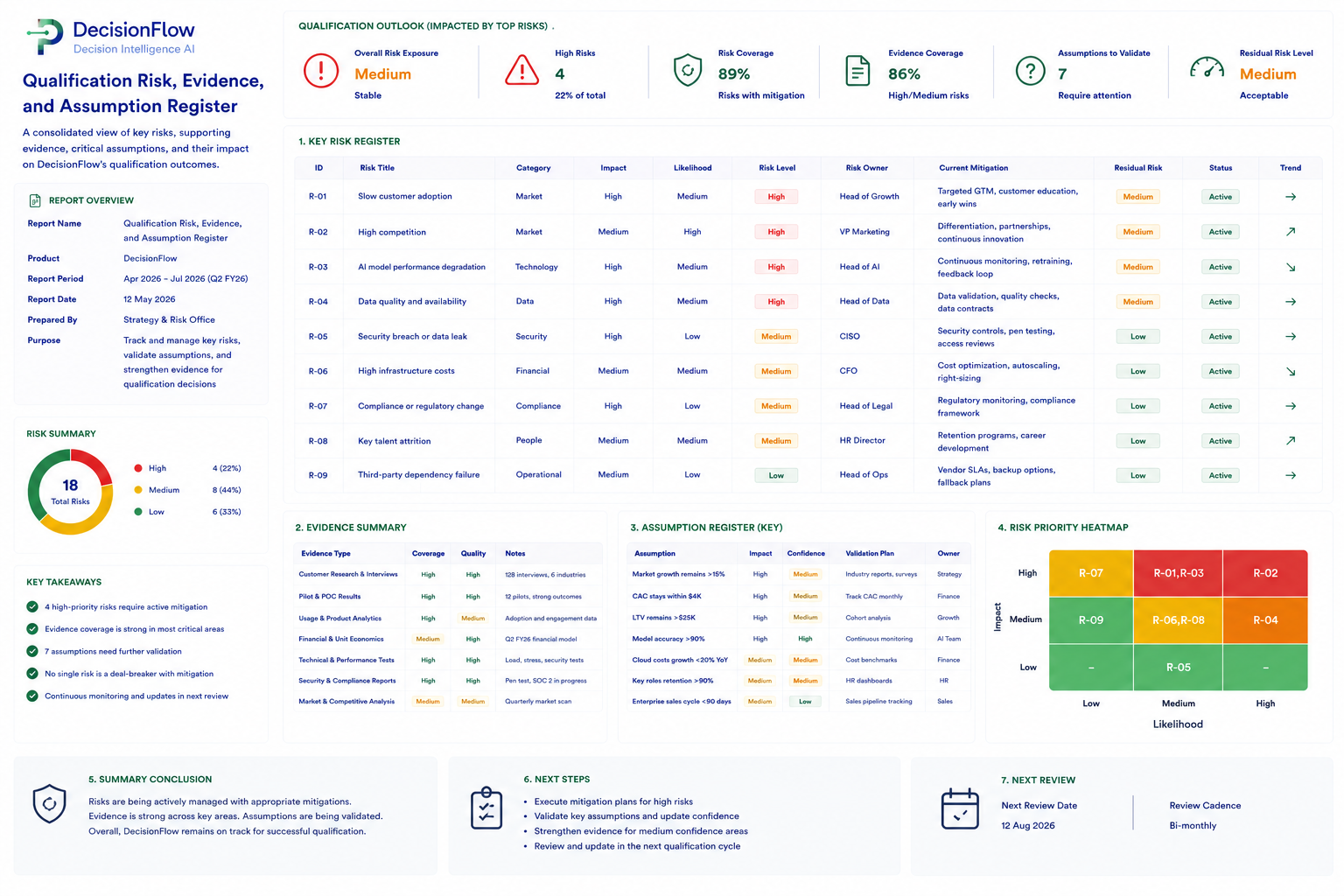
Qualification Risk Evidence and Assumption Register
Consolidates DecisionFlow’s key qualification risks, supporting evidence, unresolved assumptions, mitigation actions, owners, confidence levels, and next validation steps.
Document
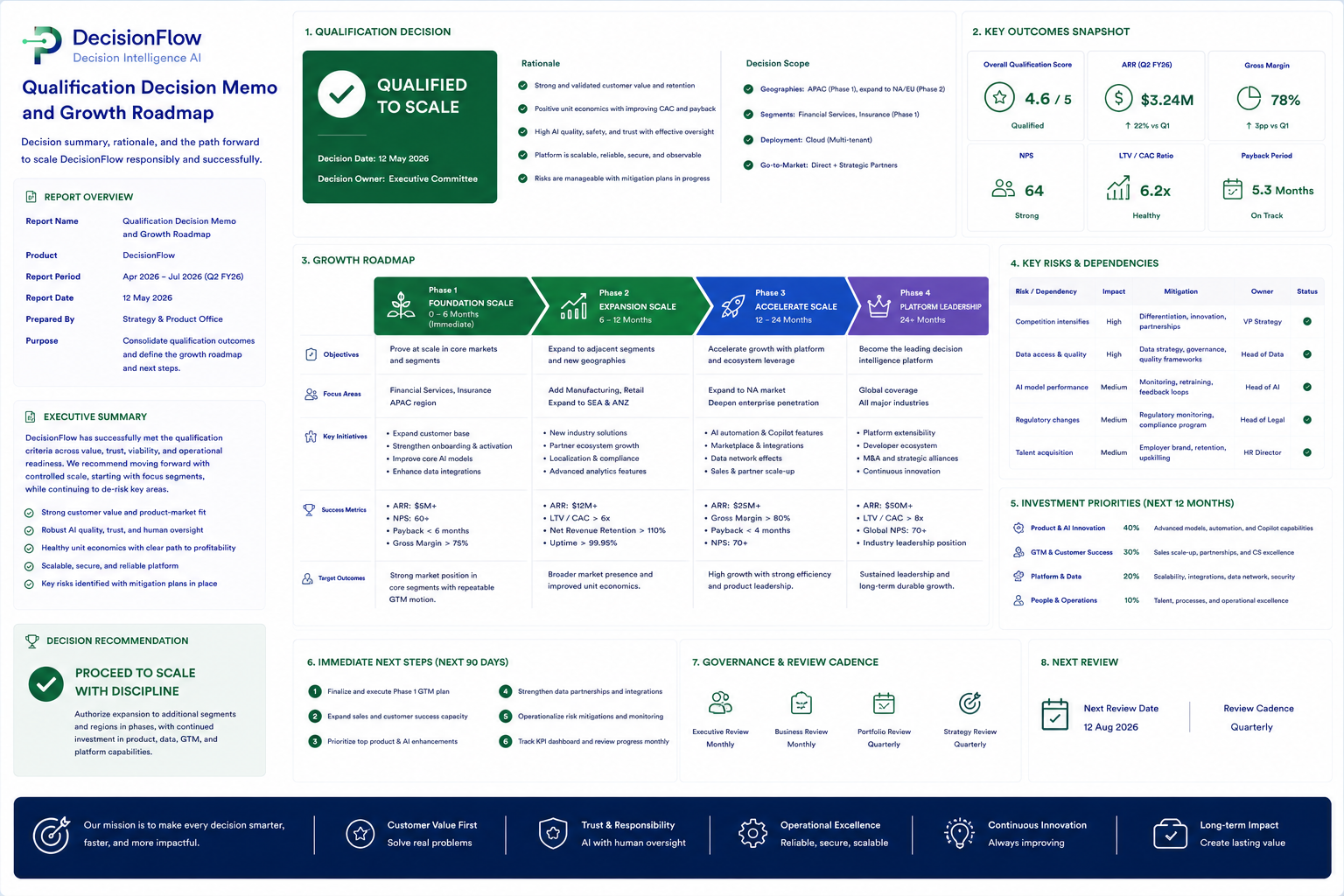
Qualification Decision Memo and Growth Roadmap
Summarizes DecisionFlow’s qualification outcome, decision rationale, approved growth path, investment priorities, key risks, governance, and roadmap for controlled scaling.
Launch
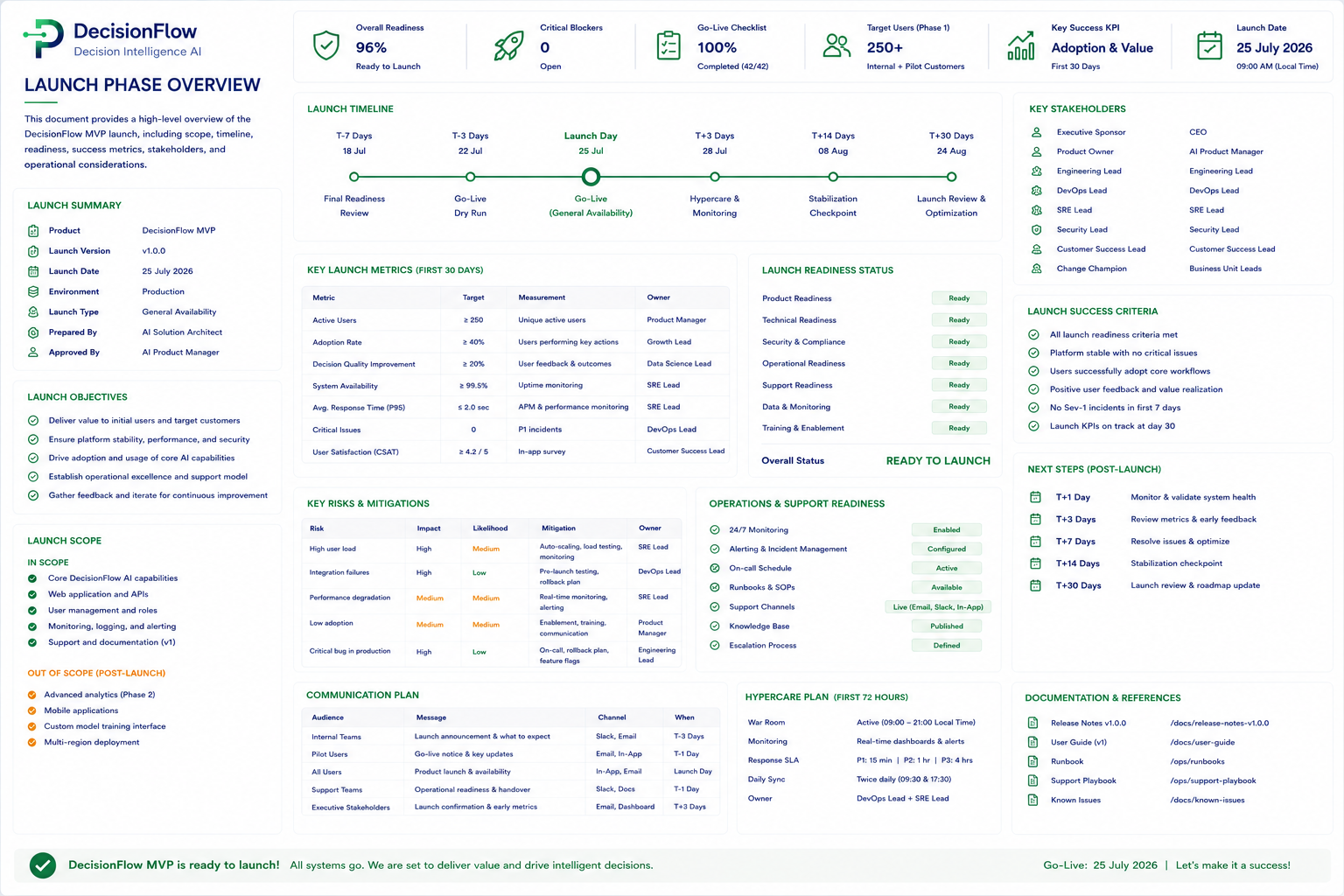
Document
Launch Phase Overview
Summarizes DecisionFlow’s launch scope, readiness, timeline, success metrics, stakeholders, risks, communication, support model, and post-launch monitoring plan.
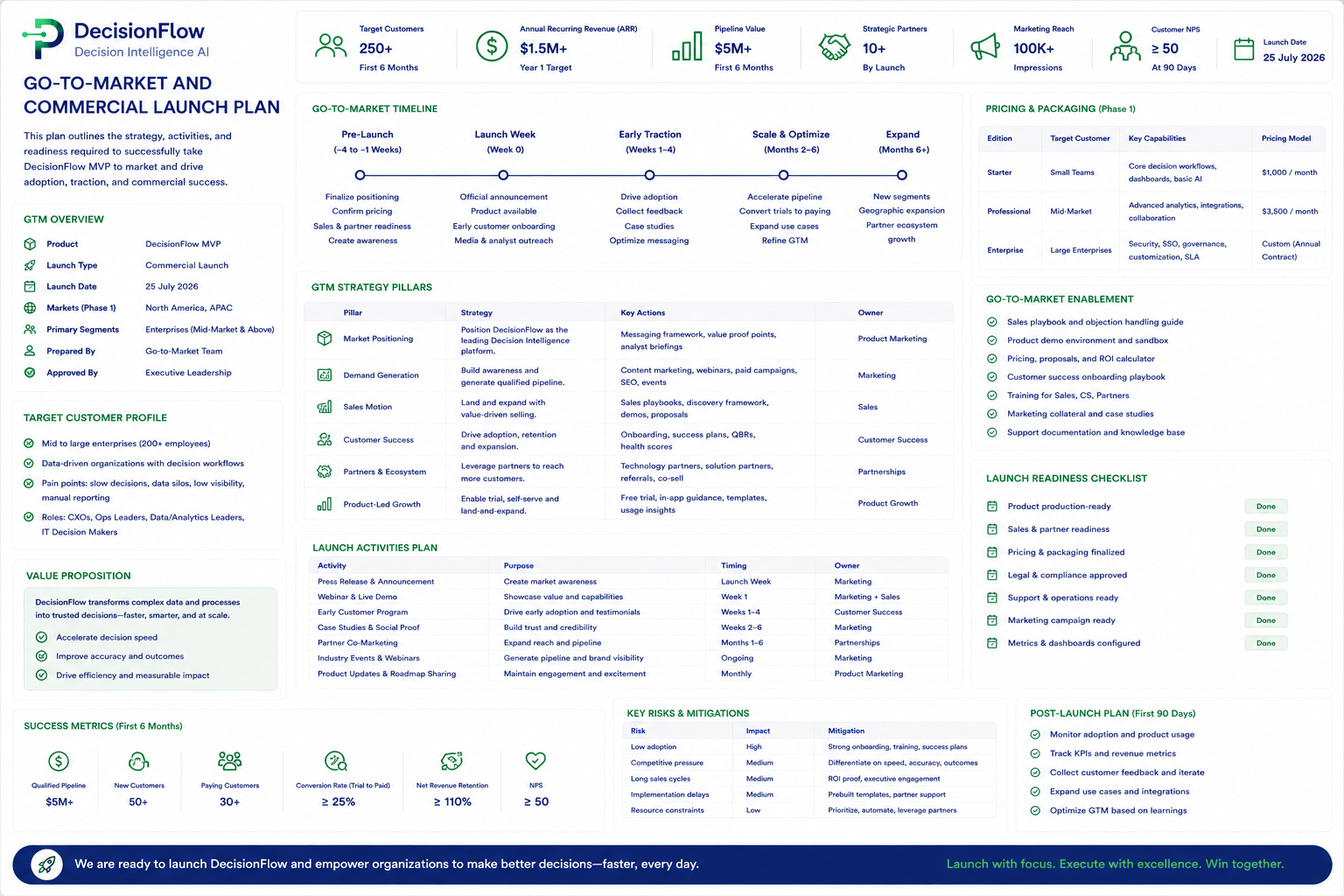
Document
Go to Market and Commercial Launch Plan
Defines DecisionFlow’s market positioning, target customers, pricing, launch channels, demand-generation strategy, sales enablement, adoption goals, commercial metrics, and post-launch growth plan.
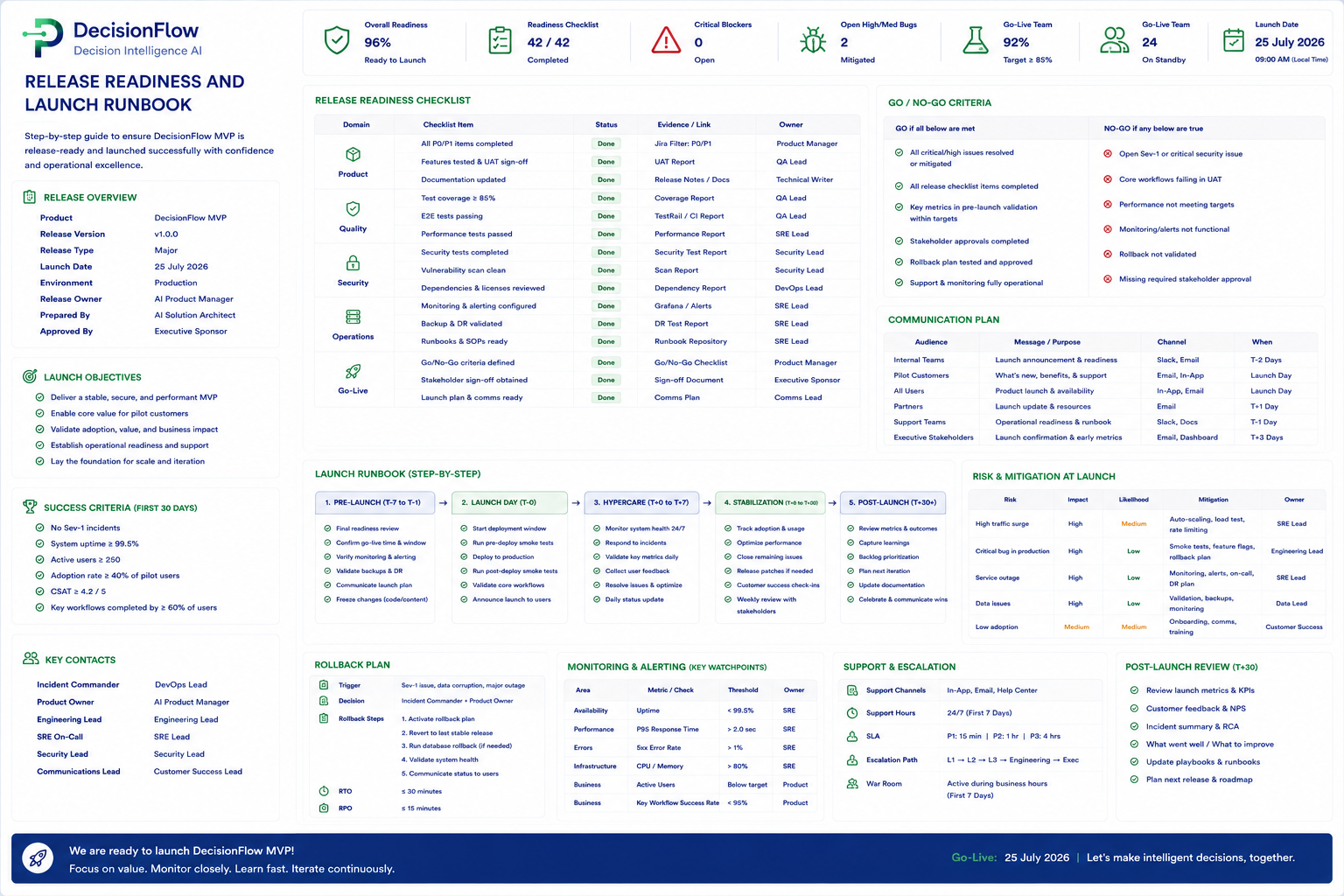
Document
Release Readiness and Launch Runbook
Provides the step-by-step process for validating readiness, approving go-live, deploying safely, monitoring launch health, managing incidents, executing rollback, and completing post-launch review.
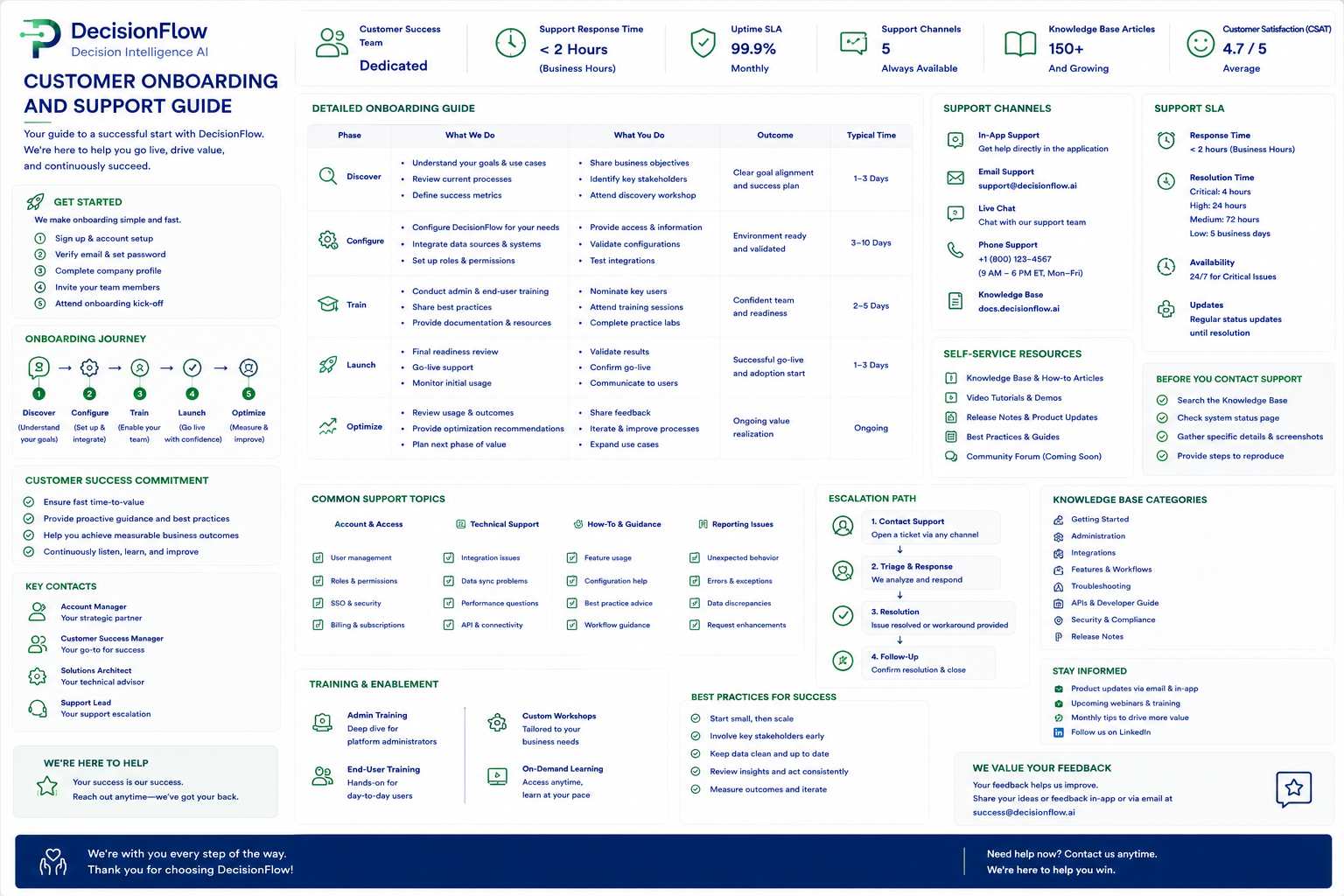
Document
Customer Onboarding and Support Guide
Guides customers through DecisionFlow setup, onboarding, training, adoption, support channels, service levels, troubleshooting, escalation, and ongoing success.
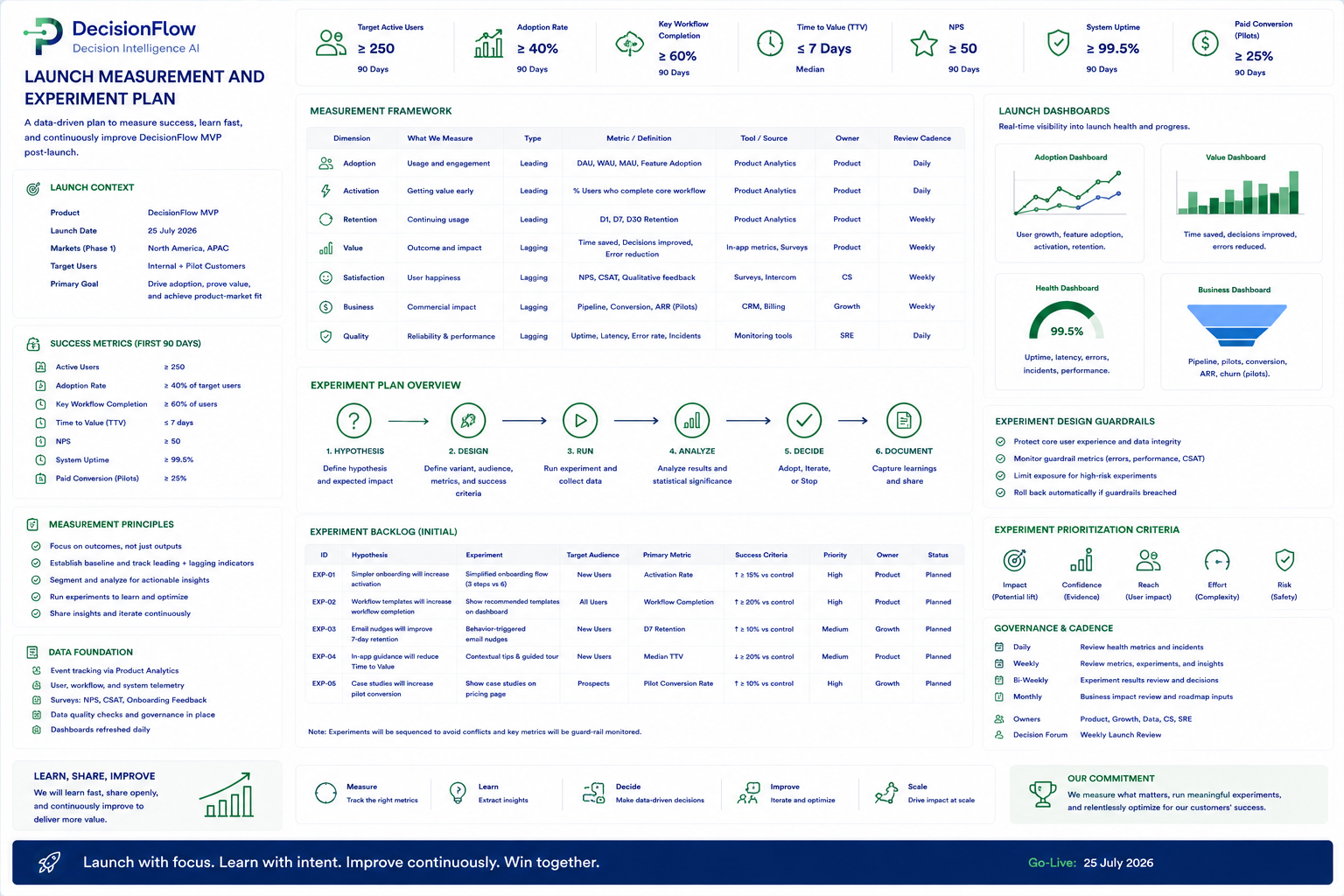
Document
Launch Measurement and Experiment Plan
Defines DecisionFlow’s launch metrics, analytics framework, experiment backlog, success criteria, data sources, dashboards, governance, and continuous improvement process.
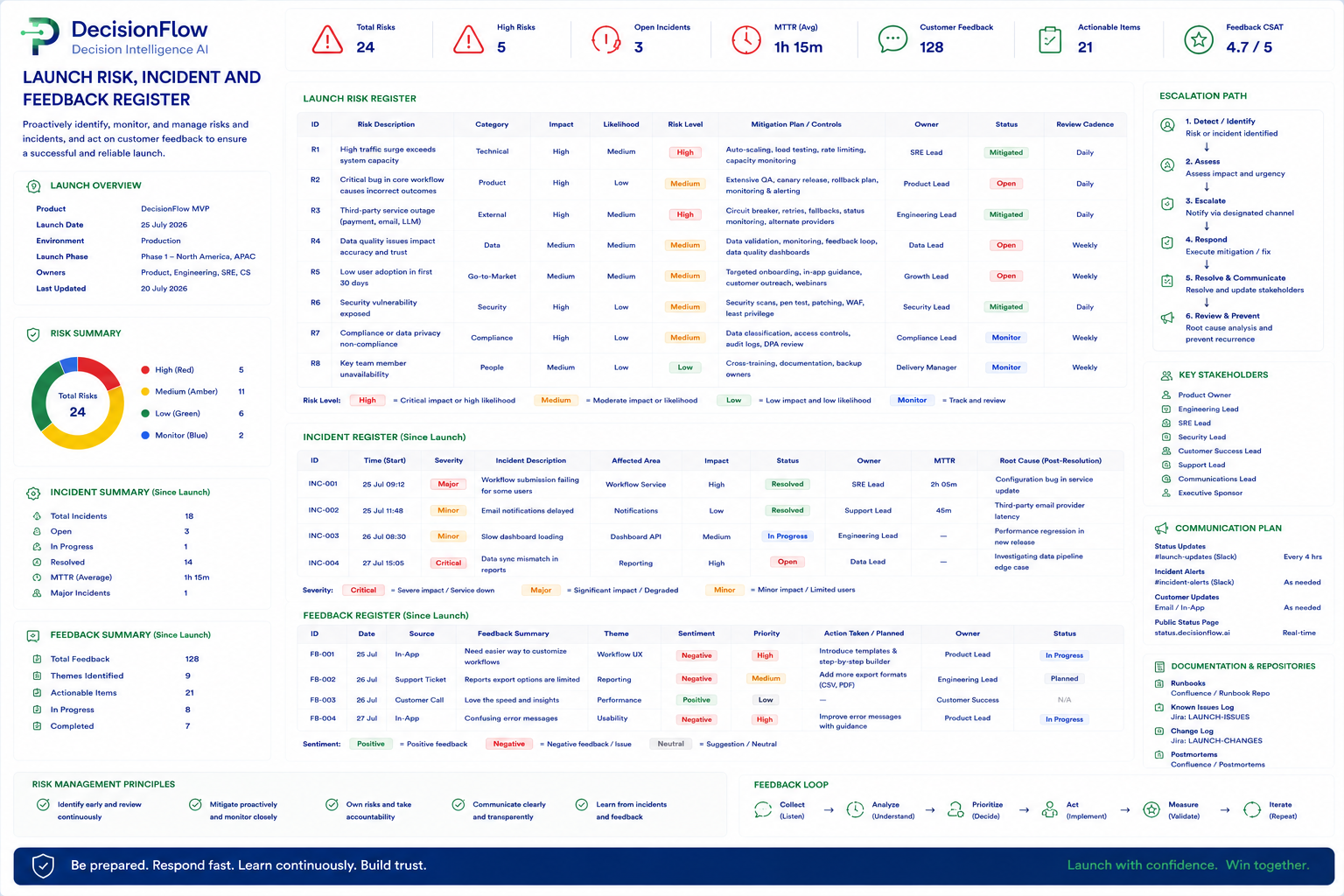
Document
Launch Risk, Incident and Feedback Register
Tracks launch risks, production incidents, customer feedback, severity, owners, mitigation actions, resolutions, and lessons used to improve DecisionFlow after release.
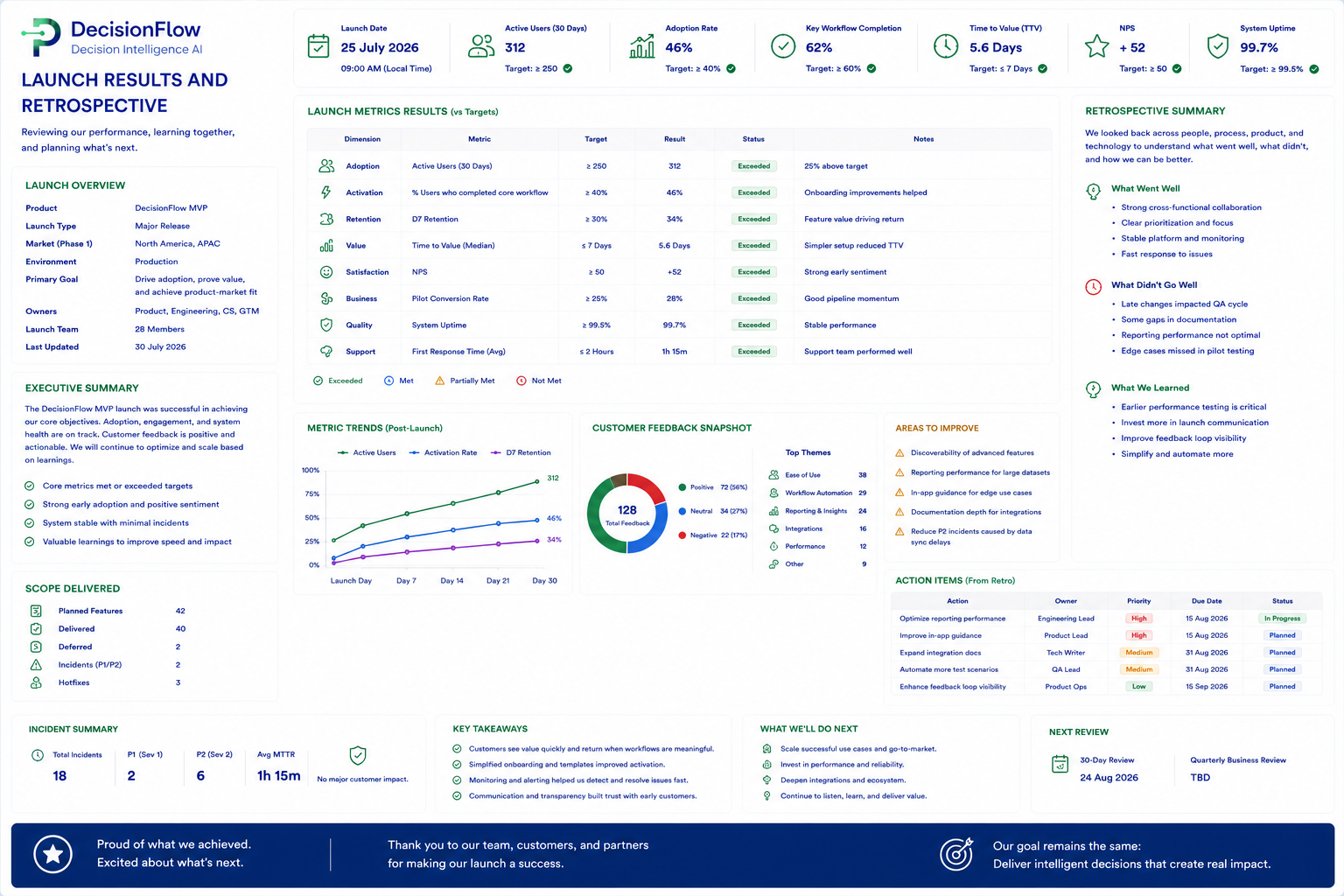
Document
Launch Results and Retrospective
Summarizes DecisionFlow’s launch performance, customer adoption, retention, business results, incidents, feedback, lessons learned, improvement actions, and next-stage recommendations.
Deliver
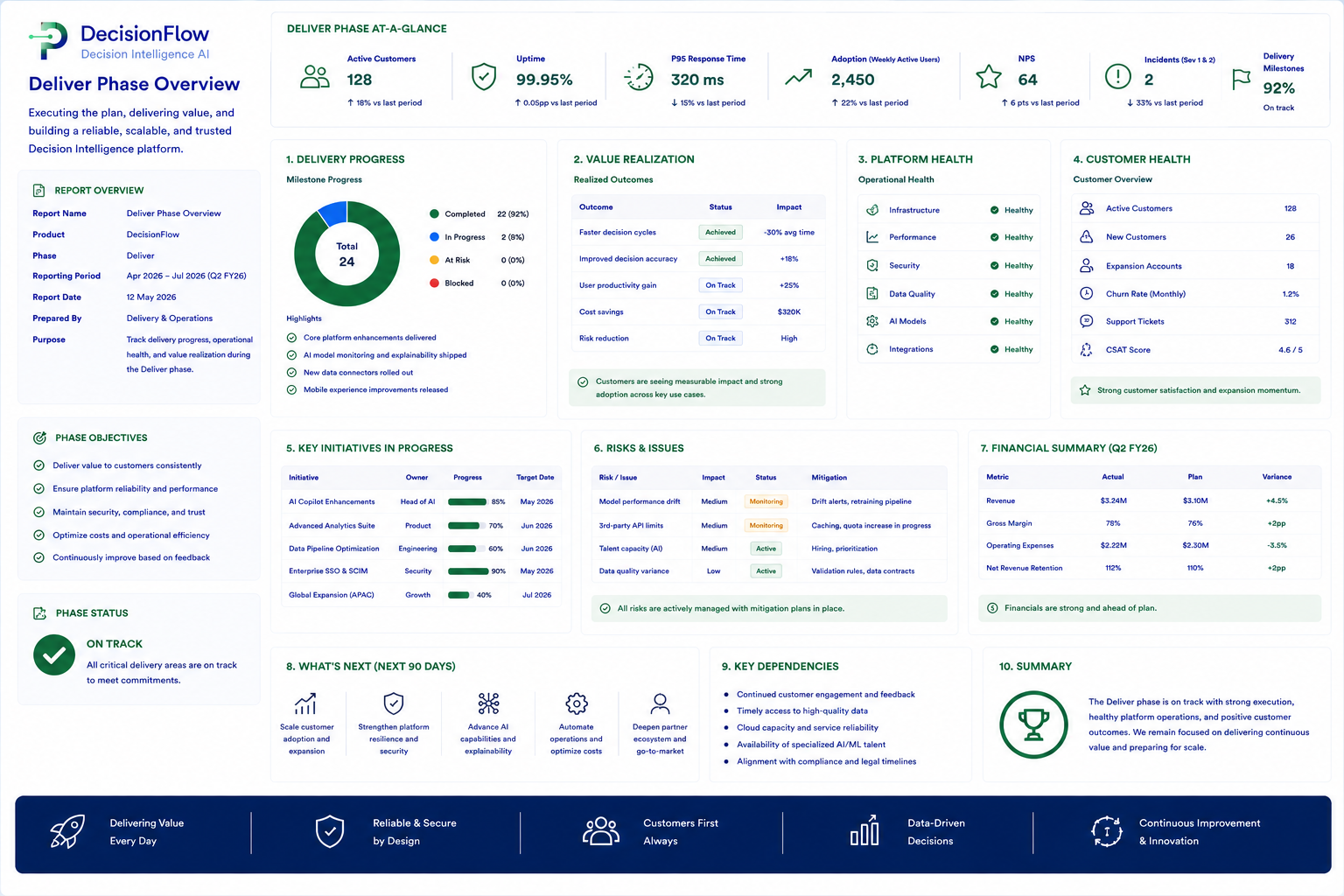
Document
Deliver Phase Overview
Summarizes DecisionFlow’s delivery progress, customer value, platform health, operational performance, financial outcomes, risks, key initiatives, and readiness for continued scaling.
Document
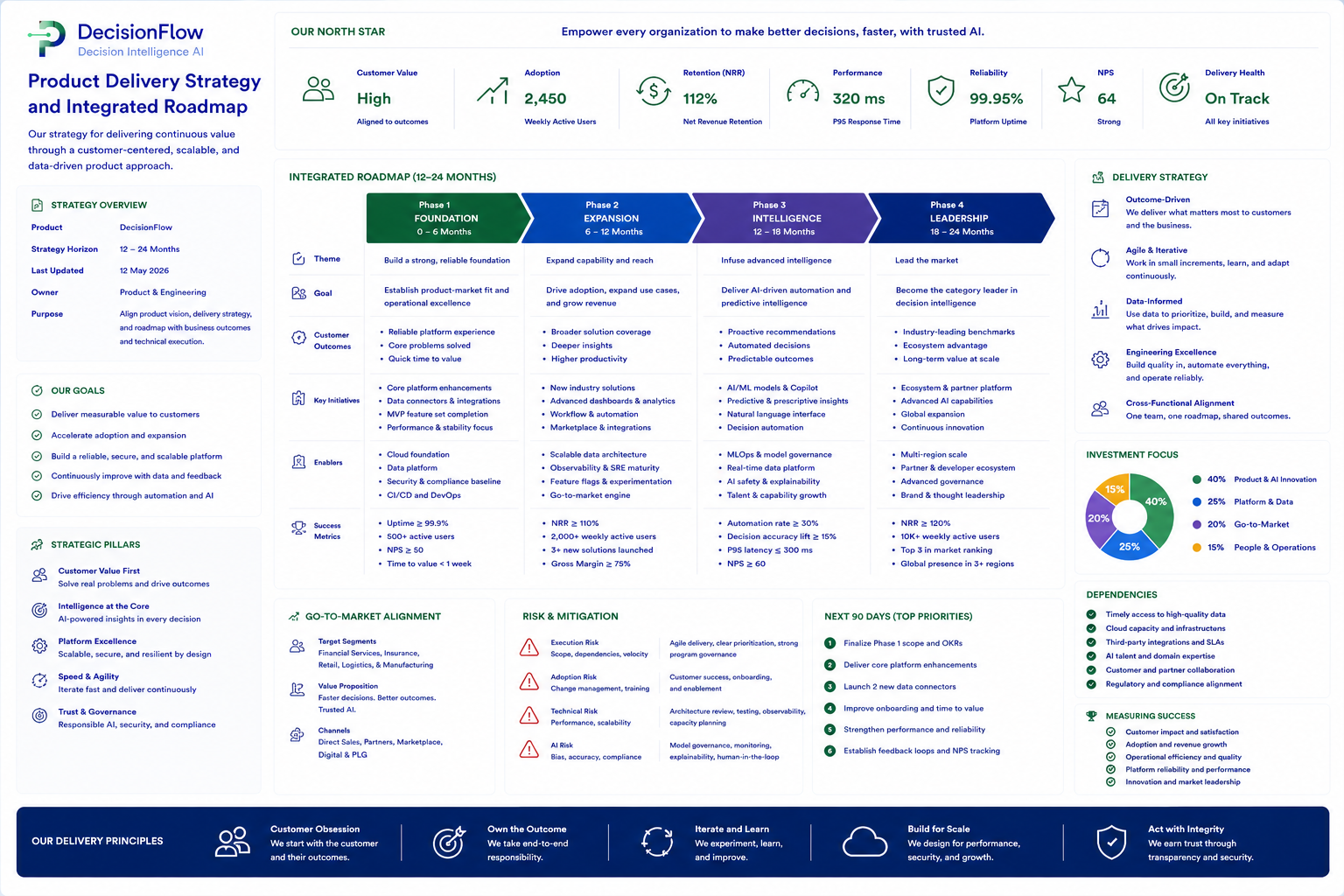
Product Delivery Strategy and Integrated Roadmap
Defines DecisionFlow’s delivery strategy, integrated roadmap, strategic priorities, investment focus, dependencies, risks, success measures, and path for delivering continuous customer value.
Document
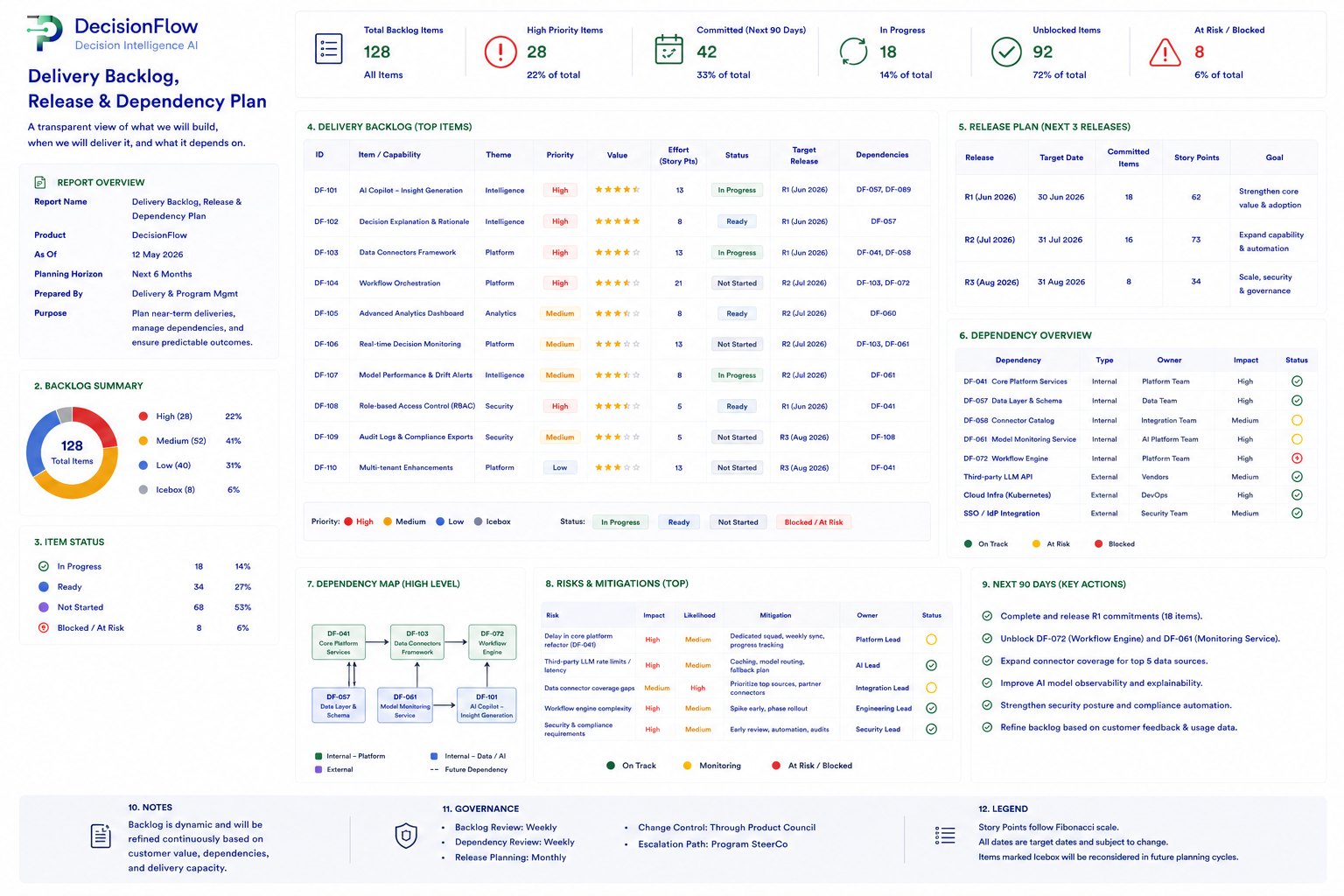
Delivery Backlog Release and Dependency Plan
Defines DecisionFlow’s prioritized delivery backlog, release commitments, dependencies, risks, ownership, sequencing, and near-term execution plan for predictable product delivery.
Document
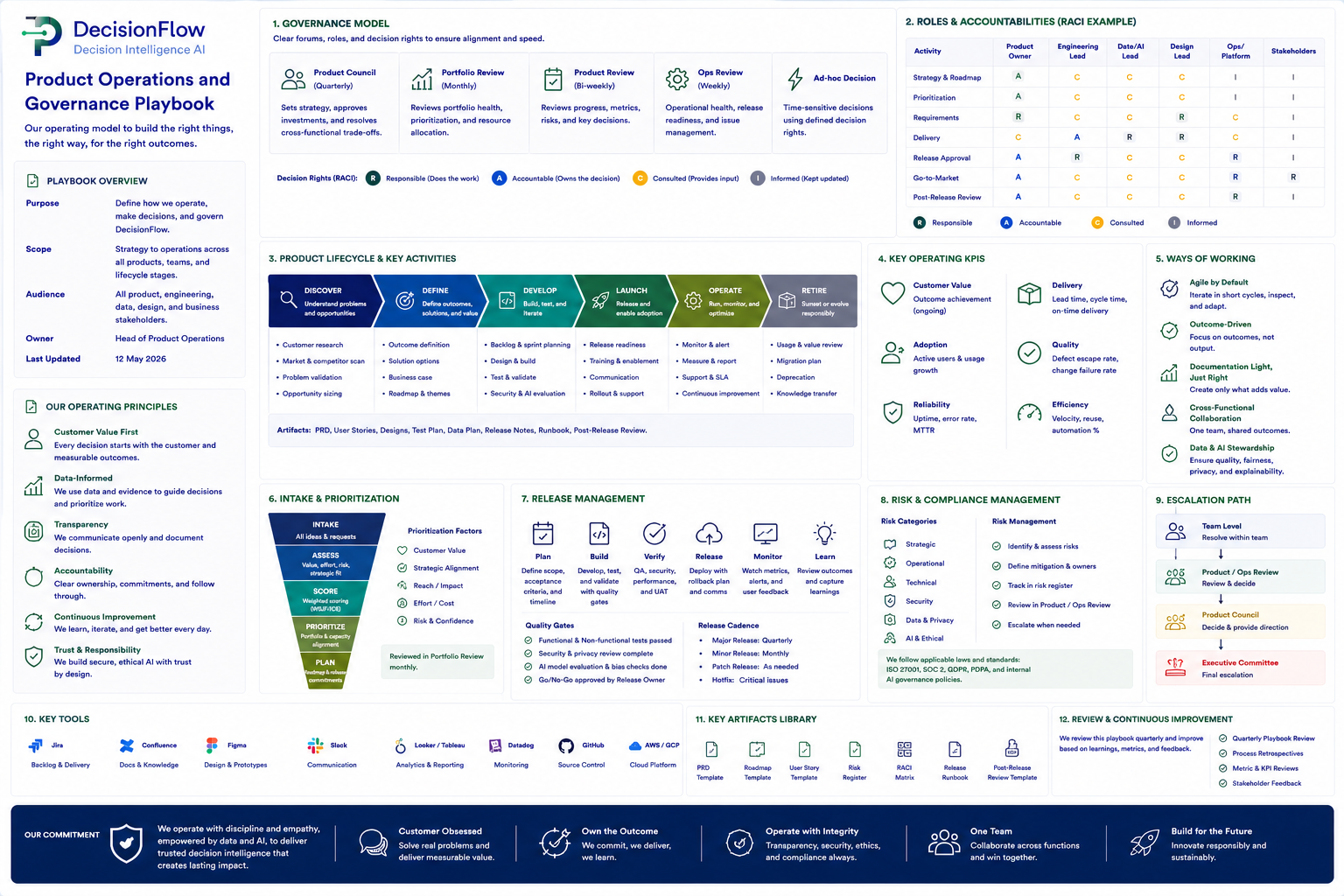
Product Operations and Governance Playbook
Defines DecisionFlow’s operating model, governance forums, decision rights, roles, prioritization, release management, risk controls, KPIs, escalation paths, and continuous improvement practices.
Document
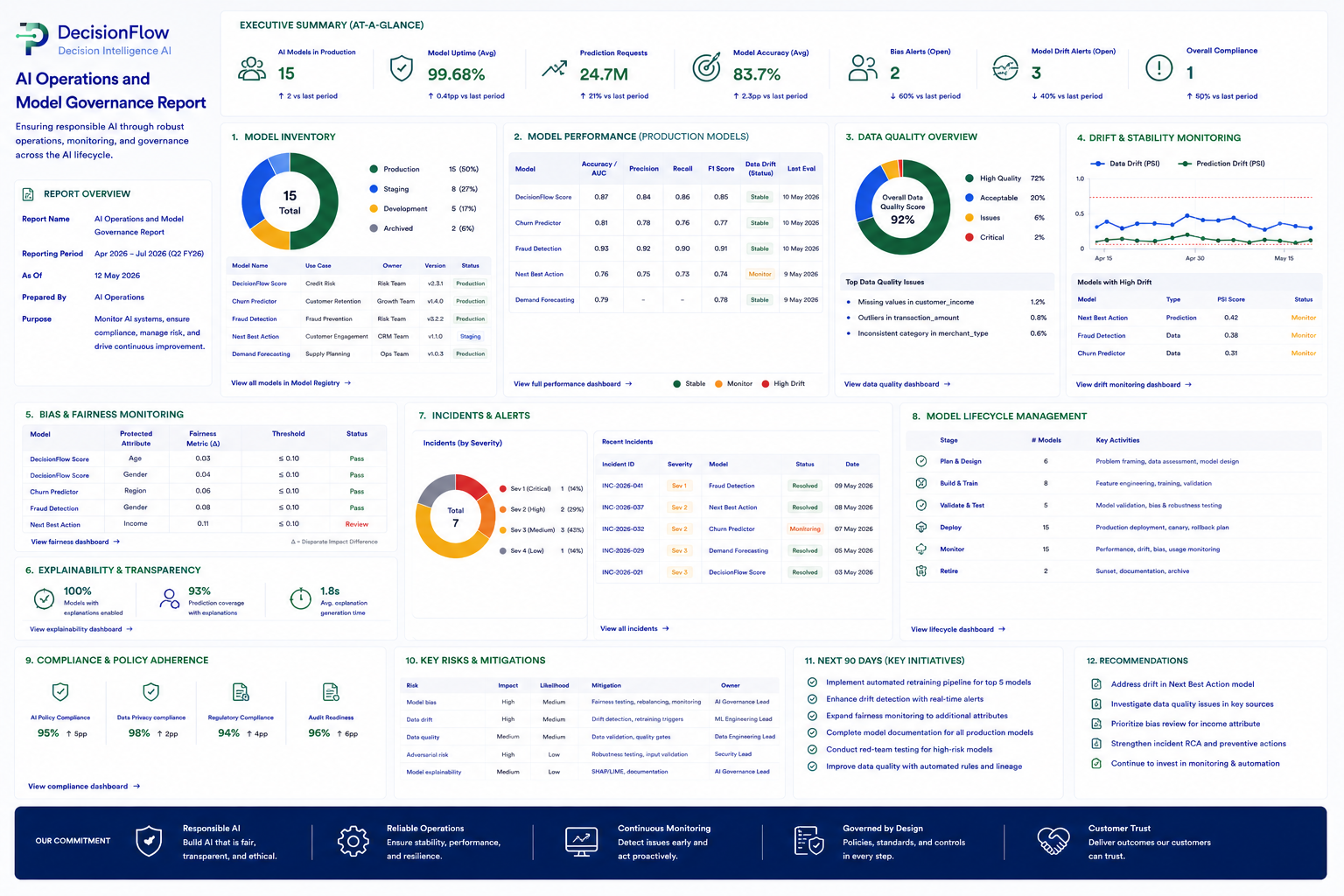
AI Operations and Model Governance Report
Defines how DecisionFlow’s AI models are monitored, governed, versioned, evaluated, secured, and improved across performance, drift, data quality, fairness, explainability, incidents, and lifecycle management.
Document
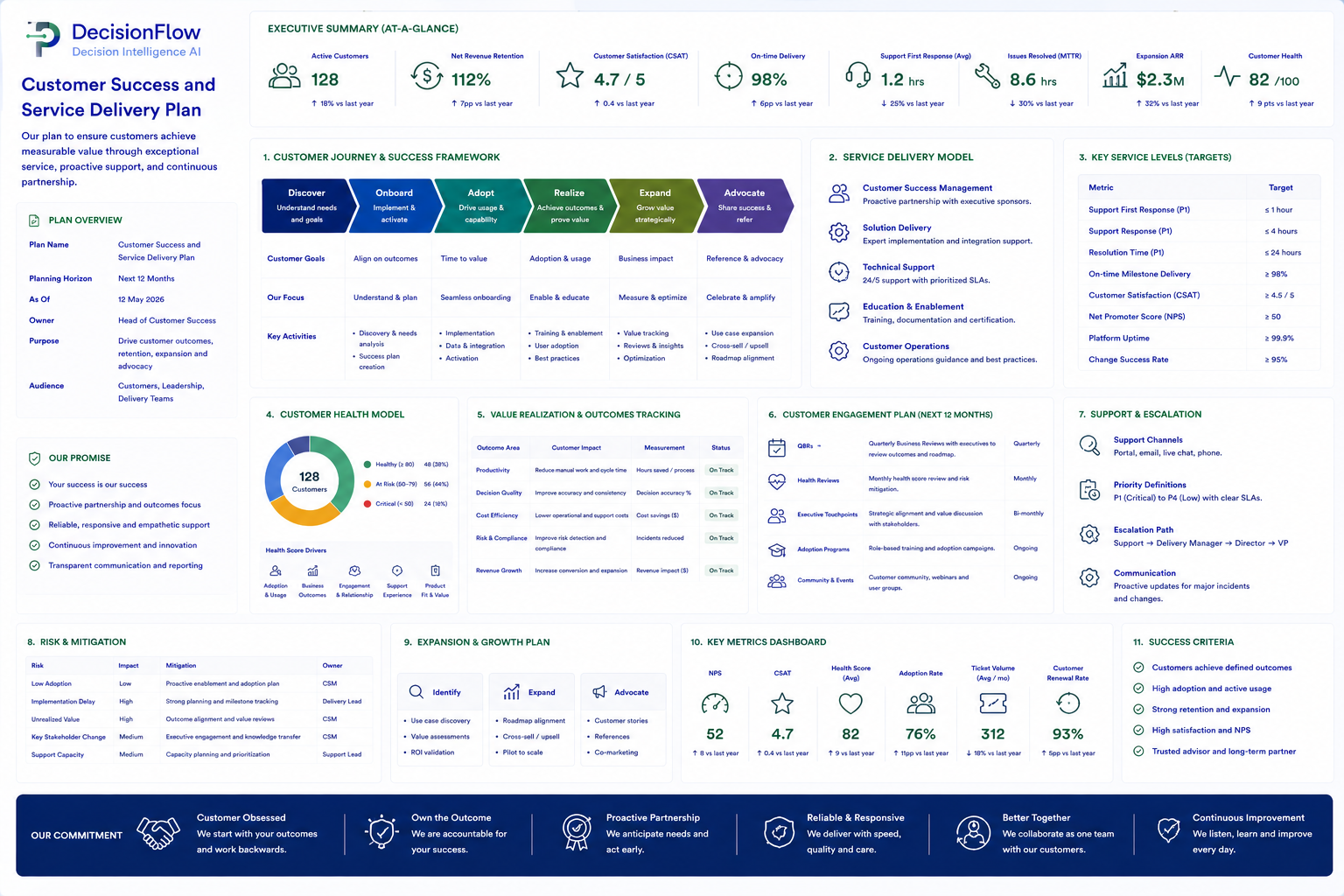
Customer Success and Service Delivery Plan
Defines DecisionFlow’s customer success model, onboarding, service delivery, support, health monitoring, value realization, retention, expansion, and long-term customer engagement.
Document
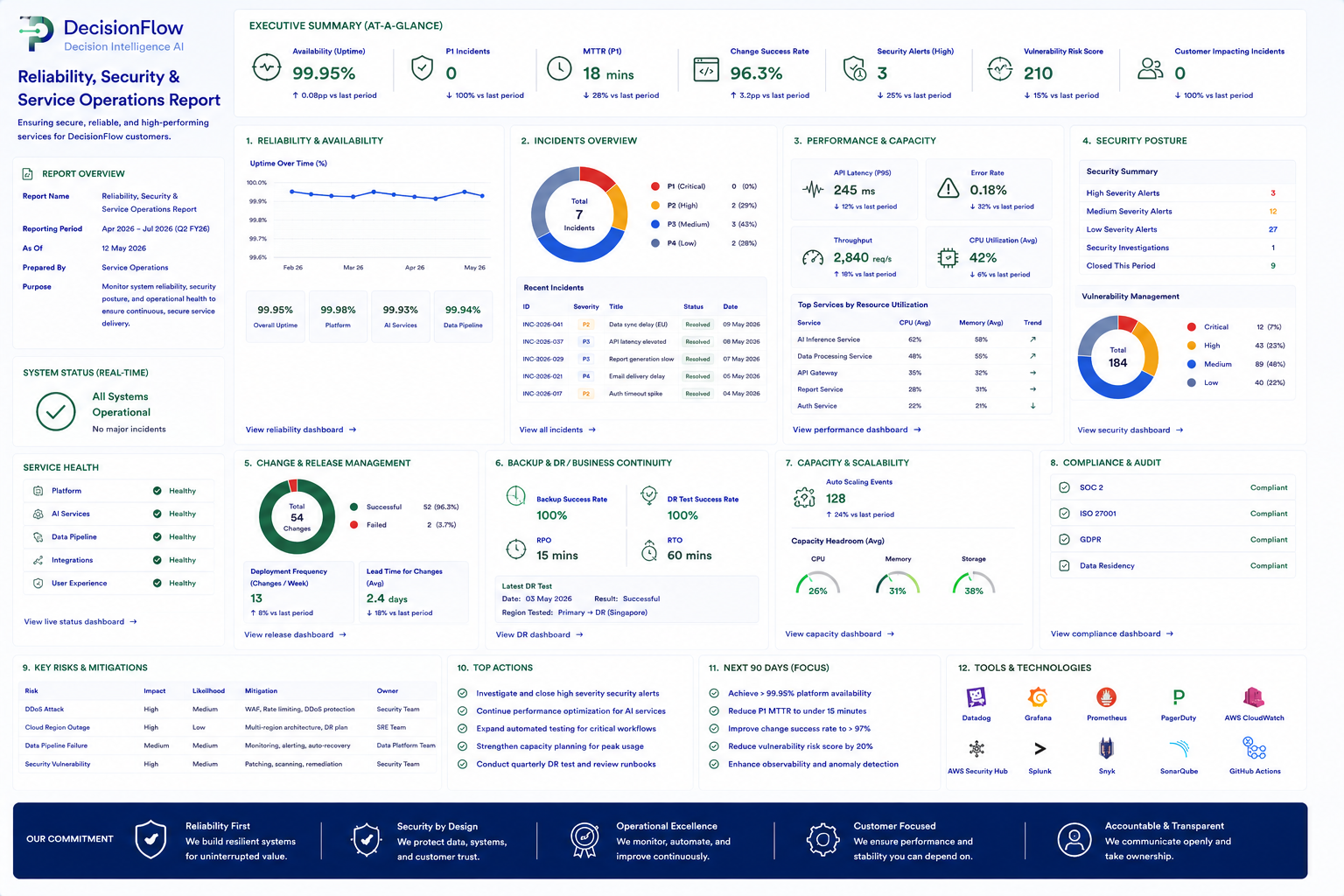
Reliability Security and Service Operations Report
Summarizes DecisionFlow’s reliability, security posture, service operations, incident response, performance, capacity, disaster recovery, compliance, and operational improvement priorities.
Document
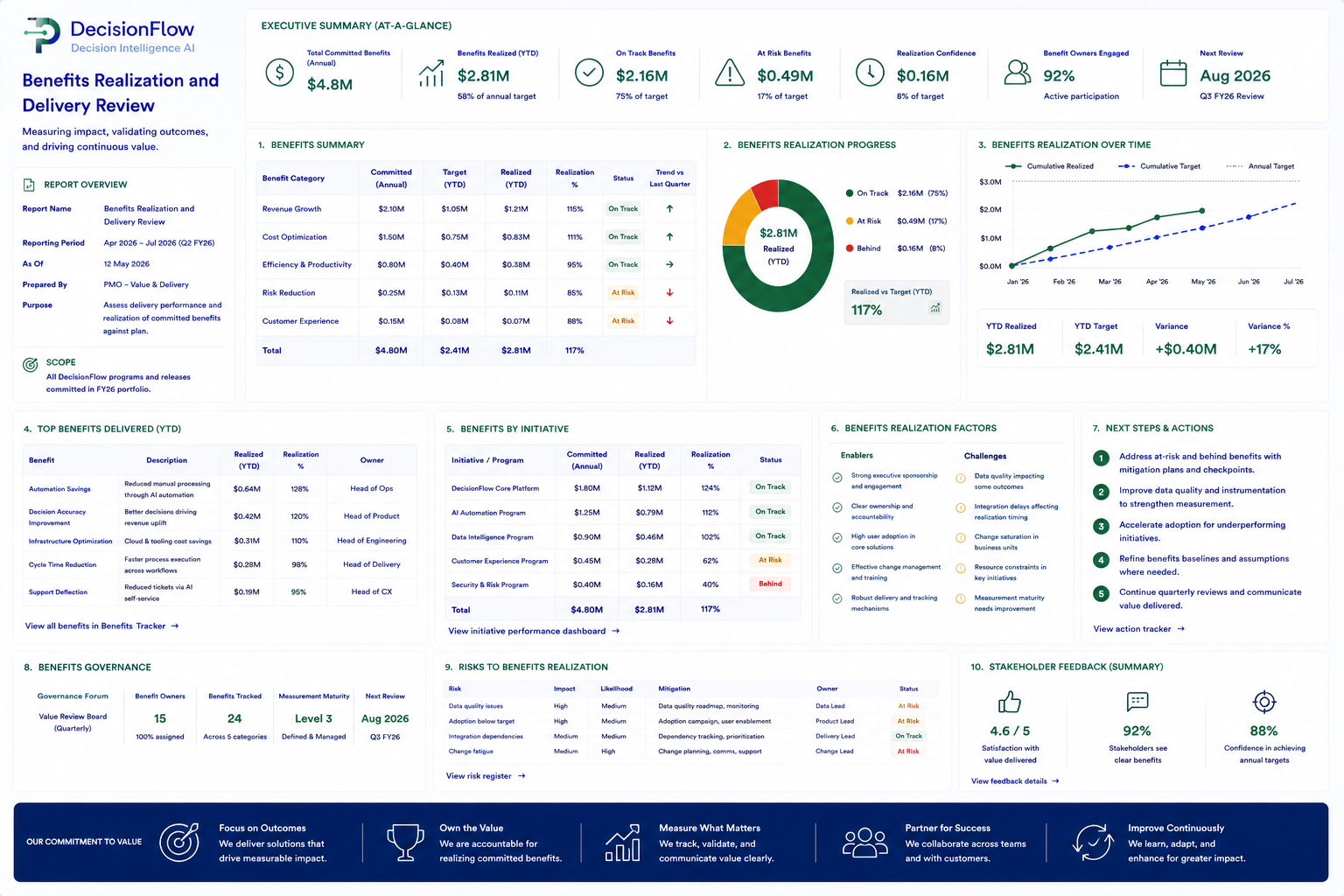
Benefits Realization and Delivery Review
Summarizes DecisionFlow’s delivered benefits, realized business value, progress against targets, customer and operational outcomes, risks, lessons learned, and next actions for continued improvement.
Controlled Scale
Document
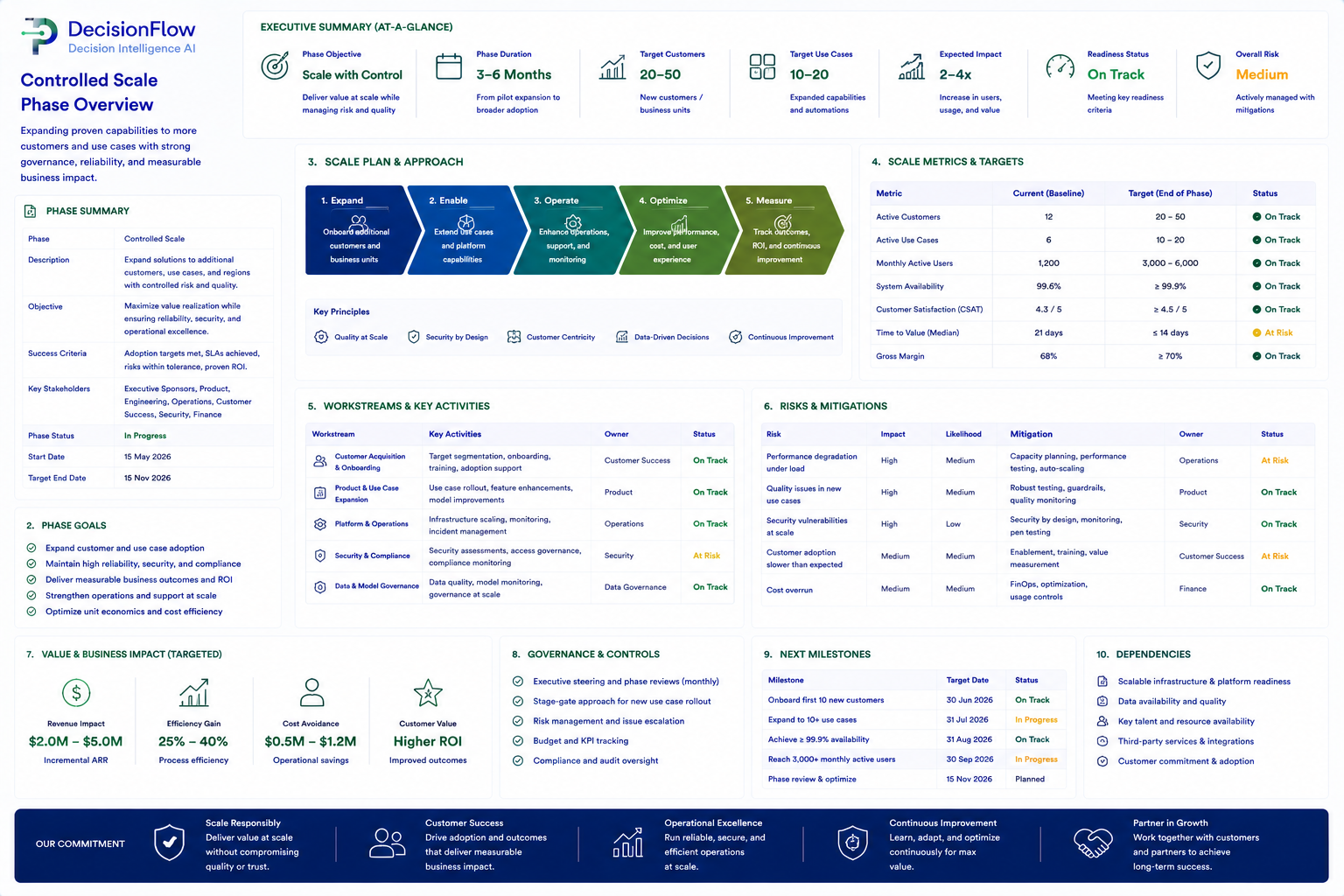
Controlled Scale Phase Overview
Summarizes DecisionFlow’s controlled expansion strategy, target customers and use cases, scale metrics, workstreams, risks, governance, operational controls, and criteria for responsible growth.
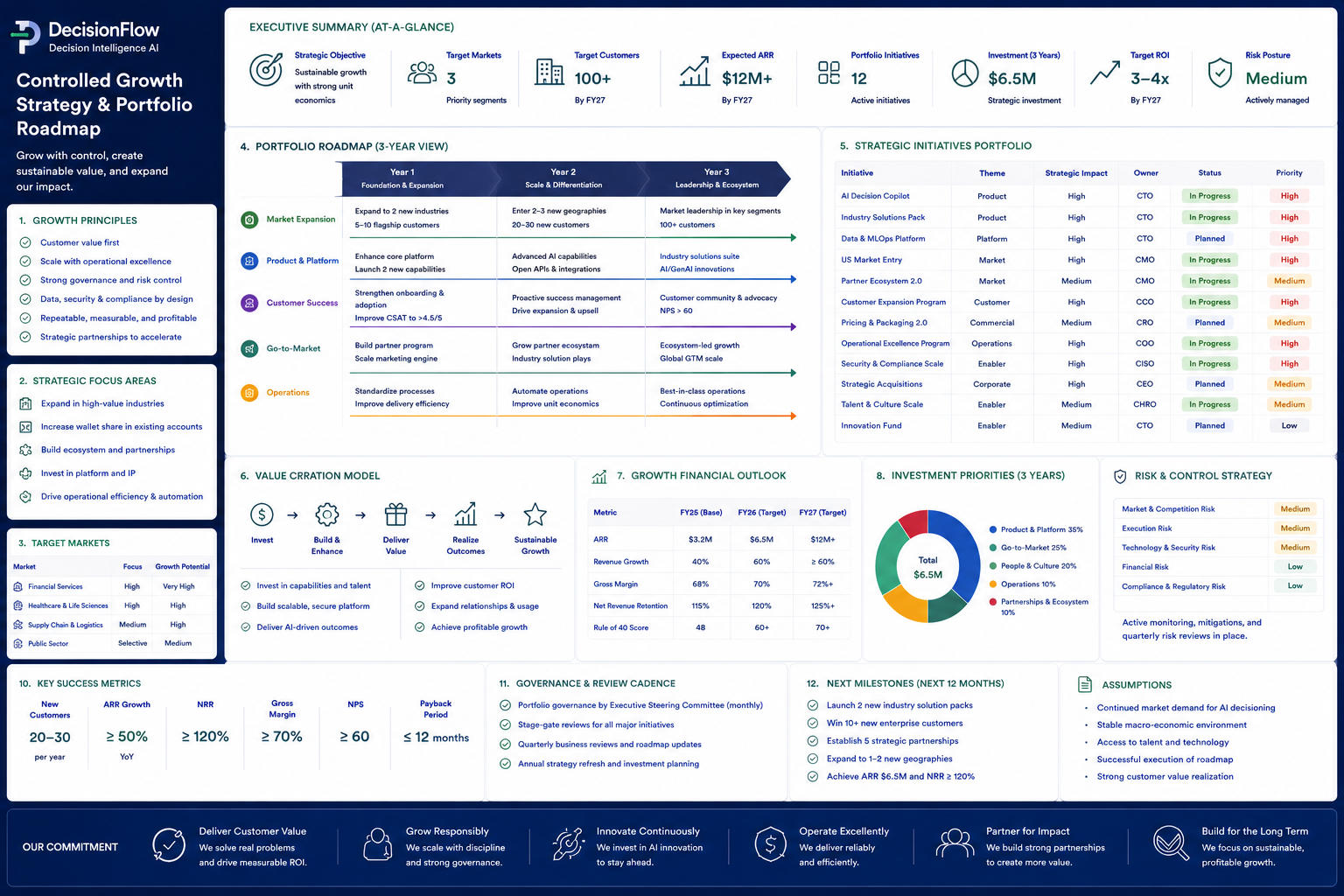
Document
Controlled Growth Strategy and Portfolio Roadmap
Defines DecisionFlow’s controlled growth strategy, target markets, portfolio priorities, investment allocation, financial outlook, governance, risks, and multi-year roadmap for sustainable expansion.
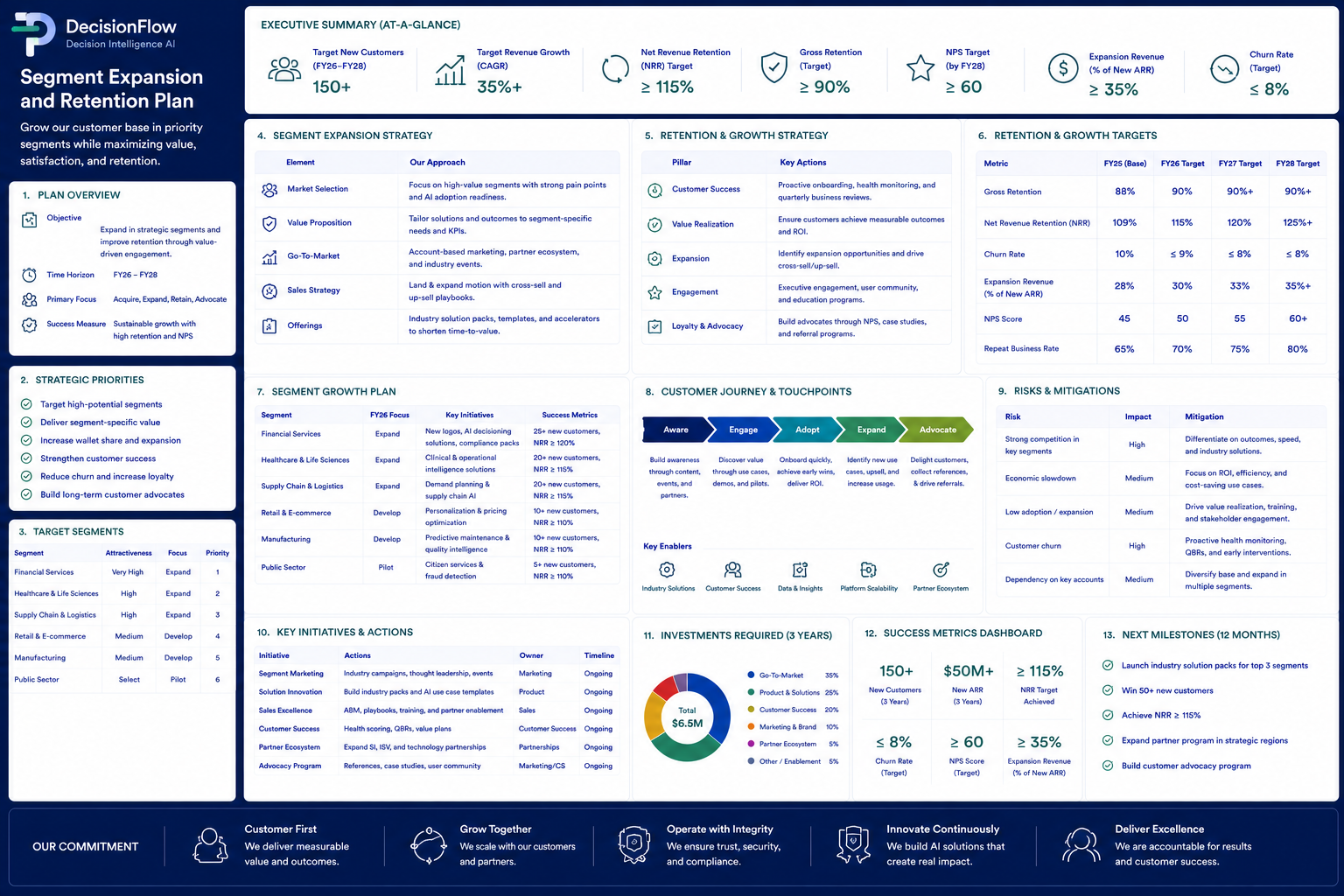
Document
Segment Expansion and Retention Plan
Defines DecisionFlow’s target segment expansion, customer retention strategy, adoption journey, growth initiatives, success metrics, risks, and investment priorities for sustainable customer growth.
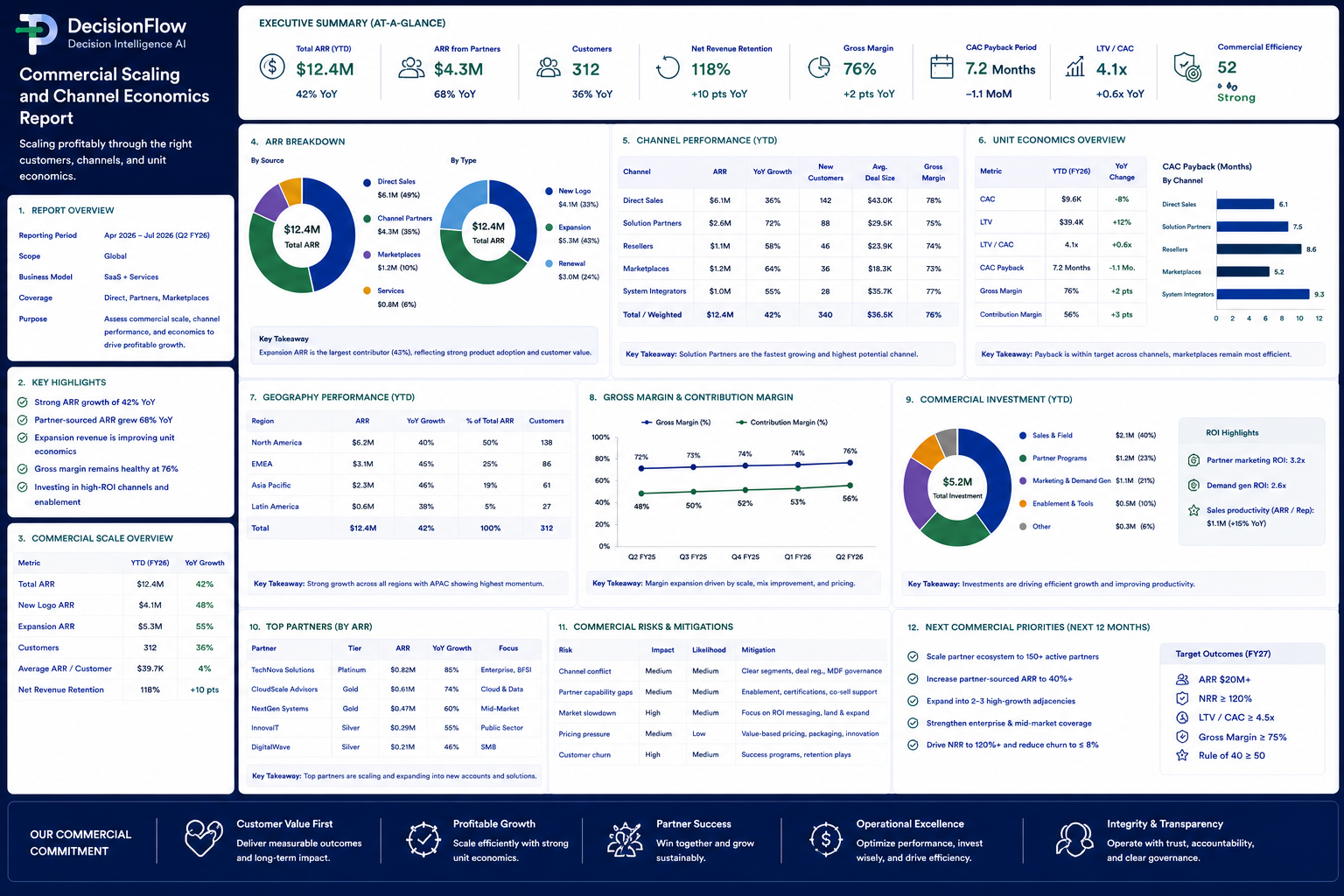
Document
Commercial Scaling and Channel Economics Report
Evaluates DecisionFlow’s commercial growth, channel performance, revenue mix, customer economics, margins, acquisition efficiency, partner contribution, risks, and priorities for profitable scaling.
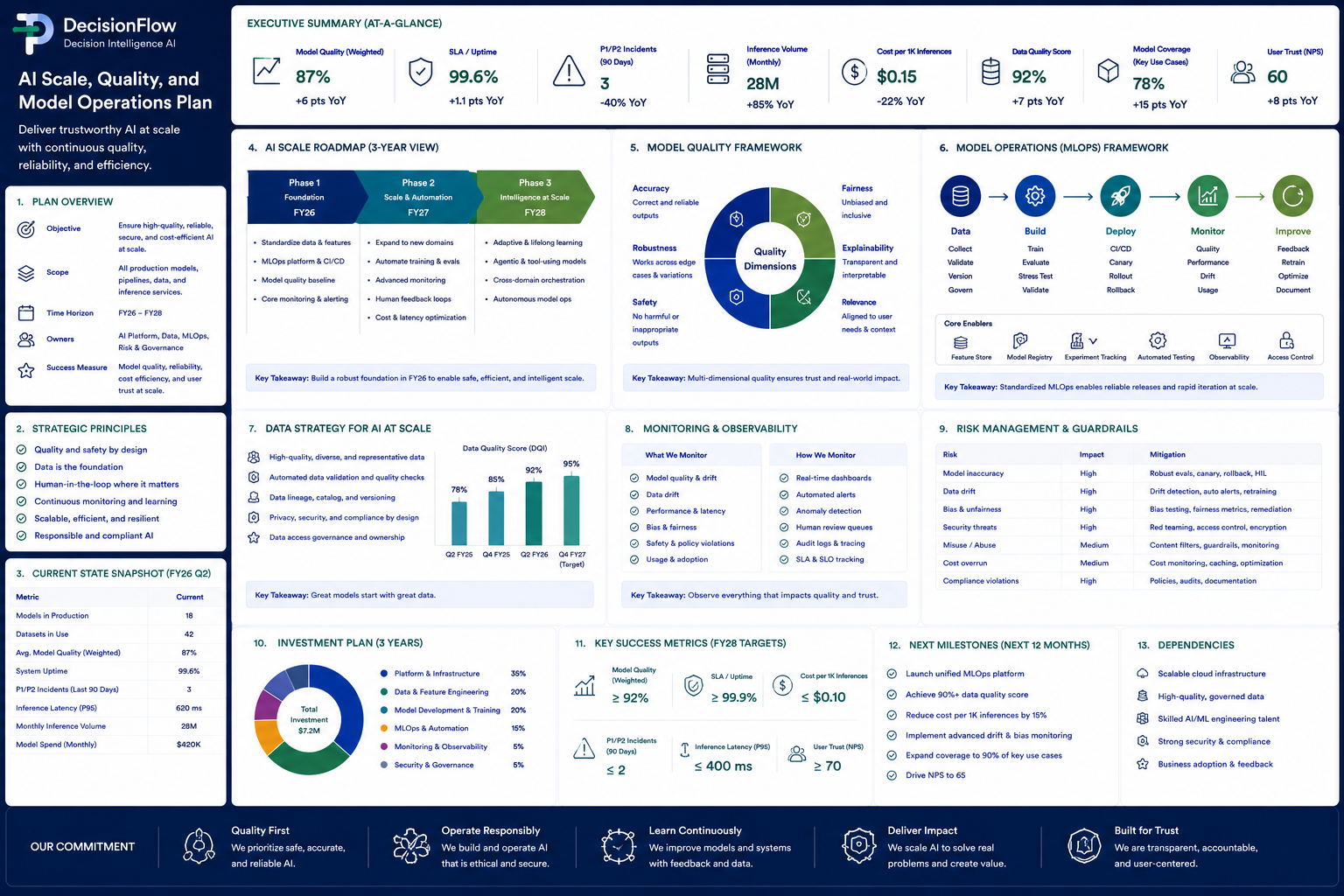
Document
AI Scale Quality and Model Operations Plan
Defines how DecisionFlow scales AI responsibly through model quality standards, MLOps, monitoring, data governance, cost controls, risk management, and continuous improvement.
Document
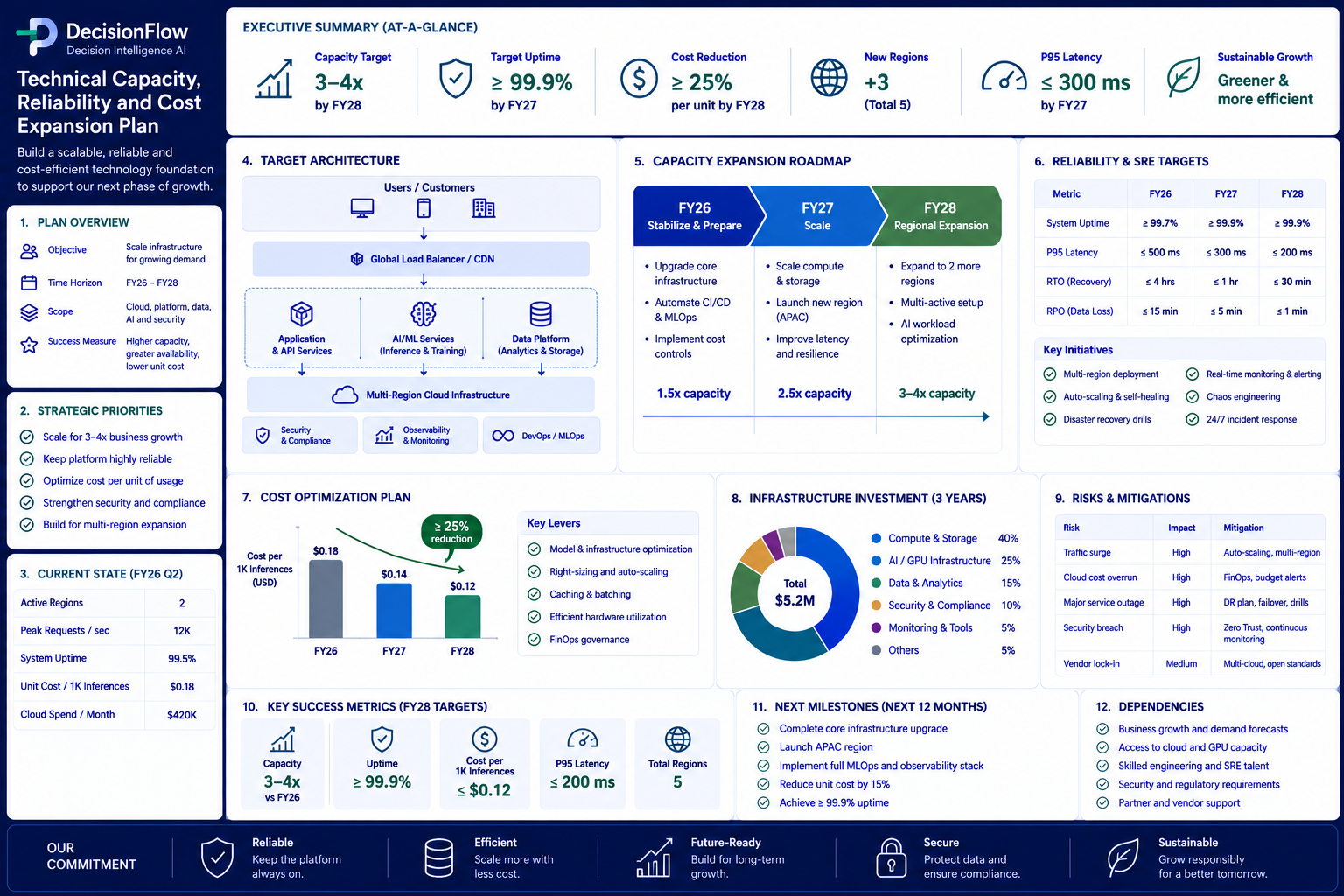
Technical Capacity Reliability and Cost Expansion Plan
Defines DecisionFlow’s capacity expansion, reliability targets, performance goals, cost optimization, infrastructure investment, multi-region scaling, risks, and technical roadmap for sustainable growth.
Document
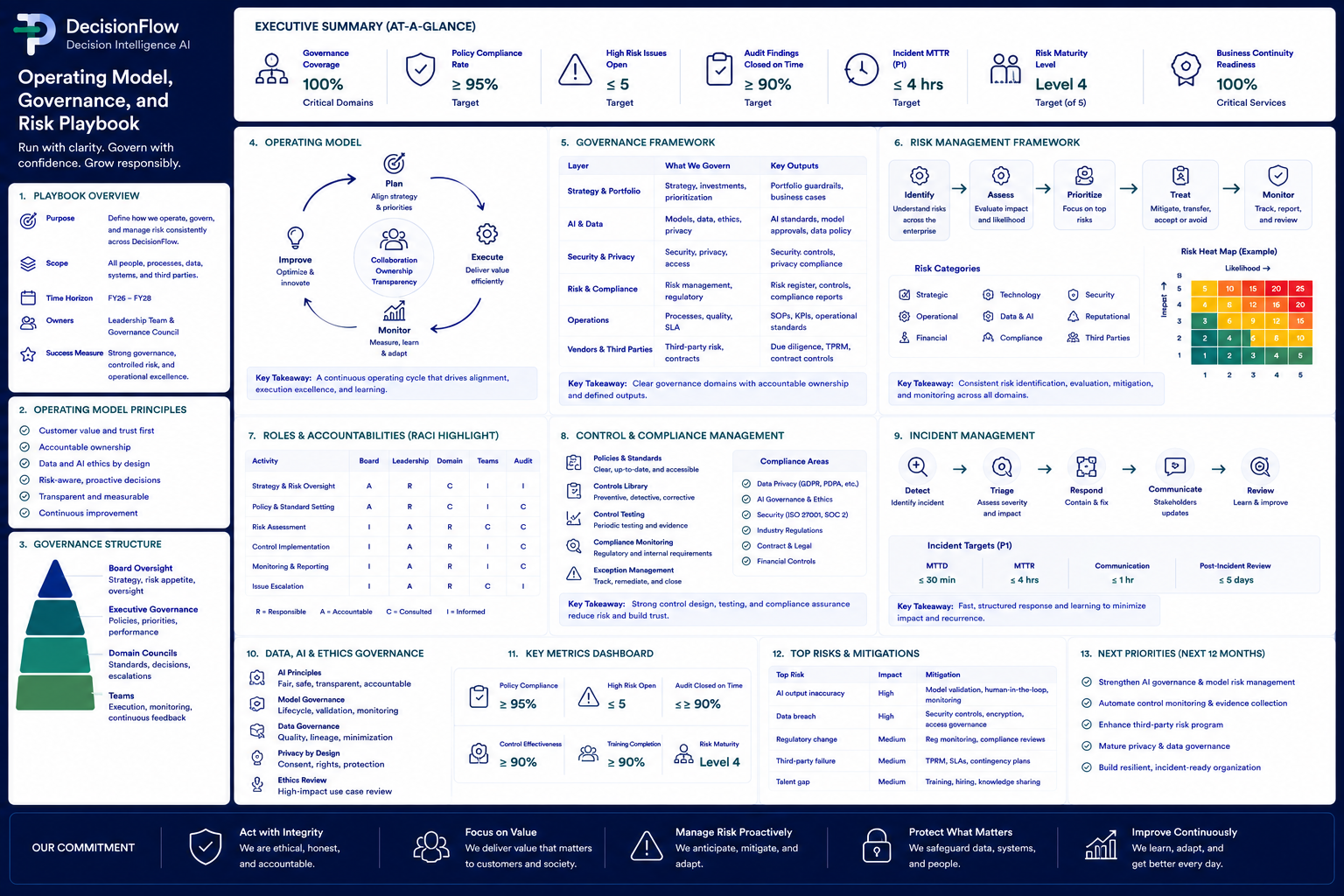
Operating Model Governance and Risk Playbook
Defines DecisionFlow’s operating model, governance structure, decision rights, risk management, compliance controls, incident response, accountability, and continuous improvement practices.
Document
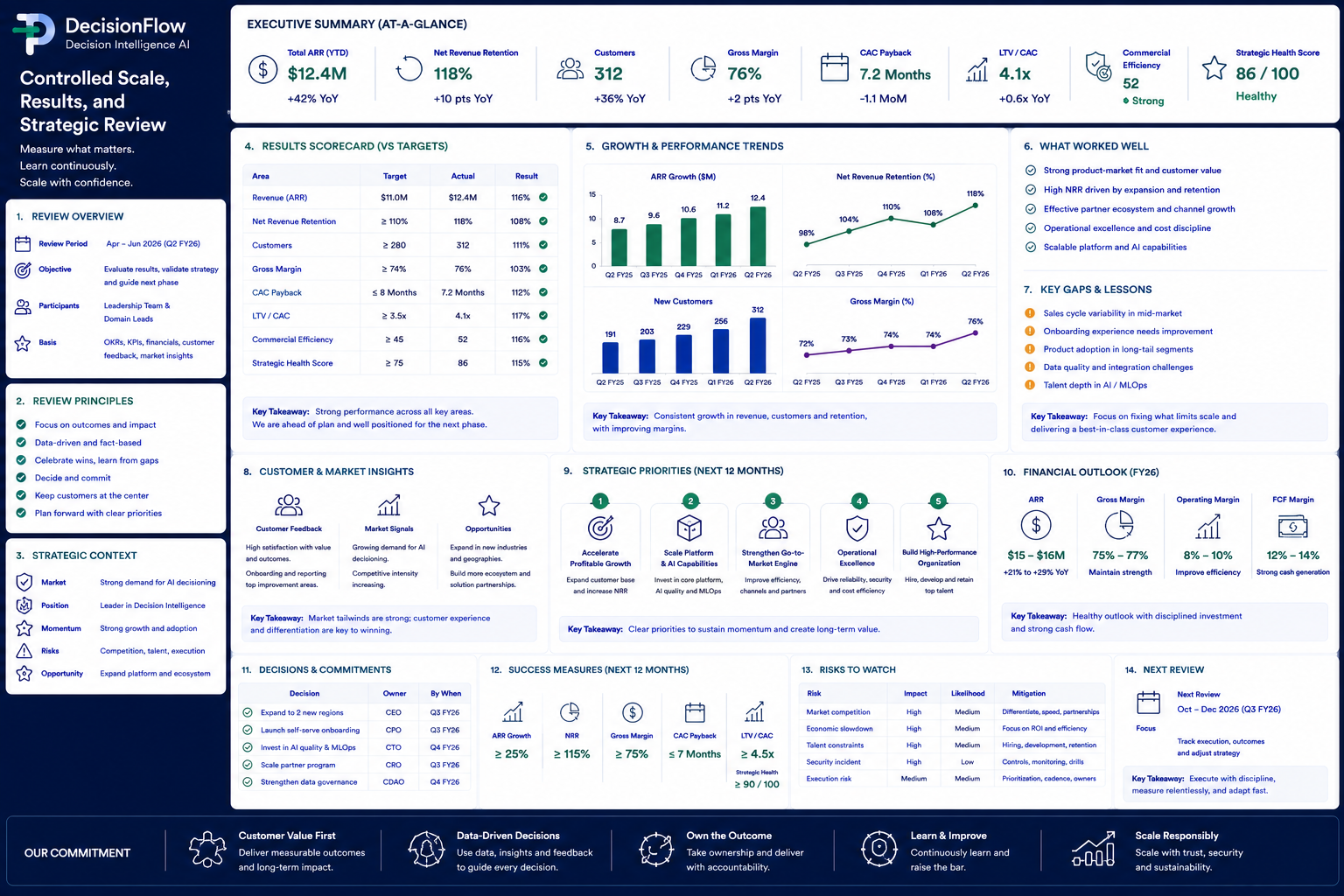
Controlled Scale Results and Strategic Review
Summarizes DecisionFlow’s controlled-scale performance, growth trends, customer and financial outcomes, strategic lessons, key risks, and priorities for the next investment decision.
Retire
Document
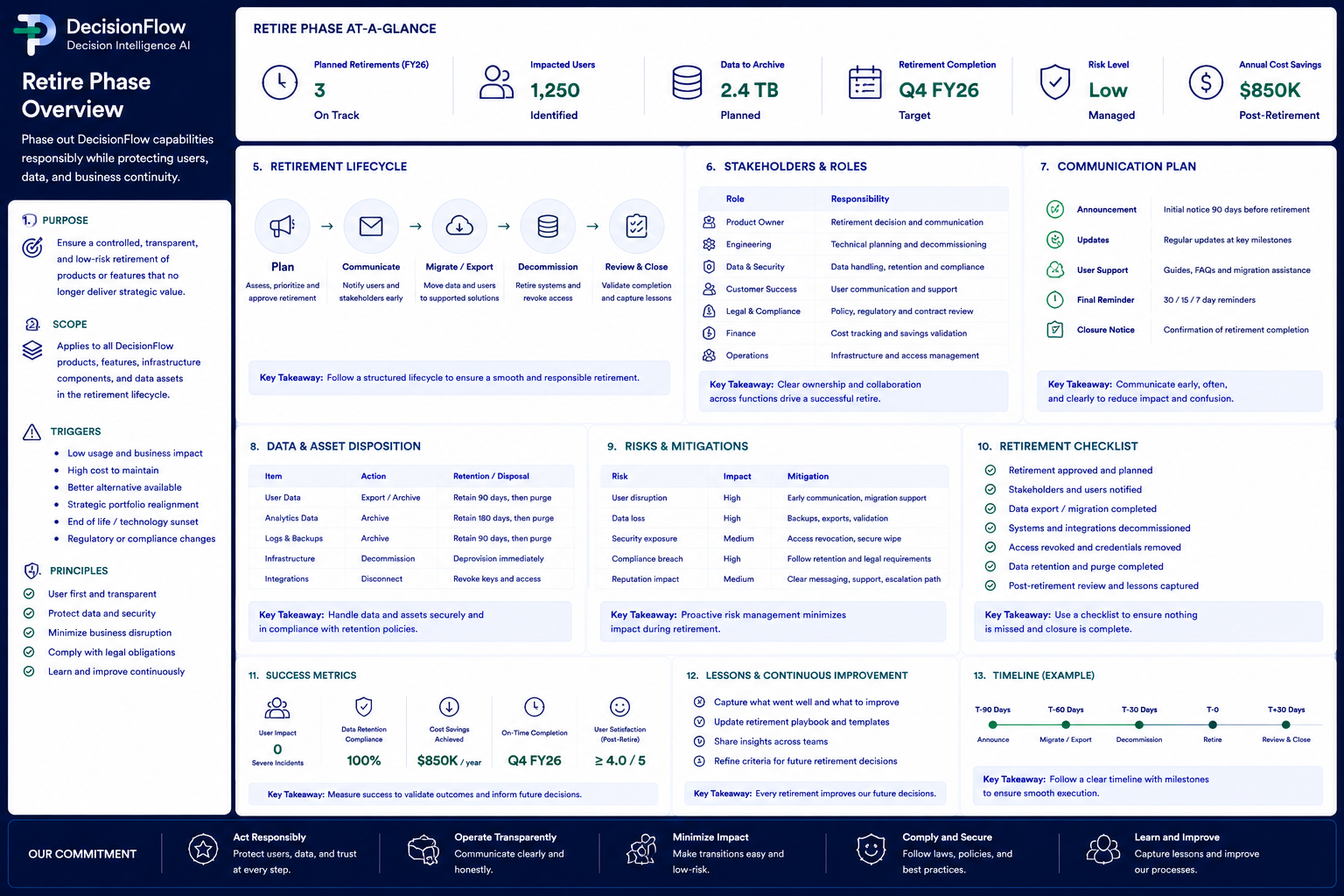
Retire Phase Overview
Summarizes DecisionFlow’s retirement strategy, triggers, customer transition, data handling, system decommissioning, risks, success criteria, timeline, and knowledge-preservation approach.
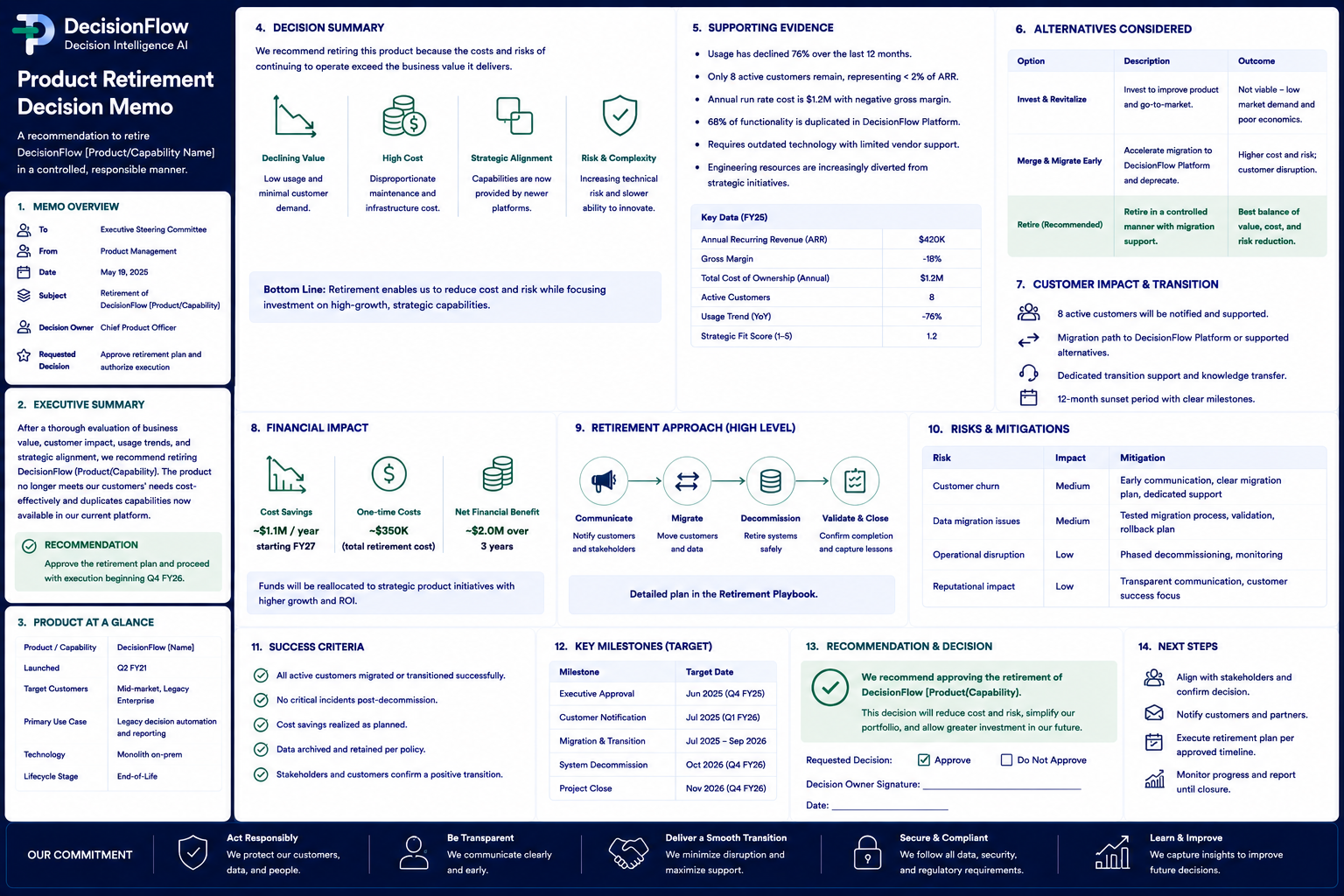
Document
Product Retirement Decision Memo
Explains the evidence, alternatives, financial impact, customer transition, risks, and executive rationale supporting the controlled retirement of DecisionFlow.
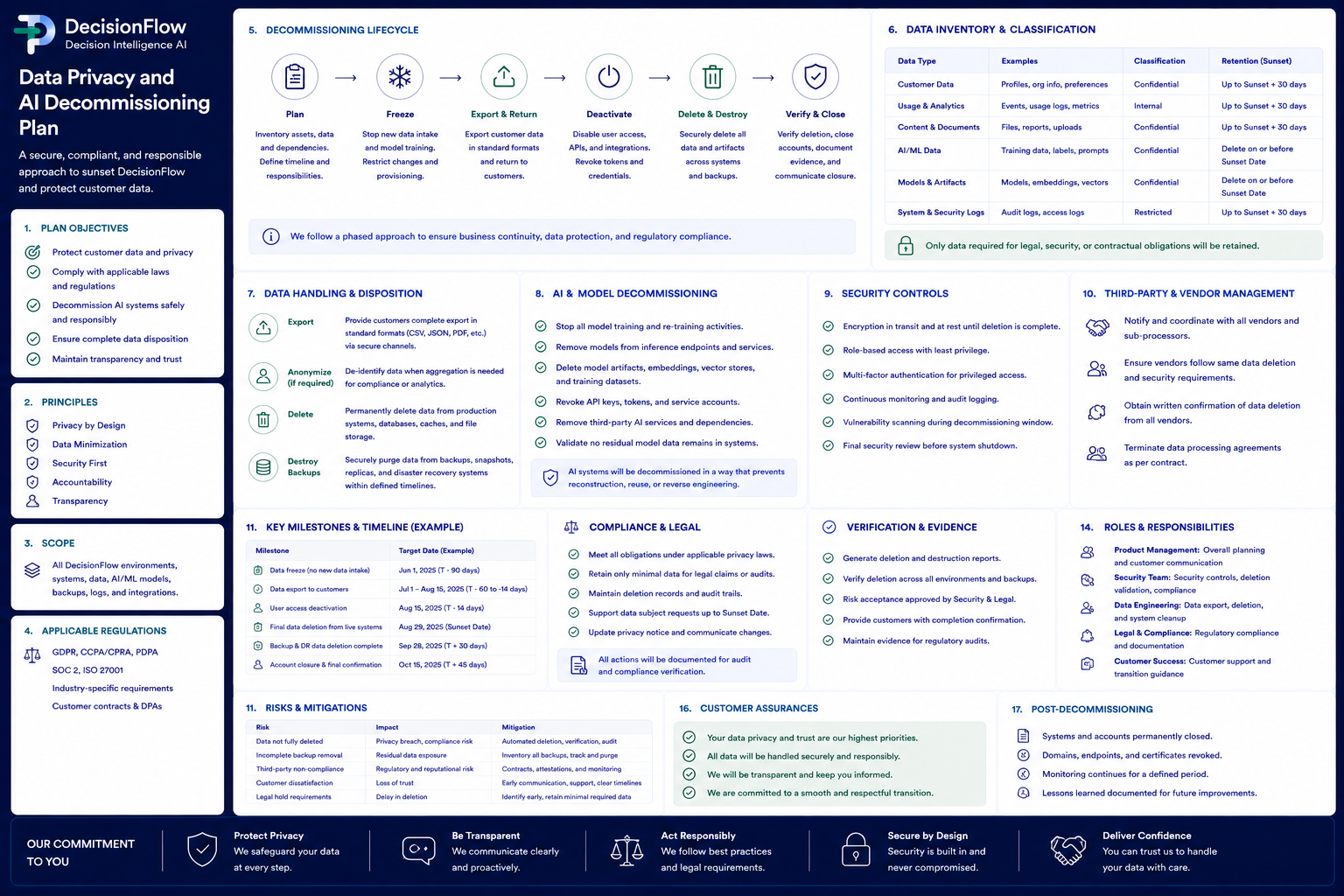
Document
Data Privacy and AI Decommissioning Plan
Defines how DecisionFlow securely exports, retains, deletes, and verifies customer data while decommissioning AI models, credentials, vendors, and supporting systems in compliance with privacy obligations.
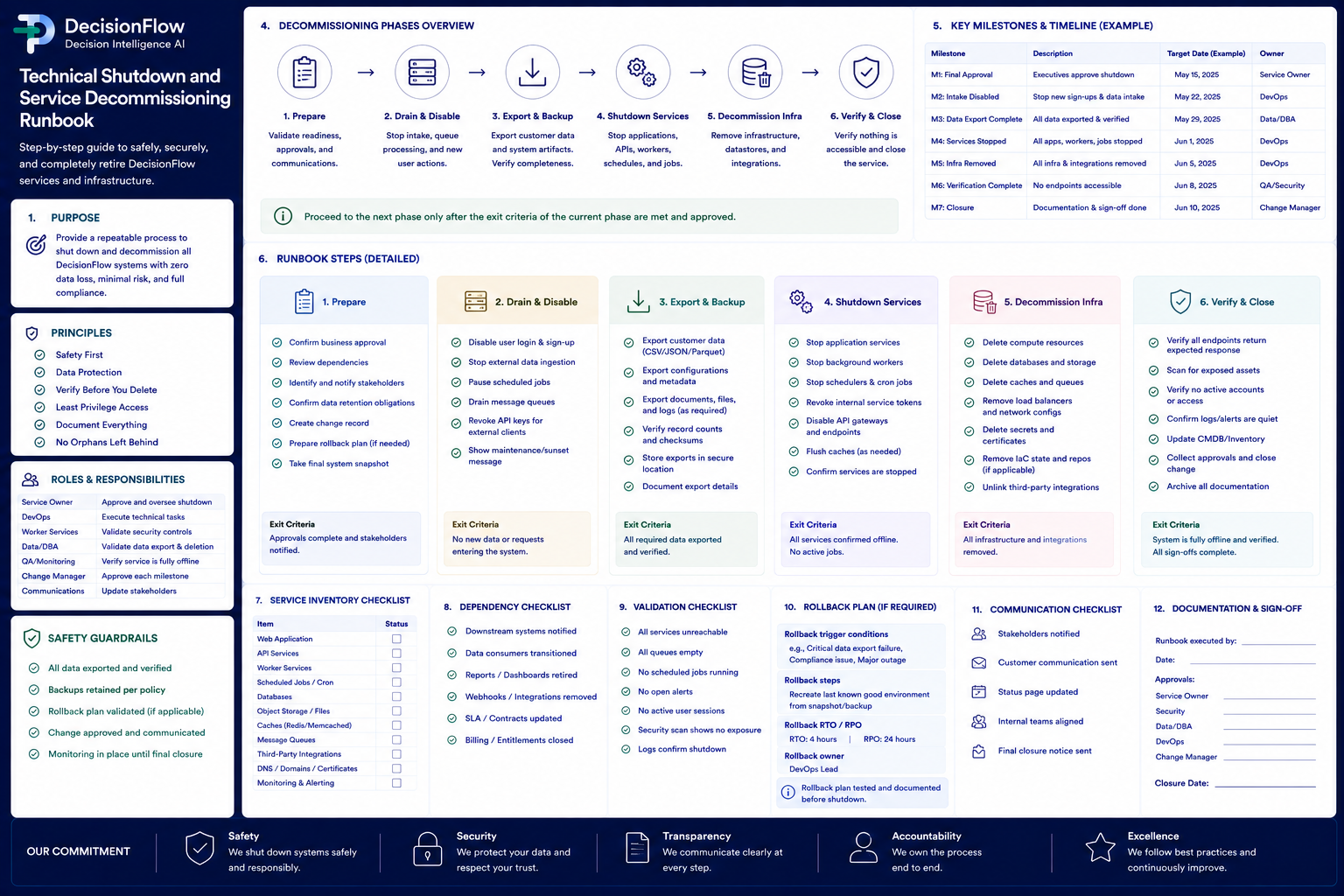
Document
Technical Shutdown and Service Decommissioning Runbook
Provides a step-by-step process for safely disabling DecisionFlow services, exporting and validating data, removing infrastructure, revoking access, verifying shutdown, and completing final sign-off.
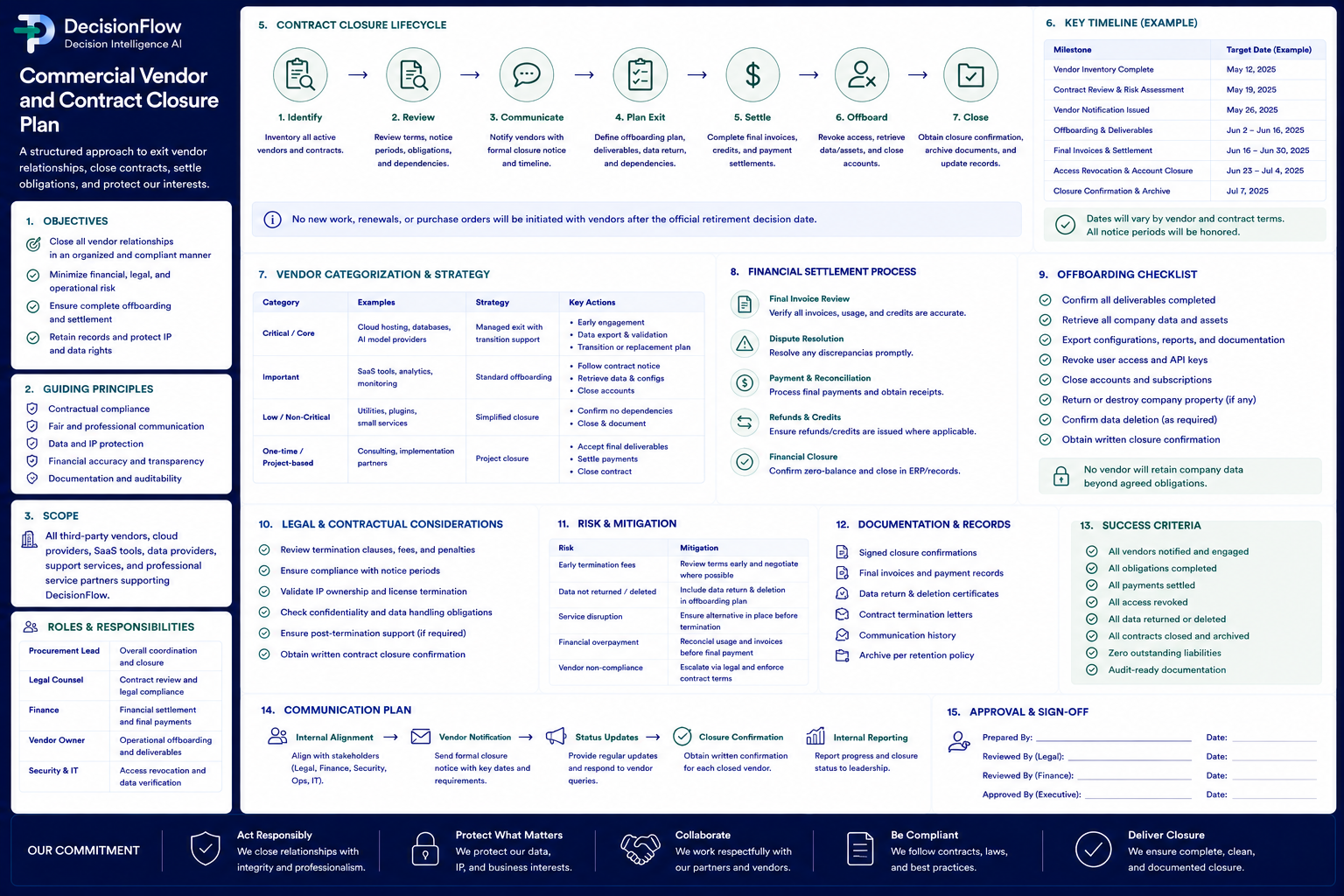
Document
Commercial Vendor and Contract Closure Plan
Defines how DecisionFlow closes vendor relationships and contracts, settles financial obligations, revokes access, protects data and intellectual property, manages risks, and documents final closure.
Document
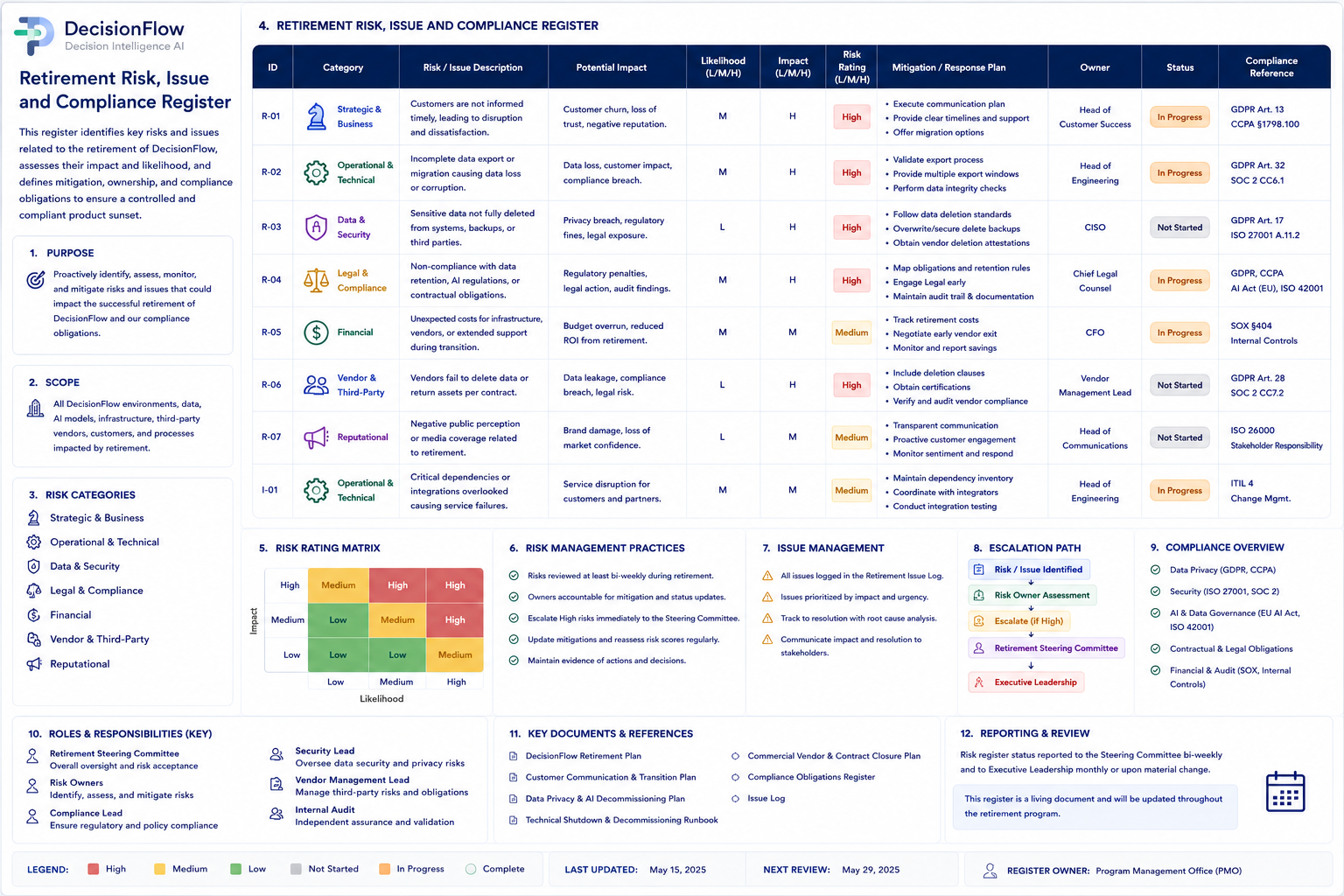
Retirement Risk Issue and Compliance Register
Tracks retirement-related risks, issues, compliance obligations, owners, mitigation actions, escalation paths, and review status to support a controlled and accountable product sunset.
Document
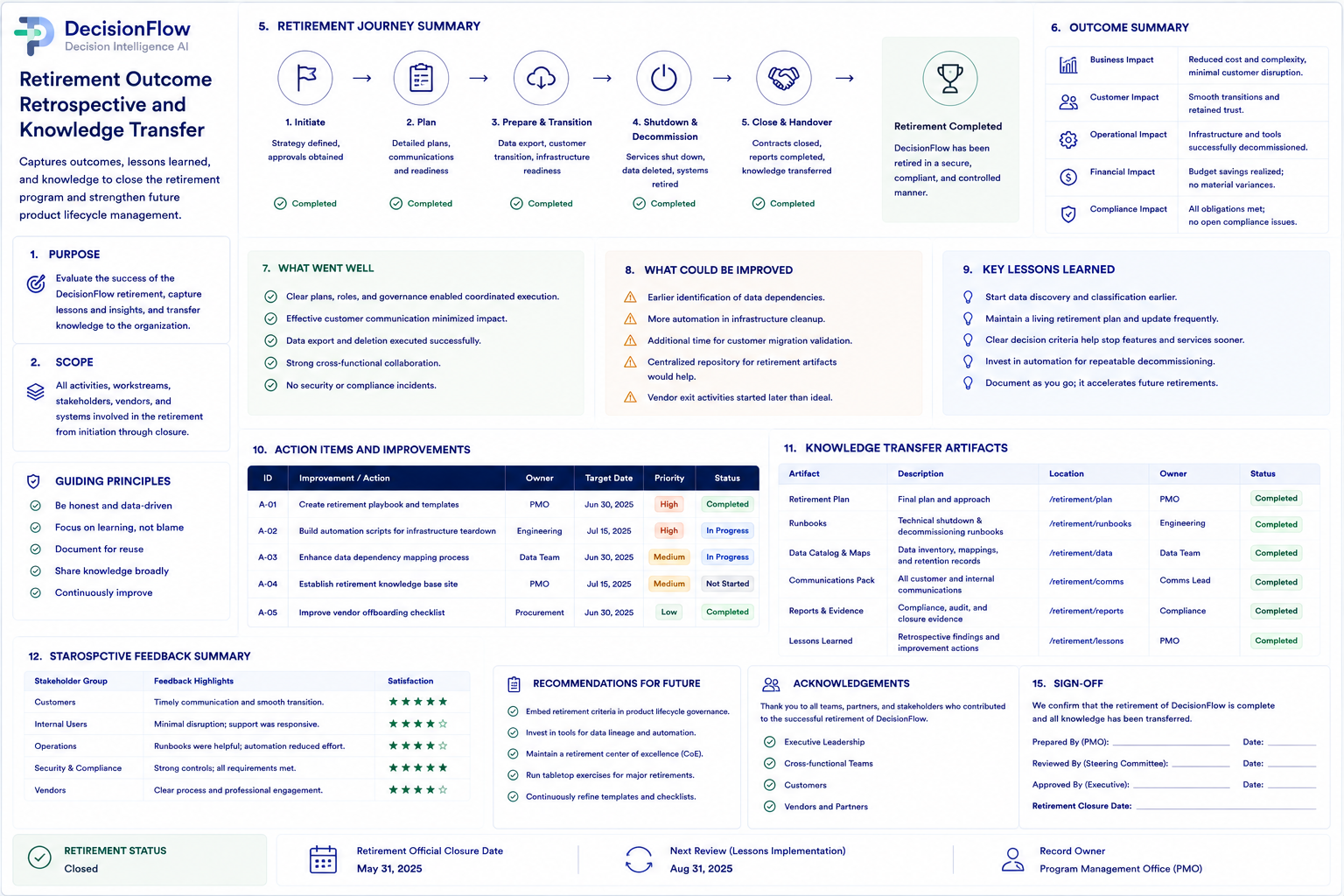
Retirement Outcome Retrospective and Knowledge Transfer
Summarizes DecisionFlow’s retirement outcomes, customer and operational impact, lessons learned, improvement actions, knowledge-transfer artifacts, and final closure status.