Confidential Enterprise AI Product — Blockchain Fraud Detection and Transaction Monitoring
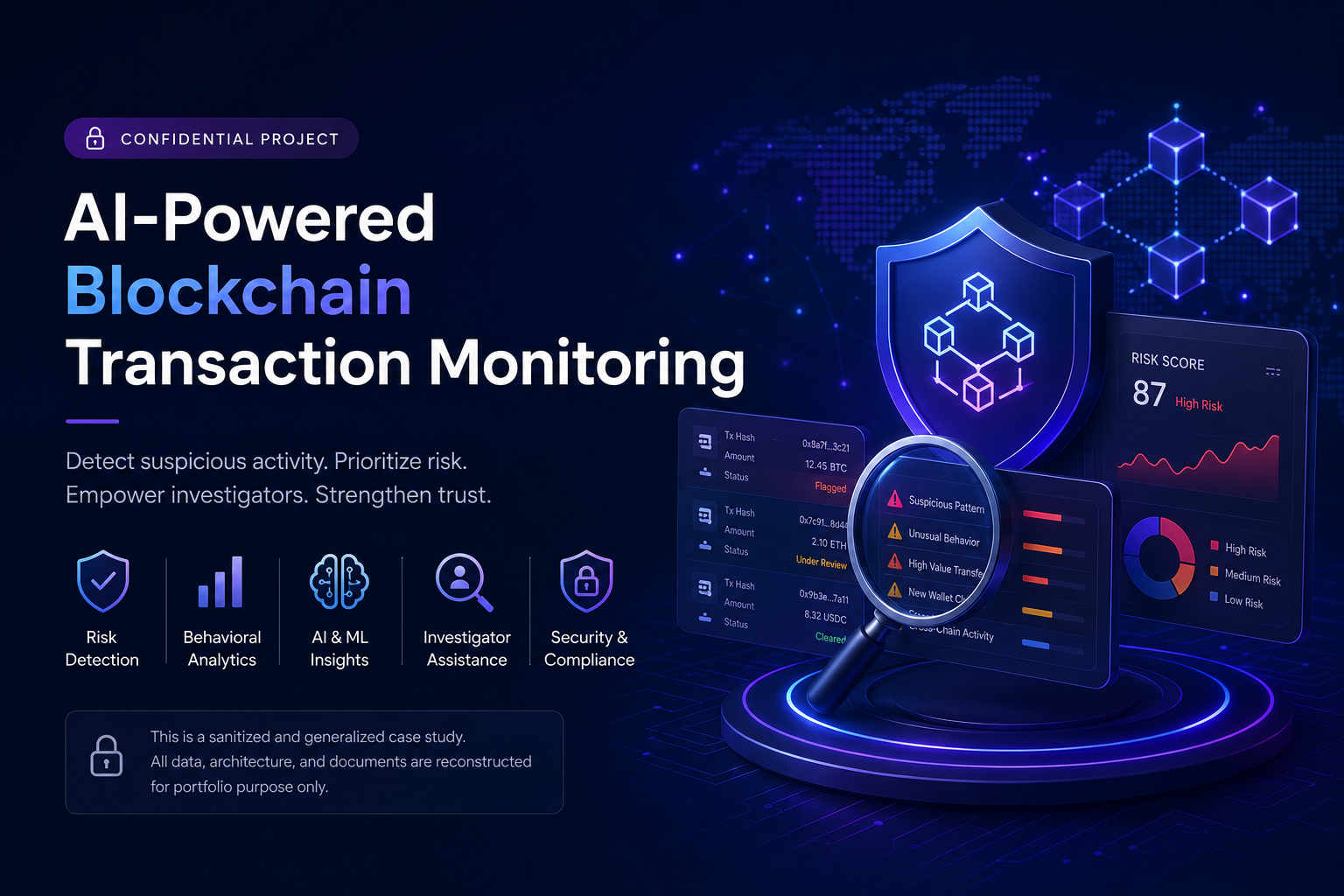
AI-Powered Blockchain Transaction Monitoring System
Led the product strategy and high-level solution design for an AI-assisted blockchain transaction monitoring system that helped fraud and compliance teams identify suspicious activity, prioritize high-risk alerts, and investigate cases more efficiently.
- Role
- AI Product Manager & Solution Architect
- Project type
- Confidential Enterprise AI Product — Blockchain Fraud Detection and Transaction Monitoring
- Status
- Completed
- Organization
- Confidential Blockchain Company
- Timeline
- 2025-11-02 — 2026-07-01
- Team
- Cross-functional collaboration with fraud and compliance specialists, blockchain engineers, backend engineers, data engineers, machine-learning engineers, security stakeholders, operations teams, and business leadership. Team size, internal structure, and individual identities are withheld for confidentiality.
- Confidentiality
- High — NDA-Protected
- Published
- published
Product walkthrough
Selected screens
Confidentiality note
This case study is a sanitized and generalized reconstruction of a confidential enterprise project. The visuals and documents were recreated from memory to demonstrate my product-management and solution-design process. They do not contain the company’s source code, production data, exact architecture, internal PRD, model configuration, security controls, transaction thresholds, proprietary logic, or confidential performance results.
Project overview
This confidential enterprise project focused on improving the monitoring of blockchain transactions and supporting fraud investigation teams.
I worked across AI product management and solution architecture, translating business and compliance challenges into product requirements, analyst workflows, AI capabilities, and a high-level system design.
The proposed solution combined rule-based monitoring, behavioral analytics, anomaly detection, risk scoring, case management, and generative AI assistance. The generative AI layer was designed to summarize transaction activity, explain risk indicators, and help investigators understand complex transaction patterns. It was not intended to make autonomous enforcement decisions.
Due to confidentiality obligations, the architecture diagrams, workflows, and product documents shown in this portfolio are sanitized and reconstructed from memory. They do not represent the company’s exact production architecture, internal documentation, model configuration, or proprietary implementation.
Business problem
Blockchain platforms process large volumes of transactions across interconnected wallets, accounts, networks, and external services. Traditional rule-based monitoring can identify known suspicious patterns, but it may generate high volumes of false-positive alerts, provide limited behavioral context, and struggle to detect new or evolving fraud patterns. Fraud analysts therefore face several challenges: Too many alerts requiring manual review Limited prioritization of genuinely high-risk cases Fragmented transaction and wallet information Difficulty understanding complex fund movement Limited explanations behind automated risk scores Time-consuming investigation and documentation Constantly evolving fraud behavior The business needed a scalable monitoring capability that could combine known fraud rules with behavioral analytics, anomaly detection, and investigator-friendly explanations.
Product objective
Design an AI-assisted transaction monitoring product that helps fraud and compliance teams identify suspicious blockchain activity, prioritize high-risk cases, understand why alerts were generated, and complete investigations more efficiently. The product should improve analyst decision-making while maintaining human oversight, explainability, auditability, privacy, and compliance controls.
Product approach
I used a human-centered and risk-based product approach. The product design began with the fraud analyst journey: receiving alerts, reviewing risk indicators, investigating transaction relationships, gathering evidence, consulting AI-generated explanations, and deciding the next action. Rather than treating AI as a single fraud-detection model, I designed the product as a layered decision-support system: Transaction and wallet data are collected and validated. Behavioral and network-based features are generated. Deterministic rules detect known suspicious patterns. Machine-learning models identify anomalies and complex behavioral risk. Risk signals are combined into a prioritized alert score. Fraud analysts review the evidence and explanations. Generative AI assists with summaries, investigation guidance, and report preparation. Analyst feedback supports model and rule improvement. The approach intentionally kept humans responsible for consequential investigation and enforcement decisions.
Solution summary
The solution was designed as a layered AI-assisted transaction monitoring platform. Blockchain transactions, account activity, wallet relationships, historical behavior, identity signals, and relevant external risk indicators enter a secure ingestion and processing layer. The analytics layer applies: Known fraud and compliance rules Behavioral feature engineering Anomaly detection Supervised risk classification where appropriate Wallet and transaction relationship analysis Combined risk scoring Alert prioritization High-risk activity is sent to an investigation workspace where analysts can review transaction history, connected wallets, risk indicators, timelines, evidence, and case status. A generative AI assistant supports investigators by: Summarizing complex transaction activity Explaining the factors contributing to an alert Highlighting relevant transaction relationships Suggesting investigation questions Producing structured case notes Assisting with investigation report preparation The final decision remains with authorized fraud and compliance professionals.
Target users
- Senior fraud analysts
- Transaction monitoring analysts
- Compliance investigators
- Risk and compliance managers
- Security operations teams
- Case management teams
- System administrators
- Business and regulatory stakeholders
Selected product decisions
Use a hybrid approach combining deterministic rules, machine learning, and human review
Position generative AI as an analyst-assistance layer rather than the primary fraud detector
Keep high-impact decisions under human control
Prioritize alert ranking and investigation efficiency over fully autonomous enforcement
Provide explainable risk factors alongside every significant alert
Separate model-generated risk signals from AI-generated natural-language explanations
Design the product around the fraud analyst workflow rather than around model capabilities
Combine transactional, behavioral, historical, and network-level signals
Introduce a feedback loop using analyst case outcomes
Require audit logs for alerts, investigations, model outputs, and analyst decisions
Treat model confidence as decision support rather than proof of fraud
Avoid disclosing exact thresholds, features, vendors, model parameters, or production architecture
Use sanitized portfolio artifacts clearly labeled as illustrative reconstructions
Outcomes
Product Direction
Established a clear product vision and high-level strategy for AI-assisted blockchain transaction monitoring.
StrategyAnalyst-Centered Workflow
Designed the product around alert triage, investigation, evidence review, and case resolution workflows.
Product DesignHybrid Detection Approach
Defined how rules, behavioral analytics, machine learning, risk scoring, and human judgment could work together.
AI StrategyExplainable Investigation Support
Included interpretable risk indicators and evidence-grounded AI summaries to support analyst decisions.
Responsible AICross-Functional Alignment
Translated fraud, compliance, engineering, data, security, and operational needs into a unified product direction.
LeadershipPortfolio Documentation
Reconstructed sanitized product documents and conceptual architecture without exposing proprietary implementation details.
ConfidentialChallenges
- Detecting suspicious behavior when confirmed fraud examples were limited
- Managing severe class imbalance between legitimate and fraudulent transactions
- Reducing false positives without weakening detection coverage
- Distinguishing unusual legitimate behavior from genuinely suspicious activity
- Explaining complex model outputs to non-technical investigators
- Combining blockchain activity with account and behavioral context
- Analyzing relationships across multiple wallets and transaction paths
- Handling evolving fraud patterns and model drift
- Maintaining low-latency monitoring for high transaction volumes
- Protecting sensitive financial, identity, and investigation data
- Designing generative AI outputs that remain grounded in verified evidence
- Preventing analysts from treating AI-generated explanations as confirmed facts
- Balancing compliance, security, usability, and engineering constraints
- Documenting a confidential project without exposing proprietary information
Lessons learned
- A strong fraud product must optimize the investigator workflow, not only model accuracy
- False-positive management is both a machine-learning problem and a product-design problem
- AI-generated explanations must be grounded in verified transaction evidence
- Generative AI is more appropriate for summarization and investigation support than final fraud decisions
- Risk scores are most useful when accompanied by understandable contributing factors
- Human review remains essential for consequential compliance and enforcement actions
- Analyst feedback should be captured as structured data for continuous improvement
- Model performance must be evaluated together with operational metrics such as review time and alert quality
- Security, privacy, auditability, and explainability should be designed from the beginning
- Confidential projects can still demonstrate product thinking through sanitized artifacts and clearly stated assumptions
- Portfolio case studies must distinguish actual contributions from reconstructed or recommended designs
Project artifacts
Selected documents and supporting product work.
All
Document
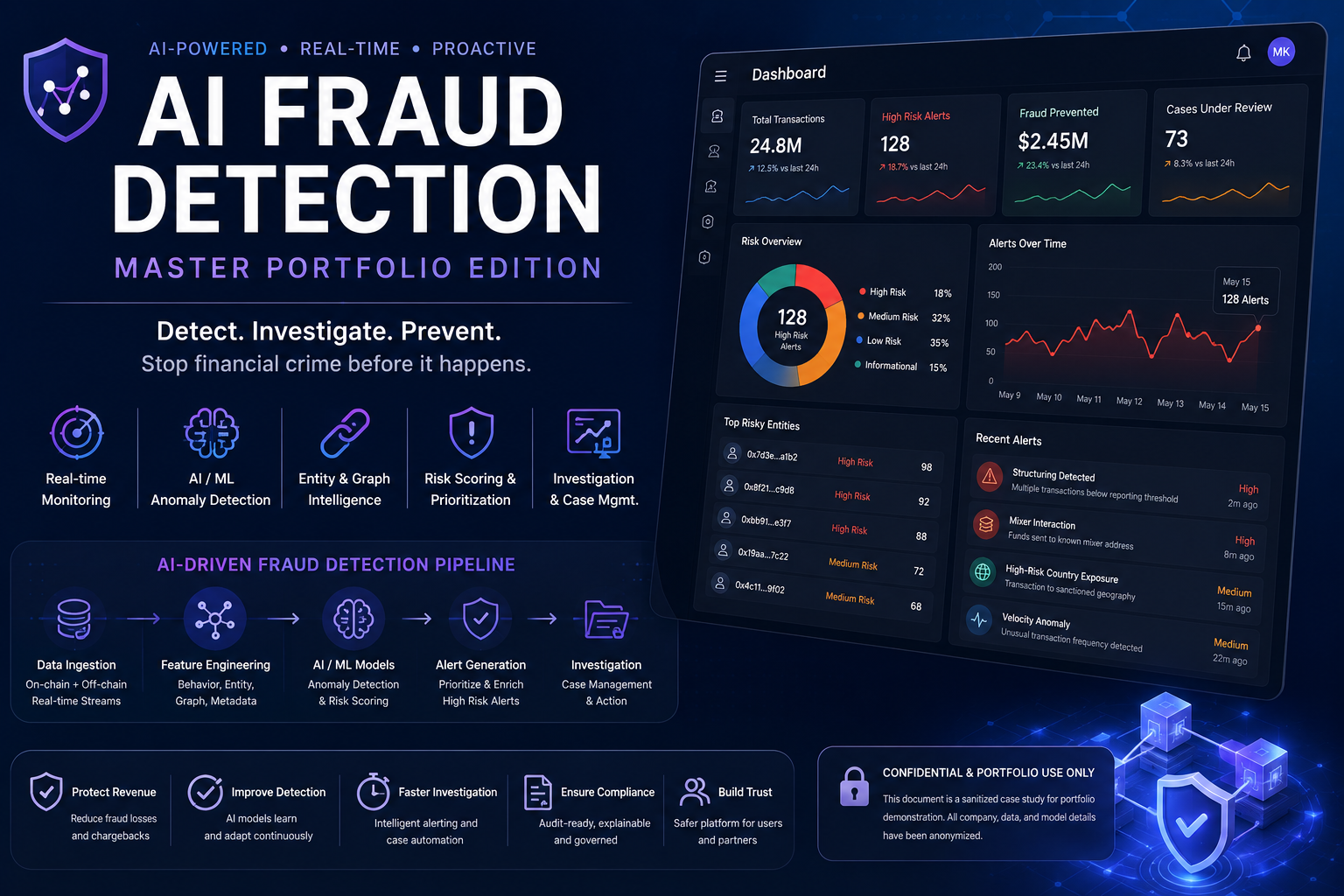
AI Fraud Detection Master Portfolio Edition
A polished, NDA-safe portfolio case study covering the product strategy, requirements, AI approach, architecture, user journey, evaluation plan, roadmap, risks, and governance for an AI-powered blockchain transaction monitoring and fraud detection system.