Confidential Enterprise AI Product — Conversational Customer Support
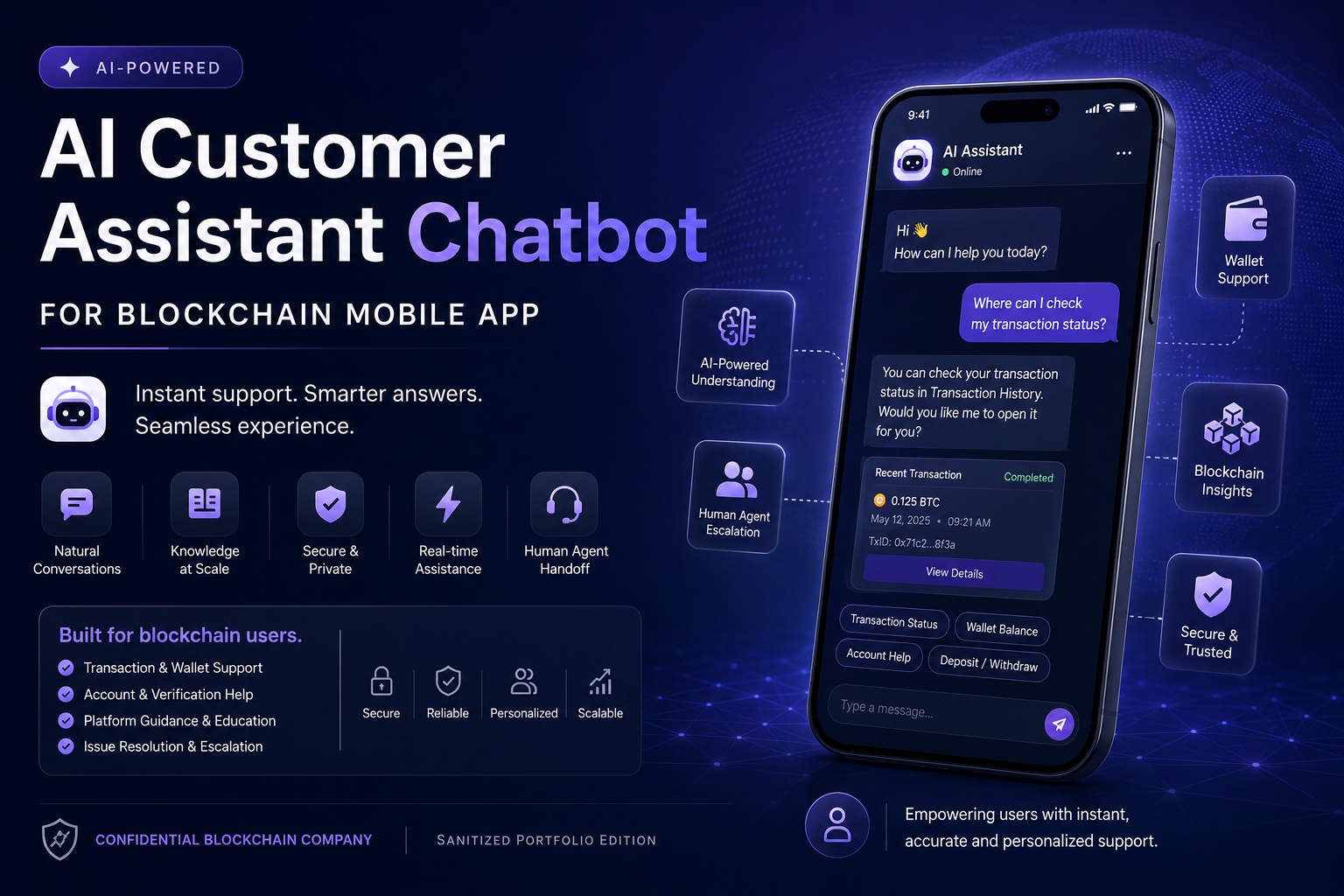
AI Customer Assistant Chatbot for Blockchain Mobile App
Led the product strategy and high-level solution design for an AI-powered customer assistant embedded in a blockchain mobile application, helping users resolve wallet, transaction, account, and platform questions through personalized self-service support with safe human-agent escalation.
- Role
- AI Product Manager & Solution Architect
- Project type
- Confidential Enterprise AI Product — Conversational Customer Support
- Status
- Completed
- Organization
- Confidential Blockchain Company
- Timeline
- 2025-12-04 — 2026-06-30
- Team
- Cross-functional collaboration with customer-support specialists, mobile engineers, backend engineers, AI and machine-learning engineers, data engineers, UX designers, security teams, compliance stakeholders, blockchain service teams, quality-assurance engineers, and business leadership. Team size, internal organization, and individual identities are withheld due to confidentiality.
- Confidentiality
- High — NDA-Protected / Sanitiz
- Published
- published
Confidentiality note
This case study is a sanitized and generalized reconstruction of a confidential enterprise AI project developed for a blockchain mobile application. It was recreated from memory solely to demonstrate product-management, conversational-design, AI-strategy, UX, and solution-architecture capabilities. It does not contain the company’s original PRD, source code, production prompts, customer conversations, account information, transaction data, internal APIs, exact architecture, model configuration, security controls, proprietary policies, vendor details, operational metrics, or confidential business information. All names, workflows, interfaces, examples, and technical details have been anonymized, simplified, or recreated for portfolio use.
Project overview
This confidential enterprise project focused on improving customer support inside a blockchain mobile application.
I worked across AI product management and solution architecture, translating customer-support problems into product requirements, conversational workflows, AI capabilities, system integrations, safety controls, and a high-level technical architecture.
The product was designed to help users understand transaction status, wallet balances, account activity, platform features, verification processes, and common support issues without leaving the mobile application.
The solution combined natural-language understanding, intent classification, retrieval-augmented generation, authenticated account context, blockchain service integrations, confidence evaluation, feedback collection, and seamless escalation to human support agents.
Due to confidentiality obligations, all portfolio materials are sanitized and reconstructed from memory. They do not represent the company’s exact production architecture, internal documentation, prompts, APIs, security controls, customer data, or proprietary implementation.
Business problem
Blockchain and financial applications often generate large volumes of repetitive customer-support requests involving transaction status, wallet balances, deposits, withdrawals, account access, identity verification, platform features, and security concerns. Users may struggle to understand technical blockchain terminology, transaction delays, network conditions, or account-related processes. Traditional help centers require users to search through articles, while human support channels can create long waiting times and high operational costs. The company needed a secure, scalable, and context-aware support experience that could: Provide immediate answers inside the mobile application Understand natural-language questions Retrieve accurate information from approved sources Use authenticated account and transaction context safely Explain complex blockchain concepts clearly Detect when the AI lacked sufficient confidence Escalate sensitive or unresolved issues to human agents Preserve conversation context during handoff
Product objective
Design an AI-powered customer assistant that helps blockchain mobile application users resolve common questions quickly, accurately, and safely through personalized self-service support. The product should reduce unnecessary support friction while maintaining data privacy, response accuracy, transparency, human oversight, and seamless escalation for complex, sensitive, or unresolved case
Product approach
I used a user-centered, context-aware, and human-supported approach. The product design began with the customer journey: encountering a wallet or transaction issue, opening the assistant, describing the problem in natural language, receiving a personalized response, completing a recommended action, providing feedback, or escalating to a human agent. The assistant was designed as a layered support system rather than a general-purpose chatbot: The user opens the assistant from an authenticated mobile session. The system identifies the user’s intent and relevant entities. Approved knowledge sources and internal services are retrieved. Account or transaction context is accessed only when authorized and necessary. The AI generates a grounded response with appropriate actions. Response confidence and safety conditions are evaluated. The user confirms whether the issue was resolved. Unresolved, sensitive, or low-confidence requests are escalated. Conversation context is transferred to the support agent. Feedback and outcomes support continuous product improvement. The product was designed to automate repetitive support while preserving human involvement for high-risk, account-sensitive, financial, and ambiguous cases.
Solution summary
The solution was designed as an AI-powered customer support capability embedded within a blockchain mobile application. A conversational gateway manages authentication context, sessions, rate limits, language detection, and secure communication with the mobile client. The orchestration layer handles: Intent detection Entity extraction Conversation context Workflow routing Response generation Confidence evaluation Escalation decisions The retrieval and AI layer uses approved product documentation, help-center articles, policies, blockchain education resources, and relevant internal service data to generate grounded answers. Where authorization permits, the assistant can retrieve contextual information from services such as: Wallet services Transaction services Account services Identity-verification services Notification services Support ticketing systems The user receives a conversational response with explanations and relevant next actions. When the issue cannot be resolved safely, the system creates or routes a support request and transfers the conversation history to a human agent. Monitoring and analytics support response-quality evaluation, feedback analysis, operational reporting, incident detection, and continuous improvement.
Target users
- Blockchain mobile application users
- New cryptocurrency users
- Experienced traders and wallet users
- Users checking transaction status or wallet balances
- Users experiencing account or verification issues
- Users seeking product and policy information
- Customer support agents
- Customer support supervisors
- Compliance and account-review teams
- Product operations teams
Selected product decisions
Embed the assistant directly inside the authenticated mobile application
Use retrieval-augmented generation instead of relying only on the language model's internal knowledge
Limit responses to approved knowledge sources and authorized service data
Use account context only when required and permitted
Separate general educational answers from personalized account-specific responses
Provide quick actions such as viewing transactions, opening wallet history, or reading relevant support content
Use confidence evaluation to determine whether the assistant should answer, clarify, or escalate
Escalate sensitive, complex, unresolved, and low-confidence requests to human support
Transfer conversation history and relevant context during human-agent handoff
Avoid allowing the AI to execute irreversible financial actions autonomously
Require explicit user confirmation before initiating consequential actions
Design responses in clear language suitable for users with different levels of blockchain experience
Capture user feedback and support outcomes for continuous improvement
Include audit logging, access control, privacy safeguards, and response monitoring
Avoid exposing production prompts, API structures, internal policies, or proprietary architecture in portfolio materials
Outcomes
Product Direction
Established a clear product vision and service strategy for an AI-powered customer assistant inside a blockchain mobile application.
StrategyCustomer-Centered Experience
Designed conversational journeys for transaction support, wallet assistance, product education, feedback, and human escalation.
UXGrounded AI Approach
Defined a retrieval-based response strategy using approved knowledge and authorized contextual data.
AI StrategyHuman-Agent Handoff
Designed a seamless escalation experience that transfers relevant conversation context to customer-support agents.
Service DesignSafety and Privacy
Incorporated confidence evaluation, access controls, data minimization, auditability, and human oversight.
Responsible AICross-Functional Alignment
Translated customer, support, product, engineering, security, and compliance needs into a unified product direction.
LeadershipPortfolio Documentation
Reconstructed sanitized product, UX, AI, architecture, and roadmap documents without exposing confidential implementation details.
ConfidentialChallenges
- Providing accurate answers across a large and frequently changing knowledge base
- Preventing hallucinated or unsupported financial and blockchain guidance
- Understanding ambiguous user questions and incomplete descriptions
- Resolving different meanings of transaction, wallet, account, and network terminology
- Using personal account context without exposing unnecessary private information
- Integrating real-time blockchain and platform service data
- Handling transaction delays that may originate outside the company platform
- Supporting users with different levels of technical and financial knowledge
- Distinguishing informational requests from sensitive account-support cases
- Determining when the AI should answer, ask a clarifying question, or escalate
- Transferring sufficient context to human agents without overexposing customer data
- Maintaining consistent responses across mobile, web, and support channels
- Managing multilingual questions and regional terminology
- Monitoring answer quality as products, policies, and platform features change
- Balancing response latency, accuracy, safety, and infrastructure cost
- Reconstructing the project for a portfolio without exposing proprietary information
Lessons learned
- A customer-support chatbot should be designed around user resolution rather than conversation volume
- Retrieval quality is as important as the language model used to generate the response
- Personalization requires strict boundaries around authentication, authorization, and data minimization
- The assistant must clearly distinguish general information from account-specific information
- Low-confidence responses should trigger clarification or escalation instead of confident guessing
- Human-agent handoff is a core product capability rather than an exception flow
- Conversation history can improve support continuity but must be shared selectively
- AI should not independently execute irreversible financial or account actions
- User feedback should be connected to intents, responses, and support outcomes
- Knowledge freshness requires ownership, versioning, and continuous content maintenance
- Product success must include resolution quality, safety, user trust, and operational impact
- Confidential projects can demonstrate strong product thinking through sanitized and clearly labeled artifacts
Project artifacts
Selected documents and supporting product work.
All
Document
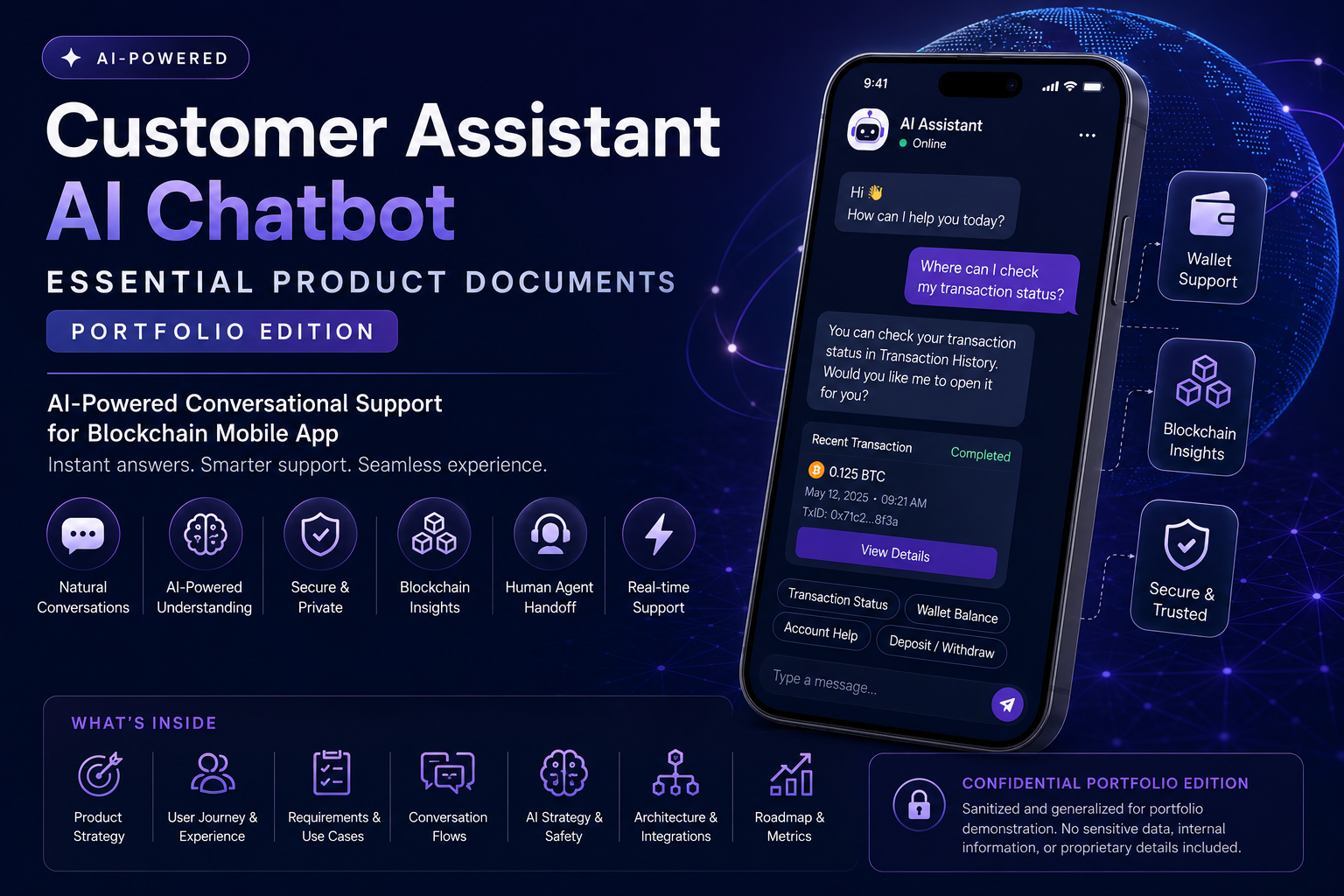
Essential Product Documents Portfolio Edition
A polished, NDA-safe portfolio document set covering the product strategy, user experience, conversational workflows, requirements, AI architecture, safety controls, evaluation plan, roadmap, and human-agent escalation design for an AI-powered customer assistant in a blockchain mobile application.