Personal AI Product / Career Automation Platform
AI Career Intelligence Agent
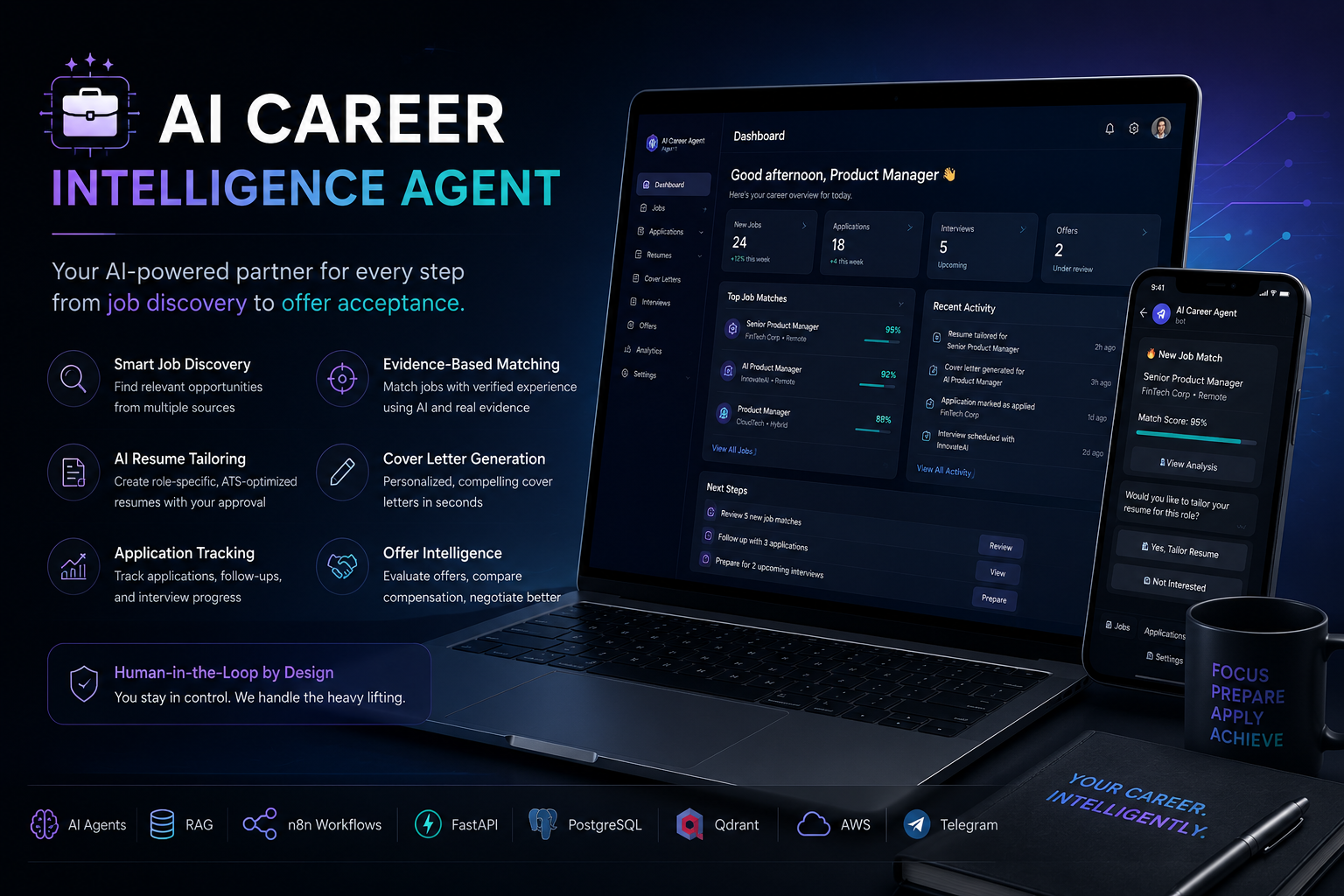
A human-in-the-loop AI career automation platform that discovers relevant jobs, evaluates fit against verified experience, tailors application documents with approval, tracks applications, prepares interviews, and supports offer evaluation.
- Role
- AI Product Manager & Solution Architect
- Project type
- Personal AI Product / Career Automation Platform
- Status
- In Development
- Organization
- Personal project
- Timeline
- 2026-07-19 — Present
- Team
- Independent product initiative. I lead product strategy, discovery, requirements definition, system architecture, AI workflow design, implementation planning, testing strategy, security requirements, and portfolio documentation. Codex is used as a coding assistant to support implementation, while all product decisions and approval rules are defined and reviewed by me.
- Confidentiality
- generalized
- Published
- published
Confidentiality note
This portfolio entry presents a generalized view of the product strategy, architecture, workflows, and product decisions. Personal resumes, contact information, application records, API credentials, private career evidence, recruiter communications, offer documents, compensation data, and internal security configurations are excluded. Any future demonstration will use synthetic or anonymized data.
Project overview
The AI Career Intelligence Agent is a personal career automation platform designed to reduce the repetitive work involved in finding and applying for relevant opportunities.
The system combines job discovery, evidence-based job matching, a personal career knowledge base, resume tailoring, cover-letter generation, application tracking, interview preparation, and offer evaluation within one human-controlled workflow.
Unlike high-volume auto-apply tools, the product uses approval gates before important actions. The user decides which jobs to analyze, whether to tailor a resume, whether to create a cover letter, and when an application has been submitted. Generated claims are grounded in verified resume, project, certification, and career evidence to reduce hallucinations and misrepresentation.
The solution is being built on an AWS-hosted architecture using n8n, FastAPI, PostgreSQL, Qdrant, Redis, local embeddings, OpenRouter models, Telegram, Docker, and Nginx.
Business problem
Job seekers spend significant time repeatedly searching job boards, reviewing long job descriptions, deciding whether they are qualified, tailoring resumes, writing cover letters, tracking applications, preparing for interviews, and following up with recruiters. Existing auto-apply tools often prioritize application volume over relevance and accuracy. They may submit generic documents, use unsupported claims, apply to unsuitable roles, or remove the candidate from important decisions. The product addresses this problem by automating repetitive research and document preparation while keeping the user in control of every high-impact action.
Product objective
Build a secure, evidence-grounded AI career platform that reduces manual job-search effort, improves the relevance and consistency of application materials, and provides decision support throughout the complete career journey—from job discovery to offer evaluation—without automatically submitting applications or misrepresenting the candidate.
Product approach
I approached the product as a human-in-the-loop career operating system rather than a fully autonomous auto-apply bot. The roadmap was divided into eight incremental phases: infrastructure, career knowledge, job discovery, evidence-based matching, resume tailoring, cover-letter generation, application and interview management, offer intelligence, and final production hardening. The system uses deterministic rules for scoring, validation, calculations, status transitions, and approval controls. Language models are used for structured extraction, synthesis, rewriting, and personalized communication, but they cannot independently submit applications, approve documents, change final decisions, or invent professional experience. A retrieval-augmented generation approach connects job requirements with verified career evidence. Lower-cost models handle classification and extraction, while stronger models are reserved for higher-value writing and review tasks.
Solution summary
The solution is an AWS-hosted AI career platform composed of eight connected product capabilities. It automatically collects and normalizes jobs from approved public sources, filters duplicates, and sends relevant opportunities through Telegram. Selected jobs are analyzed against the user’s verified career knowledge using structured requirement extraction, vector retrieval, evidence mapping, and deterministic match scoring. When the user expresses interest, the system asks whether to tailor the resume. It creates an evidence-grounded draft, generates an ATS report, shows a preview and change summary, and waits for approval. It follows the same approval-first approach for cover letters. After manual application submission, the platform tracks status changes, creates follow-up reminders, prepares interview materials and STAR outlines, evaluates offers, and drafts negotiation messages. No application, email, recruiter message, calendar change, or offer decision is executed without explicit user approval.
Target users
- AI Product Managers actively searching for new opportunities
- Technical Product Managers seeking remote or international roles
- Software engineers transitioning into AI product roles
- Job seekers who need personalized resumes and cover letters
- Professionals managing multiple applications and interview stages
- Candidates who want AI assistance without fully automated applications
Selected product decisions
Use human approval gates instead of fully autonomous job applications
Use a personal RAG knowledge base to ground candidate claims in verified evidence
Keep career evidence and external job-description vectors in separate Qdrant collections
Use deterministic scoring rather than allowing an LLM to choose match scores
Use local embeddings to reduce cost and keep document processing private
Use OpenRouter for provider-independent model access and model switching
Route lightweight tasks to Nano, standard reasoning to Mini, and optional reviews to Premium
Keep Premium disabled by default and require explicit user approval
Use n8n for scheduling and orchestration while keeping core business logic in FastAPI
Use PostgreSQL as the source of truth for jobs, applications, versions, approvals, and audit history
Use Telegram as the primary interface for notifications and approval actions
Require an approved master resume before generating job-specific versions
Prevent resume and cover-letter generation from adding unsupported qualifications or metrics
Keep application submission, message sending, calendar changes, and offer decisions manual
Build production hardening and security validation as a dedicated final phase
Outcomes
End-to-End Product Blueprint
Defined an eight-phase roadmap covering job discovery, evidence-based matching, application preparation, tracking, interviews, offers, and production hardening.
Product StrategyHuman-Controlled Automation
Designed explicit approval gates for resume tailoring, cover-letter generation, application tracking, follow-ups, calendar actions, and offer decisions.
Responsible AIEvidence-Grounded Architecture
Designed a RAG workflow that connects job requirements with verified resume, project, certification, and career evidence.
AI ArchitectureCost-Aware Model Routing
Defined Nano, Mini, and Premium model tiers so routine tasks use lower-cost models while premium review remains optional.
Cost OptimizationPortfolio-Ready Product Documentation
Produced a complete set of product strategy, PRD, workflow, risk, architecture, launch, and measurement documents.
Product CraftProduction Readiness Plan
Defined security, testing, backup, monitoring, cost-control, recovery, and release-blocking requirements for personal production use.
DevSecOpsImplementation in Progress
Core infrastructure and phased platform capabilities are being implemented and validated incrementally.
In DevelopmentChallenges
- Preventing AI-generated resumes and cover letters from inventing achievements or metrics
- Balancing automation speed with meaningful human approval
- Normalizing jobs collected from multiple sources with inconsistent formats
- Preventing duplicate jobs and repeated workflow notifications
- Mapping broad job requirements to specific career evidence
- Distinguishing direct experience, transferable skills, and educational knowledge
- Designing transparent match scores that do not depend entirely on an LLM
- Protecting personal resumes, contact details, application history, and offer information
- Controlling OpenRouter token usage and preventing accidental Premium-model escalation
- Generating editable DOCX and extractable PDF files reliably
- Handling workflow failures without corrupting application or document states
- Maintaining idempotency across Telegram callbacks, n8n retries, and backend requests
- Designing a large multi-phase platform that can be implemented incrementally
Lessons learned
- Human approval is a product capability, not simply a limitation of AI automation
- Reliable AI products require deterministic validation around probabilistic model outputs
- A personal knowledge base is more valuable when every generated claim retains evidence provenance
- High application volume is less valuable than relevant, accurate, and well-prepared applications
- Model routing should be designed around task complexity, risk, latency, and cost
- n8n is most maintainable when it orchestrates workflows instead of containing all business logic
- Versioning is essential for resumes, cover letters, prompts, analyses, and user approvals
- Privacy and security requirements should be included in the initial architecture, not added after launch
- Target metrics must be clearly separated from verified production outcomes
- Large agentic products are easier to deliver through small, testable phases
Project artifacts
Selected documents and supporting product work.
All
Document
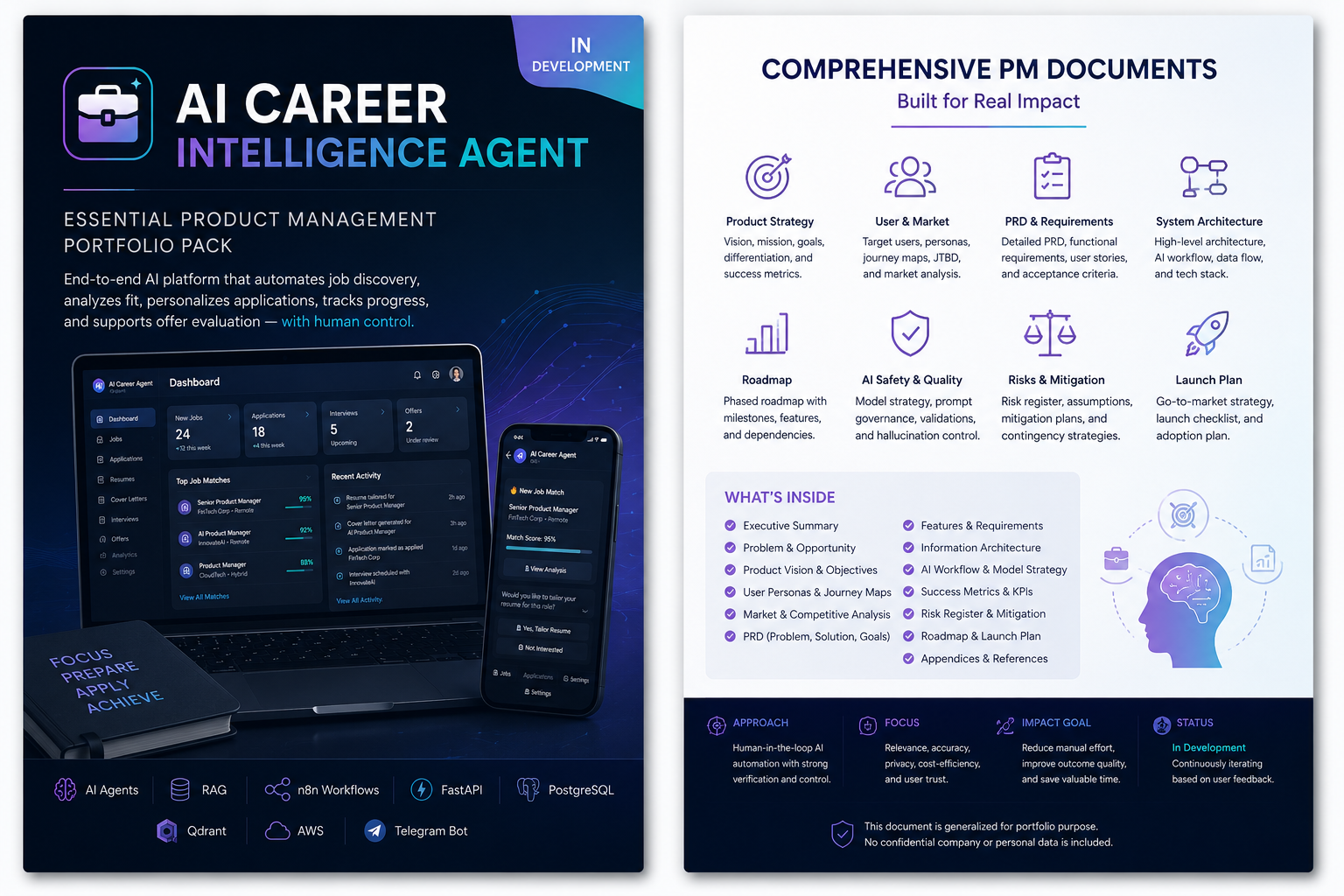
Full Essential Product Documents
A comprehensive product management portfolio pack for the **AI Career Intelligence Agent**, covering product strategy, user problems, personas, PRD, requirements, roadmap, system architecture, AI safety, success metrics, risks, and launch planning for a human-in-the-loop job search automation platform.
Document
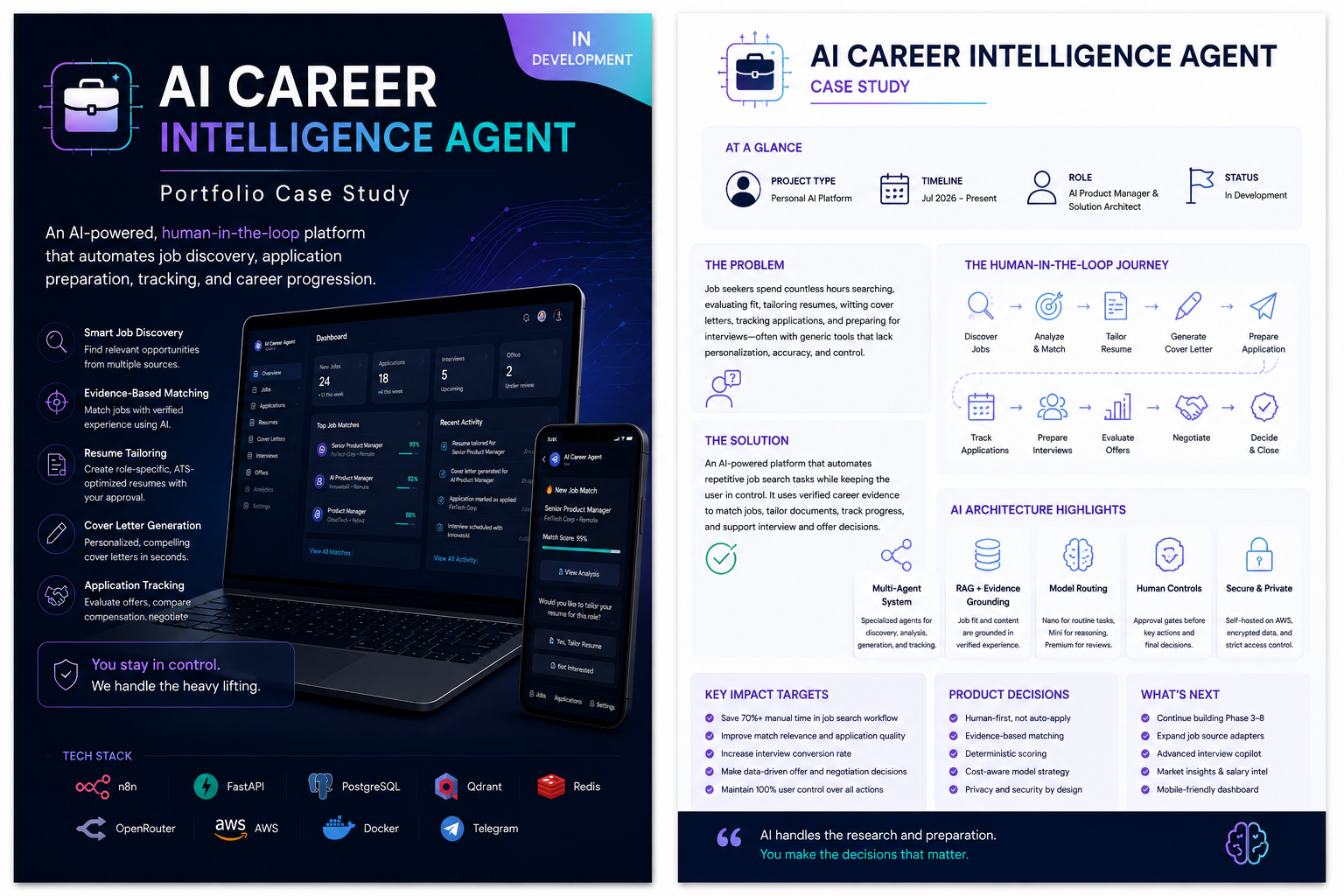
Essential Concise Product Documents
A concise product case study for the AI Career Intelligence Agent, highlighting the user problem, product vision, human-in-the-loop workflow, AI architecture, key product decisions, roadmap, risks, and expected impact of an evidence-grounded job search automation platform.