AI Product Management
AI Agents Are Becoming Products, Not Just Features
AI agents are transforming software from passive tools into intelligent collaborators. Product managers must rethink UX, requirements, success metrics, and governance to build trustworthy AI-native products that create measurable business value.
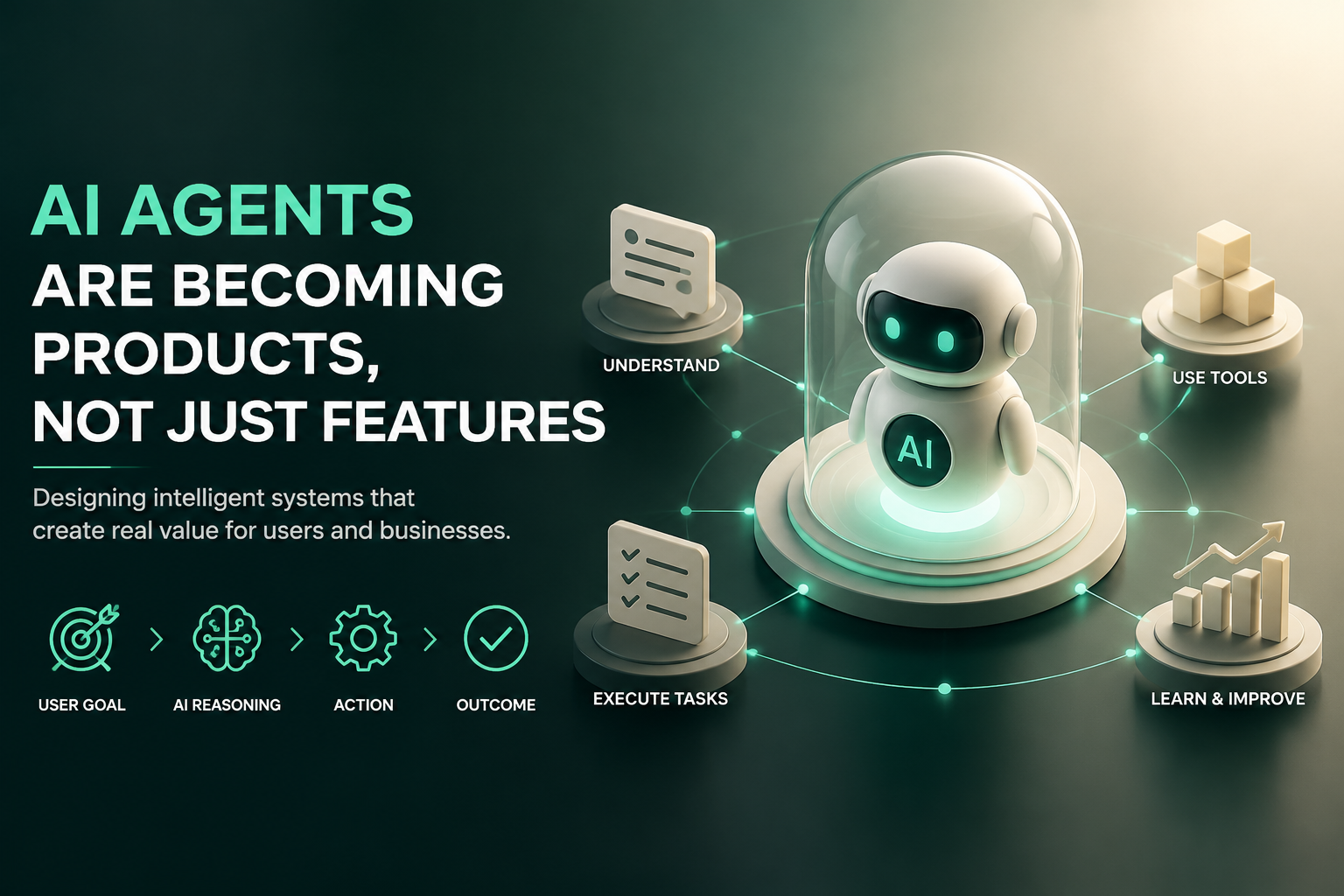
AI Agents Are Becoming Products, Not Just Features
Introduction
AI is moving beyond simple chatbots and automation features.
The next generation of software is being built around AI agents — systems that can understand goals, reason through tasks, use tools, and help users achieve outcomes.
For AI Product Managers, this changes how we design products, measure success, and build trust.
From Features to Intelligent Products
Traditional software follows:
User → Action → Result
AI-native products introduce:
Goal → AI Reasoning → Execution → Outcome
Instead of users completing every step manually, AI agents can support complex workflows.
Examples:
AI career assistants that find opportunities and prepare applications.
AI customer agents that resolve support requests.
AI financial assistants that analyze risks and provide insights.
The product becomes more than a tool.
It becomes an intelligent collaborator.
New Responsibilities for AI Product Managers
1. Designing Trust
AI products need more than accuracy.
Product teams must consider:
When AI should act independently
When humans should approve decisions
How AI explains recommendations
How users recover from errors
The goal is not maximum automation.
The goal is responsible automation.
2. Measuring AI Value
Traditional metrics are not enough.
AI products should measure:
User Impact
Time saved
Task completion
Productivity improvement
AI Quality
Accuracy
Reliability
User corrections
Trust
User confidence
Adoption
Retention
The key question changes from:
"How many users clicked this feature?"
to:
"How much value did AI create?"
AI Governance Becomes Product Strategy
AI governance is becoming a core product requirement.
Modern AI products need:
Data privacy
Security controls
Model evaluation
Transparency
Responsible deployment
Building trustworthy AI starts during product design, not after launch.
The Future of AI Product Management
AI Product Managers will work across:
Product strategy
UX design
AI engineering
Data science
Solution architecture
The winning AI products will not only use powerful models.
They will solve meaningful problems through thoughtful design.
Strong product thinking + AI capability + Responsible implementation will define the next generation of intelligent products.
References
National Institute of Standards and Technology (NIST)
AI Risk Management Framework (AI RMF)
https://www.nist.gov/itl/ai-risk-management-framework
National Institute of Standards and Technology (NIST)
Artificial Intelligence Risk Management Framework: Generative AI Profile
https://www.nist.gov/publications/artificial-intelligence-risk-management-framework-generative-artificial-intelligence
McKinsey & Company
The economic potential of generative AI: The next productivity frontier
https://www.mckinsey.com/capabilities/mckinsey-digital/our-insights/the-economic-potential-of-generative-ai-the-next-productivity-frontier